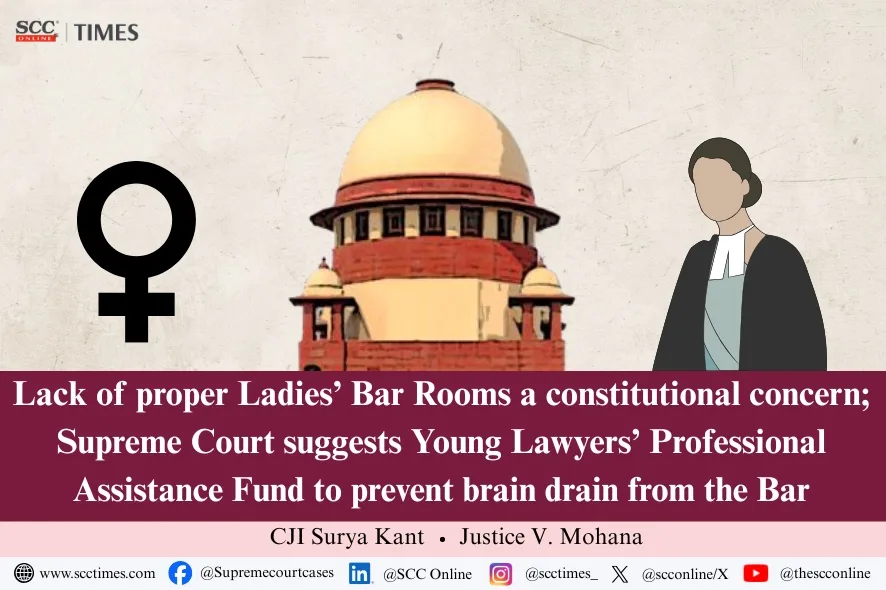
Supreme Court: In a public interest litigation (PIL) filed by a group of women advocates practising in different courts across India, seeking judicial intervention regarding lack of adequate facilities for women advocates in court complexes and the financial hardships faced by young advocates during the initial years of practice, the Division Bench of Surya Kant, CJ., and V. Mohana, J., considering the significance of the issues and their implications for the legal profession, issued notice to all respondents and made tentative and illustrative observations intended to facilitate discussion among stakeholders.
Background
The petitioners highlighted the widespread absence of properly equipped Ladies’ Bar Rooms and essential amenities in High Courts, District Courts, Taluka Courts, Tribunals, Revenue Courts, and Commissions across the country. To substantiate their claim, they conducted a survey titled “Form for Basic Provisions and Amenities” and supplemented it with physical inspections of various court complexes.
According to the data collected, many court complexes either lacked dedicated facilities for women advocates or provided facilities that were grossly inadequate. Deficiencies included insufficient seating, unhygienic washrooms, absence of changing rooms, lack of nursing facilities, and other basic amenities necessary for professional functioning.
The petitioners also drew attention to the financial vulnerability of young advocates, particularly first-generation lawyers and those from economically weaker backgrounds. They proposed the establishment of a Young Advocates Corpus Fund to provide financial assistance during the formative years of legal practice.
Observation and Reasoning
At the outset, the Court opined that the concerns raised by the petitioners could not be dismissed as matters of mere convenience. It noted that while the legal profession has witnessed increasing participation of women over the last few decades, but meaningful inclusion requires more than formal access. It emphasised that women advocates must be provided conditions enabling them to “discharge their professional responsibilities effectively, safely, and on equal terms” including availability of adequately equipped spaces for women professionals within court complexes.
The Court noted that a court complex is not merely a venue for legal proceedings. For members of the Bar, it functions as a workplace where substantial portions of their professional lives are spent and often “assumes the character of a second home”. Many advocates depend upon common facilities because they cannot afford private offices or support staff. Consequently, the absence of basic facilities disproportionately affects women advocates and may discourage them from continuing in the profession.
The Court held that the provision of essential facilities bears a direct nexus with the guarantee of life and dignity under Article 21 of the Constitution. Since women advocates spend substantial parts of their day within court premises, infrastructure relating to comfort, privacy, safety, and professional functioning becomes constitutionally significant. Therefore, the issue transcends administrative convenience and implicates constitutional values of dignity and equal participation in public life.
“The expression ‘life’ under Article 21 has consistently received an expansive interpretation from this Court and has been understood to encompass those conditions which enable an individual to live and work with dignity.”
Regarding the second issue, the Court acknowledged the severe financial challenges faced by young advocates. It noted that litigation involves a steep learning curve and that junior advocates often spend years observing proceedings, assisting seniors, and acquiring practical skills before establishing independent practices. During this period, they frequently survive on modest stipends that are inadequate even for basic sustenance.
The Court expressed concern that this phase of hardship often forces talented individuals to leave litigation altogether, resulting in professional “brain drain”. The problem is especially acute for first-generation lawyers and those from socially and economically disadvantaged backgrounds who may have immediate family responsibilities.
Recognising these challenges, the Court suggested measures to be considered by stakeholders while submitting their proposals:
-
Young Lawyers’ Professional Assistance Fund must be created and should be established under the exclusive control of the jurisdictional High Courts or an autonomous body constituted by the Union of India in consultation with the State Governments.
-
Contributions from successful Senior Advocates and experienced practitioners through a structured statutory mechanism.
-
Allocation of a portion of court fees collected by the judiciary.
-
Diversion of part of the costs imposed in judicial proceedings to the proposed fund.
-
Incentives such as tax exemptions, national awards or other honours to encourage donations.
-
Provision of a reasonable monthly stipend-cum-honorarium to first-generation lawyers and advocates from economically and socially disadvantaged backgrounds.
-
Attachment of beneficiaries to experienced members of the Bar for professional training.
-
Financial support for approximately the first 3 years of practice, tapering gradually and ending after 7 years.
-
A mechanism requiring beneficiaries to contribute back to the fund once professionally established, thereby creating a self-sustaining corpus.
The Court clarified that these observations were only tentative and illustrative and were intended to facilitate discussion among stakeholders.
Also Read: Supreme Court issues new guidelines for designation of Senior Advocates
Decision
Considering the significance of the issues and their implications for the legal profession, the Court issued notice to all respondents and made the matter returnable on 17 July 2026. The Court also requested the Attorney General for India, the Advocate Generals of all States, and the Standing Counsel for Union Territories to assist the Court in the proceedings.
[Sarika Tyagi v. Union of India, Writ Petition (Civil) No. 770 of 2026, decided on 19-6-2026]
Advocates who appeared in this case:
Dr. Monika Gusain, Sr. Adv. with Mr. C. Solomon, AOR, Mr. Hariom Yaduvanshi, Mr. Arjun Yaduvanshi, Ms. S. Harini, Ms. Tanya Gupta, Mr. K. Kulanthai Vikram and Mr. M. Srinivasan, Advs., Counsel for the Petitioners