Disclaimer: This has been reported after the availability of the order of the Court and not on media reports so as to give an accurate report to our readers.
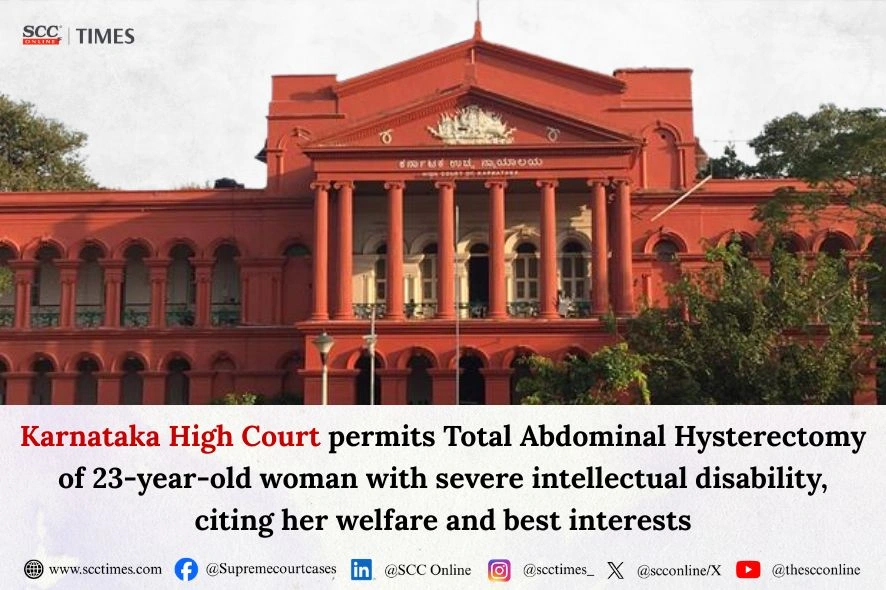
Karnataka High Court: While considering a writ petition filed by parents seeking permission to undertake hysterectomy, that is, removal of uterus, of their daughter, a Single Judge Bench of Suraj Govindaraj, J., held that the paramount consideration was the best interests of the daughter and considering that she suffered from severe developmental and intellectual disabilities, the proposed procedure was intended to advance her welfare, health, dignity and best interests.
Background
In the case at hand, the parents and primary caregivers of their daughter who was about 23 years old sought permission for conducting a total abdominal hysterectomy on her contending that she suffered from severe developmental and intellectual disabilities which substantially impaired her ability to understand, manage and perform even basic activities of daily living.
The parents placed their daughter’s medical and psychological assessments conducted at Neuro Center, Bengaluru which revealed the following:
1. Her Denver Developmental Screening Test score stating her developmental quotient as 58, indicative of developmental delay,
2. Her drawing abilities through Gesell’s Drawing Test demonstrated functioning considerably below the developmental level ordinarily expected of a 3-year-old child.
3. Her social quotient as assessed by Vineland Social Maturity Scale was at 56, suggesting substantial deficits in social adaptive functioning.
The parents contended that the cumulative effect of these assessments was that even though she was 23-year-old, her cognitive, developmental and adaptive functioning remains severely compromised. Thus, it made her incapable of independently understanding or managing her bodily functions, including menstrual hygiene and that despite attaining physical adulthood, she remained entirely dependent upon them for her daily needs and personal care.
They further contended that her menstrual cycles were irregular and unpredictable and that her inability to maintain personal hygiene during such periods resulted in recurring infections, intermittent episodes of fever and prolonged medical complications. They stated that with the passage of time and the inevitable decline in their own physical abilities, it might become increasingly difficult for them to provide the level of assistance and supervision presently required by their daughter. Thus, they approached the High Court.
Opinion of multidisciplinary Medical Board
On 2 June 2026, the Court constituted a multidisciplinary Medical Board at Vanivilas Hospital to independently evaluate the medical condition of the daughter, assess her capacity, examine the necessity and advisability of the proposed procedure.
Pursuant to the said order, the petitioners and their daughter appeared before the Medical Board on 5 June 2026 for her examination.
The report of the psychologist indicated that her social age was approximately 5 years and 4 months and that her social quotient was 36. The assessment stated that she was suffering from moderate intellectual disability and quantified permanent disability at 75 per cent.
The psychiatrist and the radiologist opined that she was presently incapable of independently maintaining or managing her menstrual hygiene and required continuous assistance and supervision in relation thereto.
The neurologist reported that she was suffering from cerebral palsy associated with intellectual disability and seizure disorder and that she had been undergoing treatment and medication for the said condition for approximately 13 years.
The obstetrician and gynaecologist opined that she suffered from global developmental delay associated with moderate intellectual and developmental disability, with an assessed IQ of 36. The specialist further recorded that having regard to her age and medical condition and, the request and consent furnished by the parents, she could be considered for total abdominal hysterectomy.
The anesthesiologist opined that she was medically fit to undergo the proposed surgical procedure.
Accordingly, the Medical Board concluded that she was suffering from global developmental delay associated with moderate permanent intellectual and developmental disability, having an IQ of 36, and from seizure disorder. The Board recommended that she could undergo total abdominal hysterectomy.
Issue and Analysis
The Court stated that the issue involved in the present proceedings is not merely a medical question, rather it concerned the bodily integrity, dignity, autonomy, health and long-term welfare of a person suffering from significant intellectual and developmental disabilities and any decision in relation to a procedure as invasive and irreversible as a hysterectomy should be approached with utmost caution, sensitivity and circumspection.
The Court stated that the law recognises and protects the autonomy and bodily integrity of every individual, including persons with disabilities and ordinarily, any invasive medical procedure, particularly one involving permanent removal of a reproductive organ, can be undertaken only on the basis of the free, informed and voluntary consent of the person concerned. The Court emphasised that such consent necessarily presupposes the ability of the individual to understand the nature of the procedure, its consequences, benefits, risks, and long-term implications.
Considering the principles laid down in Suchita Srivastava v. Chandigarh Admn., (2009) 9 SCC 1, the Court stated that it was required to ensure that the proposed procedure was not being permitted merely because the patient suffered from an intellectual or developmental disability. Further, the Court stressed that “disability, by itself, can never constitute a ground either to authorise the removal of a reproductive organ or to deprive a person of reproductive autonomy” as any such approach would be inconsistent with the constitutional guarantees recognised by the Supreme Court and with the dignity accorded to persons with disabilities under the Constitution and the statutory framework governing their rights.
Recognising that the present case stood on entirely different footing, the Court stated that the findings recorded by the Medical Board left little room for doubt that the patient lacked cognitive and intellectual capacity necessary to make an informed decision in relation to the proposed procedure. Thus, the Court stated that it was confronted with a situation where the patient was incapable of exercising meaningful informed consent and was unable to independently evaluate the consequences of medical decisions affecting her person.
Exercising its parens patriae jurisdiction, the Court stated that it would independently determine whether or not the proposed course of action advanced the best interests of the person concerned. The Court opined that the concept of “best interests” could not be construed narrowly, it required to undertake a holistic assessment of the medical, physical, psychological, emotional and social consequences of the proposed intervention. The Court stated that it is required “to balance the patient’s bodily integrity and autonomy with the practical realities arising from her medical condition, intellectual limitations, quality of life, health concerns and long-term welfare”.
The Court emphasised that the psychiatrist, neurologist, obstetrician and gynaecologist, as well as the radiologist, all recorded that the patient was incapable of independently maintaining menstrual hygiene and that the assertions were not some unsupported parental apprehensions. The Court stated that stated that the report clearly indicated that the patient’s condition was permanent and irreversible in nature. The Court took into account that nothing on record to suggested that her intellectual and developmental impairments were likely to improve to such an extent that she would, in the foreseeable future, be capable of independently understanding and managing menstrual hygiene. Thus, the Court was not dealing with a temporary incapacity but with a lifelong condition requiring continuing support, supervision, and assistance.
The Court further emphasied that there was nothing on record to indicate that the parents were motivated by any collateral consideration, rather it indicated that they approached the Court solely out of concern for the welfare, dignity, comfort and long-term well-being of their daughter.
The Court stated that it was conscious that parental inconvenience, by itself, could never constitute a justification for permitting a procedure of this nature, however, the practical difficulties highlighted by the parents in the present case were relevant as they directly impact the quality of care and health of the daughter herself. Further, the Court specified that it was equally mindful that hysterectomy is an irreversible procedure which is why an independent Medical Board was constituted to obtain an objective and professional evaluation before any decision was taken.
The Court held that the case at hand did not concern sterilisation for eugenic purposes, population control measures, or any attempt to curtail the rights of the patient on account of her disability. It stressed that the objective of the proposed intervention was to address recurring health concerns arising from a condition which the patient was incapable of understanding or managing and which had consistently exposed her to avoidable medical complications.
The Court clarified that,
“The permission is being granted only after judicial scrutiny, independent medical evaluation by specialists from multiple disciplines, consideration of the patient’s inability to provide informed consent, examination of the absence of any contraindication to the proposed procedure and a determination that the proposed intervention is in the best interests of the patient.”
The Court noted that the Medical Board suggested no less intrusive or equally effective long-term alternative and the recommendation made by the Board was based upon its professional assessment as to what would best serve the interests of the patient having regard to her peculiar medical, developmental and social circumstances. The Court stated that the paramount consideration was the best interests of the person concerned and thus, it was satisfied that the proposed procedure was intended to advance the welfare, health, dignity and best interests of the daughter.
Decision
Accordingly, the Court allowed the petition and permitted the parents to have a Total Abdominal Hysterectomy performed on their daughter. The Court directed the Medical Superintendent, Vanivilas Hospital, to make all necessary arrangements for carrying out the said procedure in accordance with the recommendations of the Medical Board and in compliance with all applicable medical, legal and ethical requirements.
The Court further directed the Medical Superintendent to ensure that the welfare, dignity, safety and best interests of the patient get protected at all stages of treatment and that she be provided such pre-operative counselling, psychological support and post-operative counselling, care and rehabilitation services as considered necessary by the treating team, including the psychiatrist and other specialists concerned.
Further, the Court specified that the date and time of the surgical procedure would be fixed by the Medical Superintendent in consultation with the parents and the treating specialists. The Court directed the Medical Board or such specialists, as may be nominated by Medical Superintendent, to monitor the patient’s post-operative recovery and ensure that all appropriate follow-up treatment and medical support are provided.
Lastly, the Court directed that brief report regarding the conduct of the procedure, and the post-operative condition of the patient shall be placed before the Registrar General within a period of eight weeks from the date of the procedure.
[H. Kusuma v. Chief Secretary to Government, 2026 SCC OnLine Kar 4589, decided on 17-6-2026]
Advocates who appeared in this case:
For the Petitioner: Zulfi Sultana, Advocate
For the Respondent: Mohammed Jaffar Shah, AGA