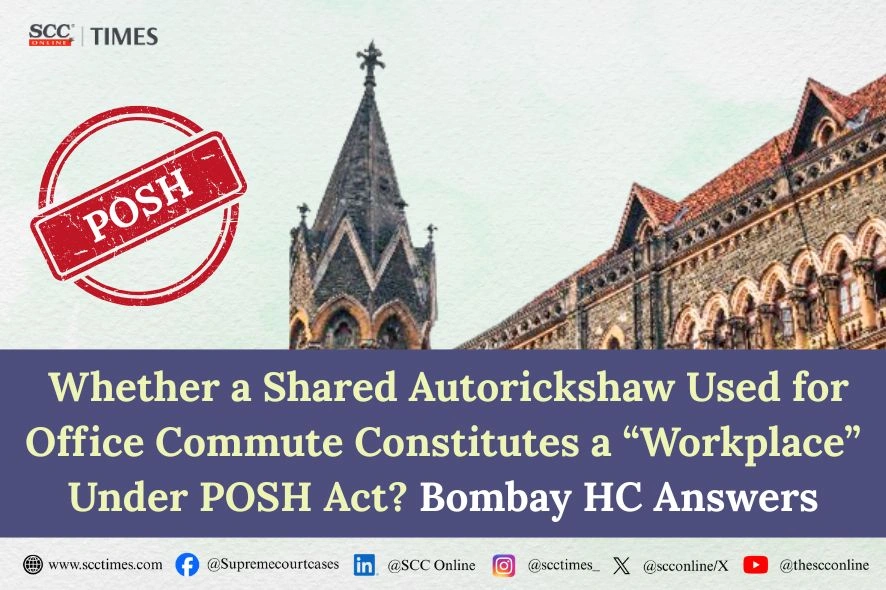
Bombay High Court: In a case concerning the scope of the expression “workplace” under the Sexual Harassment of Women at Workplace (Prevention, Prohibition and Redressal) Act, 2013 (POSH Act), the Division Bench of Firdosh P. Pooniwalla* and Suman Shyam, JJ., stated that in the present case, although the petitioner was going to his office, the said transportation had not been provided either by his employer or Respondent 3’s employer. In these circumstances, such transportation would not fall within the definition of a “workplace” as defined by Section 2(o)(v), POSH Act. Thus, the Court held that the alleged incident had not taken place at a “workplace”.
Background
On 24 March 2023, the petitioner, an SBI employee, was travelling in a shared autorickshaw with Respondent 3 and another passenger. He claims any contact with Respondent 3 was incidental due to overcrowding, which she misinterpreted, leading to an altercation where she allegedly abused him and used pepper spray.
He further alleges that she escalated the situation by calling others and the police, resulting in his detention and a FIR under Section 354-A, Penal Code, 1860. Respondent 3 also filed a sexual harassment complaint under POSH Act . The Internal Complaints Committee found the petitioner guilty and recommended disciplinary action against the petitioner. The petitioner filed an appeal against the said order. However, vide an order passed in the present petition, it was directed that no final orders should be the passed in the said appeal without the Court’s leave. Thus, no final order has been passed in the said appeal.
Issue: Whether the alleged incident occurred at a “workplace” under Section 2(o), POSH Act?
Analysis, Law and Decision
The Court stated that in the present case, although the petitioner was going to his office, the said transportation had not been provided either by his employer or Respondent 3’s employer. In these circumstances, such transportation would not fall within the definition of a “workplace” as defined by Section 2(o)(v), POSH Act. Thus, the Court held that the alleged incident had not taken place at a “workplace”.
The Court stated that Respondent 2 could not entertain a complaint of an aggrieved woman being subjected to sexual harassment, if the alleged harassment had not taken place at the “workplace”. Thus, Internal Complaints Committee had no jurisdiction to entertain Respondent 3’s complaint. Thus, the said order is unsustainable and accordingly set aside. However, the Court clarified that it had not decided that whether the petitioner had sexually harassed or not, and the said matter is left open to be dealt in an appropriate proceeding.
The Court opined that the Internal Complaints Committee must first determine whether the alleged incident occurred at a “workplace” under Section 2(o), POSH Act, and only if the answer is in affirmative, the Internal Complaints Committee have jurisdiction to conduct a further enquiry in the matter.
[Siddhesh Pradeep Satpute v. SBI, 2026 SCC OnLine Bom 3824, decided on 16-6-2026]
*Judgment authored by- Justcie Firdosh P. Pooniwalla
Advocates who appeared in this case:
For the Petitioner- Mr. Anand Pande i/b Adv. Shobit Shukla
For the Respondent- Mr. Abhijit Joshi a/w Adv. Varsha Sawant, Adv. Varad Sirsikar and Adv. Sourav Somani