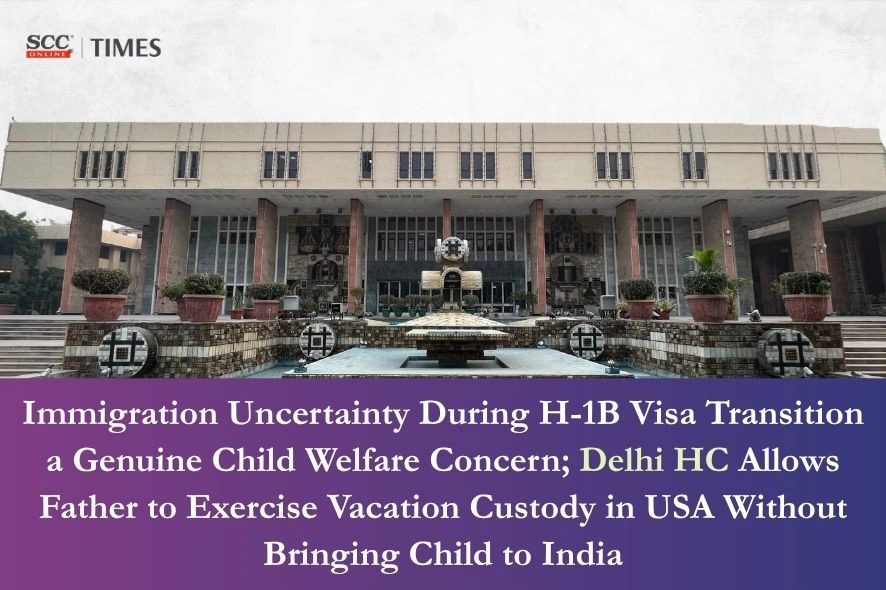
Delhi High Court: In an appeal filed under Section 19, Family Courts Act, 1984 challenging the Family Court’s order dated 5 June 2026, allowing an application moved by the respondent-father under Section 26, Hindu Marriage Act, 1955 and permitted the minor child to be brought to India from the United States of America (USA) during the summer vacation. The Division Bench of Tejas Karia* and Madhu Jain, JJ., held that child welfare and immigration stability prevail over overseas visitation claims. While balancing the respondent’s visitation rights with the child’s welfare, educational continuity, and immigration-related uncertainties, the Court modified the Family Court’s visitation order, and directed that the child should remain with the respondent in USA during the vacation period without being brought to India.
Background
The minor child was residing in USA with the appellant-mother and studying there. The appellant contended that the child’s immigration status was dependent upon her own visa status, which was undergoing a transition following her selection under the H-1B FY 2027 CAP Programme. According to her, international travel during this period could adversely affect the child’s ability to re-enter and continue residing in USA. She also relied upon documents and an opinion from a US immigration attorney warning of possible immigration complications if the child left the country during the ongoing visa process.
The appellant further asserted that she had never denied the respondent access to the child and had facilitated the child’s visits to India during the summer vacations of 2024 and 2025 and the winter vacation of 2025. She also emphasised that the child’s new academic session was scheduled to commence on 15 July 2026 and that any interruption could affect his educational continuity.
The respondent opposed the appeal, contending that the child possessed a valid multiple-entry B-1/B-2 tourist visa and could therefore re-enter USA even if issues arose regarding the F-2 dependent visa. He argued that the child’s immigration status remained secure and that the concerns raised by the appellant were unfounded.
During the pendency of the appeal, the High Court directed the parties to place on record affidavits concerning the child’s visa status and ordered that although the respondent could travel to USA, he should not bring the child to India without further permission of the Court.
Analysis
At the outset, the Court held that the Family Court had not adequately appreciated the immigration-related concerns raised by the appellant. While the Family Court proceeded on the basis that there was no legal prohibition or binding direction preventing the child from travelling outside USA, it failed to give due weight to the practical consequences arising from the transition in the appellant’s immigration status. The material-on-record showed that the minor child’s immigration status was directly linked to that of the appellant, whose visa position was undergoing a transition after completion of her academic programme and commencement of employment in USA.
The Court noted that the child was studying in USA and that the new academic session was scheduled to begin on 15 July 2026. Although the opinion of the immigration attorney was not binding, the Court treated the affidavit of a qualified immigration attorney as having persuasive value.
The Court observed that if the child travelled to India and was thereafter not permitted to return to USA because of immigration complications, such a situation would not be conducive to the welfare and best interests of the child. Since the child’s visa status remained connected with that of the appellant and her own status was presently in transition, the immigration issues raised a genuine concern regarding the child’s ability to travel to India and thereafter return to USA. Consequently, the Court found the Family Court’s view that the immigration concerns merely amounted to a denial of access to the respondent, as not entirely accurate.
The Court further noted that the respondent had already travelled to USA and could spend time with the child there. Having travelled with full knowledge of the pendency of the appeal and the Court’s interim directions, no prejudice would be caused to him if he continued to remain in USA and spent the entire summer vacation with the child without bringing him to India. The Court also remarked that, if necessary, the respondent could extend his stay and work remotely, thereby giving priority to the welfare of the minor child.
Decision
The Court modified the impugned order and directed that the minor child should remain with the respondent in USA during the vacation period and should not be brought to India. It directed the respondent to ensure that the child was returned to the appellant in USA, 3 days prior to the reopening of the child’s school on 15 July 2026.
Accordingly, the appeal was allowed and the Family Court’s order stood modified to the extent indicated. All pending applications were also disposed of.
[Sanam Talwar v. Shabeer Gerewal, 2026 SCC OnLine Del 4736, decided on 17-6-2026]
*Judgment authored by Justice Tejas Karia
Advocates who appeared in this case:
Ms. Priya Hingorani, Sr. Adv. with Ms. Aditi Ladda, Adv., Counsel for the Appellant
Mr. Somnath Bharti and Ms. Kashish Aggarwal, Advss., Counsel for the Respondent