Disclaimer: This has been reported after the availability of the order of the Court and not on media reports so as to give an accurate report to our readers.
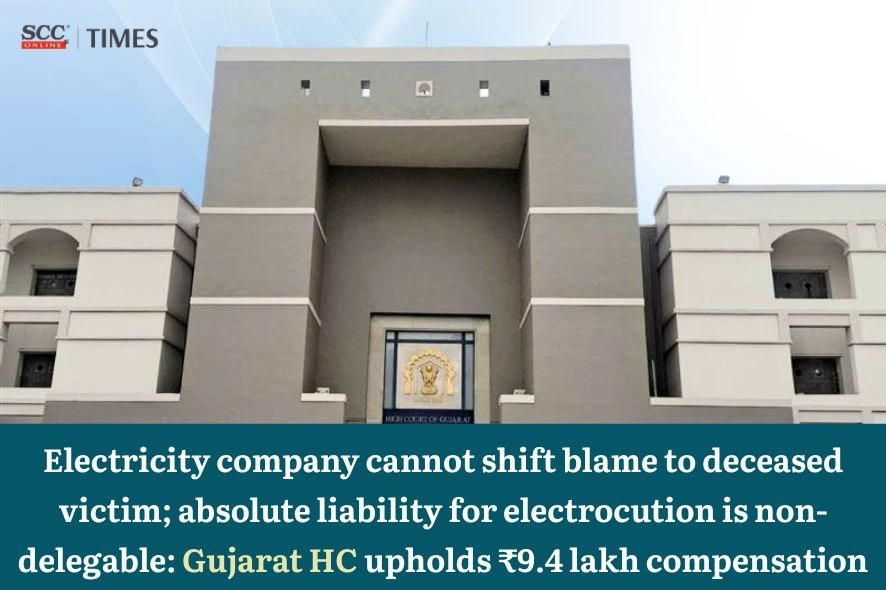
Gujarat High Court: In a first appeal filed by the appellant Gujarat Energy Transmission Co. Ltd. (GETCO) challenging a trial court judgment and decree awarding Rs 9,40,000 compensation to the family of a man who died due to electrocution from a 66 kv transmission line, the Single Judge Bench of J.C. Doshi, J., dismissed the appeal and held that electricity distribution is an inherently hazardous activity attracting the principles of strict and absolute liability. The Court held that GETCO could not avoid liability by attributing negligence to the deceased.
The Court observed that,
“Considering the fact that the GETCO is engaged in selling the hazardous substance, is required to pay compensation for death of the deceased applying the principles of strict and absolute liability.”
Background
In the instant case the plaintiffs are the legal heirs of deceased Gemarsinh Rupsinh Sodha, who was a Maldhari by occupation and was herding his sheep and goats through the Ugamani Sim area of Village Nana Reha on the afternoon of 24 April 2003. As he passed near an open canal, a 66 kv transmission line running through the branches of a Boraci tree came into contact with him. The powerful electric current caused severe injuries, and despite treatment, he succumbed to those injuries on 28 April 2003. Alleging that the accident occurred due to GETCO’s failure to properly maintain its transmission lines and ensure public safety, his widow and other legal heirs instituted a suit seeking compensation. The trial court partly decreed the suit and awarded Rs 9,40,000 with interest at 9 per cent per annum. Challenging the finding of liability, GETCO approached the High Court contending that the accident occurred due to the deceased’s own negligence and that no compensation was payable.
Issue
Whether the deceased was negligent and due to his negligency, the incident occurred?
Analysis and decision
Noting that the deceased while passing through the branches of “Boraci Tree” near open Kenal of tube well, came in contact with the live electric wire and died due to electrocution, the Court referred M.C. Mehta v. Union of India, where the principles of strict liability in Rylands v. Fletcher, was extended and held to be absolute liability.
The Court observed that GETCO is engaged in the business of selling hazardous product which is electricity and is therefore liable to maintain and insulate all the wires to prevent accidents and if any incident occurs the principles of absolute liability shall be attracted.
“Considering the fact that the GETCO is engaged in selling the hazardous substance, is required to pay compensation for death of the deceased applying the principles of strict and absolute liability.”
The Court noted that if transmitted energy through electricity line causes injury or death, of a person, who unknowingly comes in contact with it, then it is the primary liability of the electricity company to compensate the sufferer in accordance with the principle of strict liability and also noted that the wires has potentiality of dangerous dimension. The Court observed that electricity companies are under a duty to take all necessary safety measures to prevent the escape of electricity and ensure that transmission lines do not pose a risk to human life. Since the supply of electricity is an inherently hazardous activity involving foreseeable risks, the law of torts imposes strict liability on such undertakings for any injury or death caused thereby, irrespective of any negligence or carelessness on their part.
The Court explained that strict or absolute liability is distinct from fault-based liability, as the latter arises on negligence. In cases of negligence, a defendant may avoid liability by demonstrating that all reasonable precautions were taken to prevent the foreseeable harm. However, in cases governed by strict liability, such considerations are irrelevant, as liability arises from the inherently hazardous nature of the activity itself and is imposed regardless of whether the harm could have been avoided through reasonable care or precautions.
Applying the principles of strict and absolute liability, the Court held that GETCO could not escape liability by attributing negligence to the deceased and dismissed the appeal upholding the compensation awarded by the trial court, and directed that any amount deposited before the trial court be disbursed to the plaintiffs along with accrued interest.
[Gujarat Energy Transmission Ltd. v. Naniba, C/FA/1310/2012, decided on 11-6-2026]
Advocates who appeared in this case:
For the petitioner: Jayant P Bhatt
For the respondent: Henil M shah