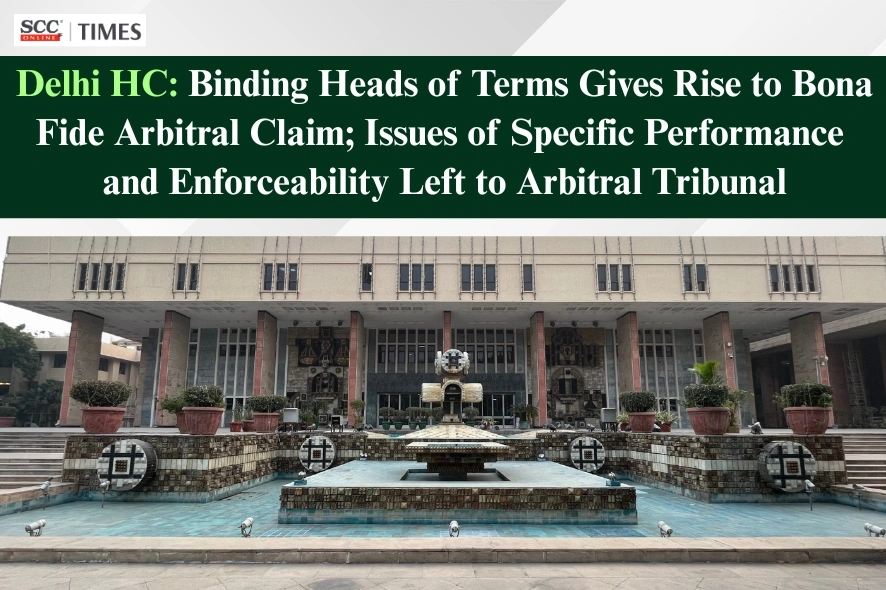
Delhi High Court: While hearing a petition under Section 9, Arbitration and Conciliation Act, 1996 (Arbitration Act) requesting grant of interim protection in a dispute arising from a binding Heads of Terms (HoT) executed for the development of land in Delhi, the Single Judge Bench of Harish Vaidyanathan Shankar, J., held that the HoT prima facie constituted a binding commercial arrangement and disclosed a bona fide arbitral claim and that questions relating to the enforceability of the HoT and the petitioner’s entitlement to specific performance were matters to be determined by the Arbitral Tribunal.
Facts and Background
The dispute arose from an HoT dated 17 May 2023 executed between the parties for the development of the collaboration land. Under the arrangement, the respondents were to contribute the land, while the petitioner was responsible for developing a residential group housing or mixed-use project, obtaining all necessary approvals, and bearing the project costs. The HoT also contained an arbitration clause providing for arbitration seated in Delhi.
The respondents represented that they had clear and marketable title to the land and disclosed only one existing dispute relating to Fountainhead Motels Pvt. Ltd. Following execution of the HoT, the petitioner undertook various steps towards project implementation, including preparation and submission of layout plans before the Municipal Corporation of Delhi (MCD), obtaining regulatory approvals, and demolishing the existing “Jhankar Banquet” structure on the land.
According to the petitioner, the approval process encountered delays due to requirements for clearances from the Airports Authority of India and the Ministry of Defence, revisions to layout plans because of the land’s proximity to an Air Force Station, the absence of the MCD Standing Committee for a substantial period, and the operation of the Model Code of Conduct during elections. The petitioner also facilitated settlement of the disclosed dispute involving Fountainhead Motels Pvt. Ltd. in March 2024.
The parties subsequently executed 3 addenda extending the validity of the Binding HoT, ultimately up to 17 December 2025. During this period, the petitioner made substantial payments to the respondents, including upfront payments, additional consideration, and monthly payments of ₹25 lakhs under the later extensions.
The petitioner alleged that in October 2025 it was informed for the first time about 2 pending appeals concerning the collaboration land under the Delhi Land Reforms Act, 1954. Those appeals were dismissed on 18 December 2025.
As the third extension approached expiry, the petitioner circulated a draft fourth addendum seeking a further extension. Although no further addendum was executed, the petitioner contended that both parties continued to act in furtherance of the HoT after 17 December 2025, including pursuing statutory approvals and jointly appearing before the Commissioner, MCD, in February 2026. The petitioner claimed that by then only the final approval of the MCD Standing Committee remained pending.
On 10 March 2026, the respondents asserted that the HoT had expired on 17 December 2025 and sought reconciliation of accounts. They subsequently refunded ₹2.8 crore to the petitioner and reiterated their position that the arrangement had lapsed.
Apprehending that the respondents might create third-party rights or encumbrances over the collaboration land, the petitioner issued public notices and invoked its rights under the HoT. Claiming to have invested approximately ₹8 crore and incurred substantial development and approval-related expenses, the petitioner approached the Court under Section 9, Arbitration Act seeking interim measures, including restraint orders against the creation of third-party interests in the land and interference with its alleged contractual rights.
Issue for consideration
Whether the HoT constituted a binding and enforceable commercial arrangement capable of supporting interim relief under Section 9, Arbitration Act.
Analysis
The Court emphasised that, in proceedings under Section 9, Arbitration Act, it was not required to finally determine the enforceability of the HoT or the petitioner’s entitlement to specific performance. The inquiry was limited to whether the petitioner had raised a bona fide and arguable arbitral claim warranting preservation of the subject-matter pending arbitration.
On a prima facie examination, the Court found that the HoT contained essential commercial terms, including identification of the project land, the development framework, revenue-sharing arrangement, financial commitments, and reciprocal obligations. The mere fact that the parties contemplated execution of a future collaboration agreement did not render the HoT non-binding. Relying on Trimex International FZE Ltd. v. Vedanta Aluminium Ltd., (2010) 3 SCC 1, the Court observed that a binding contractual relationship may exist even where a more detailed agreement is intended to follow.
The Court also attached significant weight to the parties’ conduct after execution of the HoT. Multiple addenda extending the arrangement, substantial payments made by the petitioner, continued engagement with statutory authorities, and ongoing negotiations demonstrated that both sides had acted upon the arrangement over an extended period. This conduct prima facie undermined the respondents’ argument that the HoT was merely exploratory or unenforceable.
Addressing the respondents’ contention that the arrangement was incapable of specific performance, the Court observed that the 2018 Amendments to the Specific Relief Act, 1963 (SRA) marked a legislative shift in favour of enforcement of commercial contracts. Questions regarding the applicability of Sections 14 and 41 SRA required detailed factual examination and could not be conclusively decided at the interim stage. The Court held that such objections did not justify denying interim protection where a substantial arbitral dispute existed.
The Court further rejected the argument that the petitioner’s rights automatically came to an end upon expiry of the contractual timelines. The repeated extensions, continued negotiations, and post-expiry conduct of the parties indicated that the arrangement was treated as subsisting even beyond the stipulated period. Whether time was truly of the essence of the contract was held to be a matter for determination by the Arbitral Tribunal.
Applying the settled principles governing interim relief, the Court held that the petitioner had established a strong prima facie case. The balance of convenience favoured preserving the project land and the commercial arrangement pending arbitration. The Court observed that creation of third-party rights or alienation of the property could fundamentally alter the nature of the dispute and render any eventual arbitral award ineffective. Since the dispute concerned valuable development rights in immovable property and a unique commercial opportunity, monetary compensation alone would not be an adequate remedy. Interim protection was therefore necessary to safeguard the efficacy of the arbitral proceedings and preserve the subject-matter of the dispute.
Decision
The Court allowed the petition and granted interim protection in favour of the petitioner pending arbitration. The Court restrained the respondents from creating any third-party rights, alienating, transferring, encumbering, or otherwise dealing with the collaboration land in a manner prejudicial to the petitioner’s claimed rights under the HoT. The protection was directed to continue until the Arbitral Tribunal considers the issue upon an application by either party.
The Court clarified that its findings were only prima facie and confined to the adjudication of the Section 9 petition. All questions regarding the enforceability of the HoT and the parties’ substantive rights and obligations were left open for determination by the Arbitral Tribunal. The petition was accordingly disposed of.
[Conscient Infrastructure (P) Ltd. v. Mahesh Kapoor, OMP (I) (COMM.) 138 of 2026, decided on 29-5-2026]
Advocates who appeared in this case:
For Petitioner: Dayan Krishnan, Senior Advocate, Anirudh Bakhru, Divyam Agarwal, Ayush Puri, Ranvir Singh Sisodia, Kanav Madnani, Siddhant, Advocates
For Respondent: Sandeep Sethi, Senior Advocate, Manu Bajaj, Parul, Krisna Gambhir, Shreya Sethi, Riya Kumar, Advocates
Buy Arbitration and Conciliation Act, 1996 HERE