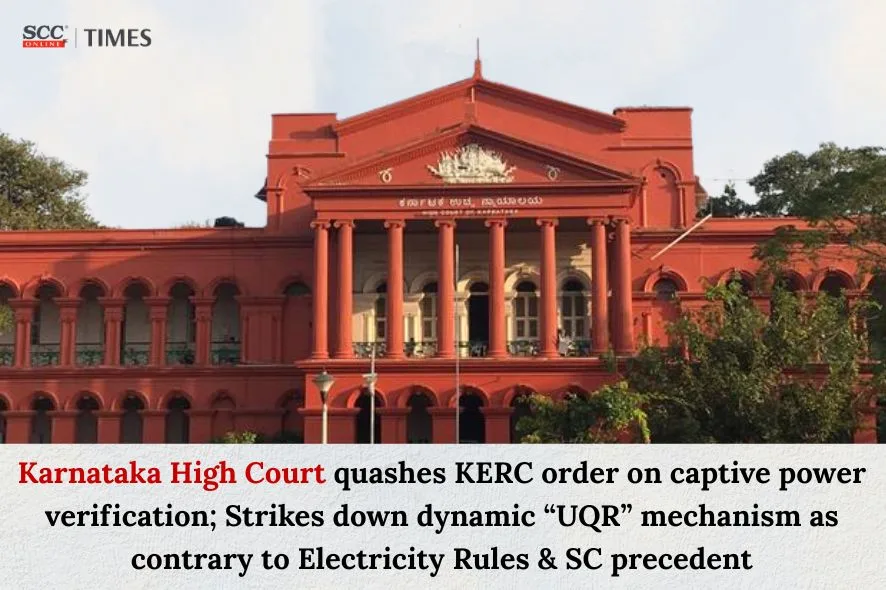
Karnataka High Court: While considering 4 writ petitions challenging Clause 6.7 of the order passed by the Karnataka Electricity Regulatory Commission (KERC) which prescribed the procedure related to the proportionality test and “Unitary Qualifying Ratio” (UQR) applicable to group captive users, a Single Judge Bench of K. S. Hemalekha, J., held that impugned order introduced a dynamic “UQR” based on actual captive consumption contrary to the qualifying benchmark. Accordingly, the Court quashed the said order.
Background
In the present case, the petitioners were entities engaged in captive generation, captive consumption, renewal energy regeneration and association of captive users within Karnataka and they challenged the impugned order dated 28 March 2025 principally on the ground that Clause 6.7 of the Captive Verification Procedure was contrary to Section 9 Electricity Act 2003 (Electricity Act), Rule 3 Electricity Rules 2005 (Electricity Rules) and the law declared by the Supreme Court in Dakshin Gujarat Vij Co. Ltd. v. Gayatri Shakti Paper and Board Ltd., 2023 SCC Online SC 1276 (Dakshin Gujarat case).
According to the petitioners, Rule 3 prescribed only the minimum qualifying requirements of 26 per cent ownership and 51 per cent captive consumption and did not contemplate any upper limit or continuing ceiling on consumption. It was contended that by introducing a dynamic UQR based on actual ownership and actual consumption, KERC had effectively rewritten Rule 3 and imposed a substantive condition not contemplated either under the statutory framework or by the judgment in Dakshin Gujarat case (supra).
The petitioners further contend that KERC lacked jurisdiction to prescribe such a verification mechanism and further argued that the impugned order was issued without adequate public consultation, operated retrospectively for the financial year 2024-25, violated principles of natural justice and amounted to excessive delegation of power.
Per contra, KERC, Bengaluru Electricity Supply Co. Ltd. (BESCOM) and the State contended that the impugned order merely operationalises Rule 3 and did not introduce any new substantive condition. They further submitted that the procedure was intended to prevent misuse of captive status by insignificant shareholders consuming disproportionate quantities of electricity while claiming exemption from Cross Subsidy Surcharge (CSS) and Additional Surcharge (ASC).
They stated that the State Commission possessed incidental and ancillary powers to determine and verify captive status while examining claims for surcharge exemption under the Electricity Act.
Issues and Analysis
The Court stated that the issue in the case at hand was whether the impugned order was contrary to Rule 3 Electricity Rules and the Dakshin Gujarat case, and it introduced a new mechanism beyond the statutory framework and whether the KERC could prescribe a dynamic “UQR” based on total actual captive consumption and total ownership, contrary to the proportionality formula recognised in Dakshin Gujarat case?
After perusal of the relevant provisions, the Court stated that the generating plant has to be established in accordance with Section 2(8) Electricity Act and has to fulfill the conditions under Rule 3 Electricity Rules with respect to share holding pattern and consumption pattern in order to be qualified as a captive generator users. Further, the Court noted that the KERC published the draft KERC (Verification of Captive Status of Generating Plants/ Consumers in the State of Karnataka), Regulations 2023 under Section 181 Electricity Act subsequent to which the Supreme Court in Dakshin Gujarat case interpreted Rule 3 Electricity Rules and held that the eligibility criteria for captive plants and captive users to claim captive status under the Electricity Act.
The Court noted that in Dakshin Gujarat case, the Supreme Court gave a formula for “UQR” as 51 per cent ÷ 26 per cent = 1.96 per cent and clarified that benchmark for proportionality is qualifying captive consumption requirements under Rule 3 Electricity Rules and not total actual generation or total actual consumption. The Court further noted that KERC, under Clause 6.7 provided the formula for UQR as Y ÷ X, where “Y” is equal to percentage of total consumption by captive users and “X” is equal to percentage of total ownership of captive users in the Captive Generating Plant (CGP).
Thus, the Court stated that under the impugned procedure, proportionality is determined with reference to total actual captive consumption and total ownership and not with reference to the qualifying threshold of 51 per cent captive consumption as recognized in Dakshin Gujarat case.
The Court stated that in Dakshin Gujarat case, the Supreme Court examined proportionality with reference to qualifying captive consumption requirement under Rule 3 Electricity Rules and not with reference to total actual consumption and Clause 6.7 of the impugned order departed from the above methodology and recalculated the UQR dynamically on the basis of total actual captive consumption and total ownership.
Further, the Court stated that neither Rule 3 Electricity Rules nor Dakshin Gujarat case expressly contemplated such fluctuating or dynamic UQR as the Rule prescribed qualifying thresholds and the Supreme Court explained proportionality with reference to those qualifying thresholds. The Court stated that though the KERC sought to justify the impugned methodology by relying upon the anti-gaming observations of Dakshin Gujarat case, however such observations could not be read in isolation to substitute the qualifying ratio.
Thus, the Court held that the illustration furnished in the impugned order substantially altered the basis of proportionality by treating total actual captive consumption as the benchmark which resulted in the introduction of a new verification mechanism.
The Court considered the respondents’ contention that petitioners had an alternative effective remedy before the Appellate Tribunal for Electricity (APTEL) under Section 111 Electricity Act and that the KERC had earlier issued draft regulation during 2023 and revised draft regulation during 2024 inviting stakeholder objections. The Court stated that the impugned order introducing a materially different methodology could not be issued without fresh consultation or hearing the petitioners. The Court stated that thus, it could not be non-suited solely on the ground of an alternative remedy, particularly, when the challenge was to the jurisdiction and legality of the impugned framework itself.
Decision
Thus, the Court held that the impugned order introduced a dynamic “UQR” based on actual captive consumption contrary to the qualifying benchmark explained in Dakshin Gujarat case and the same could not be sustained.
Accordingly, the Court allowed the petition at hand by quashing the impugned order and directed that KERC to reconsider the matter and frame an appropriate procedure consistent with Rule 3 Electricity Rules and Dakshin Gujarat case after following the due consultative process and principles of natural justice.
[Distributed Solar Power Association v. Karnataka Electricity Regulatory Commission, 2026 SCC OnLine Kar 4440, decided on 12-6-2026]
Advocates who appeared in this case:
For the Petitioner: C.K. Nandakumar, Senior Counsel, Mohammed Shameer, Advocate, Dhyan Chinnappa, Vishrov Mukharjee, Yashaswi Kant.
The CAM Team representing JSW Energy Limited and JSW Steel Limited, was led by Ramanuj Kumar, Partner (Co-Head – Projects (Energy & Energy Transition)); Lomesh Kumar Nimduri, Partner (Head — Disputes, South India); and Vishal Binod, Partner; along with Sagnik Maitra, and Twinkle Chadwa, Senior Associates; Ajay T.K. and Swadha Sharma, Associates.
For the Respondent: Pratibhanu Singh Kharola, Advocate, Aravind Kamath, ASG, K.N. Phaneendra, Senior Counsel and Shivaprasad Shanthanagoudar, Advocate, Shahabaaj Husain, Advocate