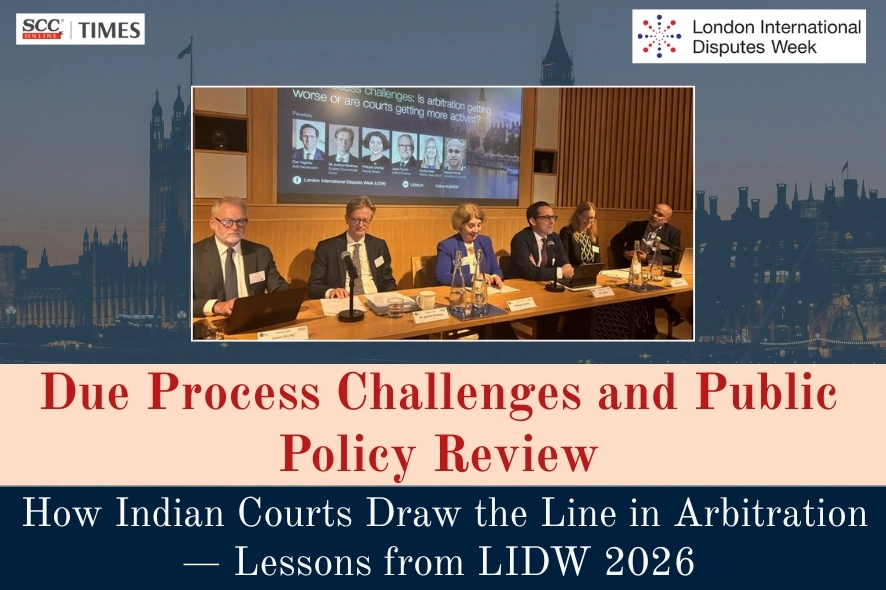
Can an arbitral award be challenged simply because a party disagrees with how the tribunal conducted the proceedings? Or does court intervention require something more fundamental? These questions lie at the heart of the distinction between due process review and public policy review, a distinction that was explored in depth at LIDW 2026 and has increasingly shaped the approach of Indian courts to arbitral award challenges.
Due process concerns the fairness of the arbitral process, namely whether parties were given a proper opportunity to present their case, respond to evidence and participate meaningfully in the proceedings. Public policy, by contrast, concerns the legitimacy of the award itself and asks whether enforcement would offend the most fundamental legal principles of the forum state. Indian arbitration law reflects a similar distinction. Due process challenges are generally raised under Section 34(2)(a)(iii) of the Arbitration and Conciliation Act, 1996 (Arbitration and Conciliation Act), which permits a court to set aside an award where a party was not given proper notice of the arbitral proceedings or was otherwise unable to present its case.
Also Read: Supreme Court explains impact of undue and unexplained delay on validity of arbitral awards
Courts have consistently held that this ground is directed at genuine procedural unfairness and not mere dissatisfaction with a tribunal’s case-management decisions. Judicial review is therefore not available simply because a party believes that additional evidence should have been admitted, further hearings should have been granted, or a different procedural course ought to have been followed. As several panellists observed at LIDW26, the relevant inquiry is not whether every procedural request was granted, but whether the party had a fair opportunity to be heard.
Public policy challenges are treated differently. Section 34(2)(b)(ii) of the Arbitration and Conciliation Act permits a court to set aside an award if it is in conflict with the public policy of India. Over the last decade, Indian courts have progressively narrowed the scope of this ground and repeatedly emphasised that courts are not sitting in appeal over arbitral awards. The modern approach recognises that an award cannot be challenged merely because a court might have reached a different conclusion on the facts or the law. Intervention is generally confined to cases involving the fundamental policy of Indian law or the most basic notions of morality and justice.
In this respect, the Indian position mirrors the distinction discussed at LIDW26. Due process review protects the integrity of the arbitral procedure, while public policy review safeguards the legal system from awards that undermine its most fundamental values.
SCC Times extends its appreciation to Zehra Naqvi, EBC–SCC Online Foreign Student Ambassador and Lawyer, for her on ground presence, valuable assistance and contribution to the reporting of this event.