Disclaimer: This has been reported after the availability of the order of the Court and not on media reports so as to give an accurate report to our readers.
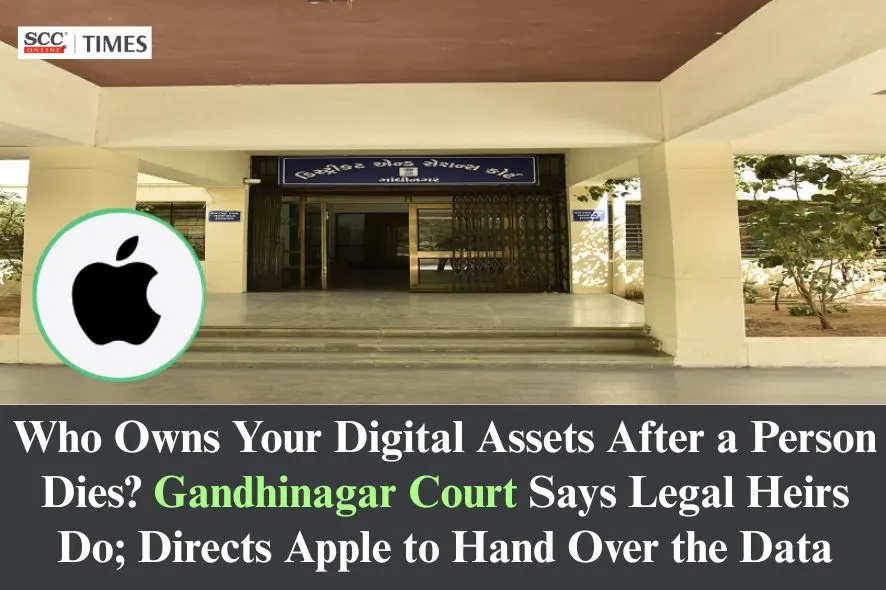
3rd Additional Senior Civil Judge, Gandhinagar: In a petition filed under Sections 218, 219, 220, 278 and 283, Succession Act, 1925 (Act), seeking grant of letters of administration in respect of the deceased’s Apple iPhone and associated Apple ID/iCloud account, the Single Judge Bench of Himanshu Choudhary, J., held that digital data forms part of the deceased’s estate and is capable of administration under succession law. The Court further held that the right to privacy, being an inherently personal right, does not survive the death of the individual and, applying the maxim actio personalis moritur cum persona, no claim in respect of the deceased’s right to privacy can be sustained so as to obstruct the lawful heirs from administering the digital estate.
Also Read: Data Privacy, Surveillance & India’s Digital Future | Full Episode Out Now
Background
The petitioners, being the widow and daughter of late Shaishav Dineshbhai Shah (the deceased), sought grant of letters of administration in respect of the deceased’s Apple iPhone 13 Pro Max and associated Apple ID/iCloud account containing photographs, videos, documents, voice notes and contact lists. The deceased died intestate on 24 April 2025, without any will and is survived by 2 Class-I legal heirs, his wife and daughter.
The petitioners approached Apple seeking access and recovery of the deceased’s digital estate, to which Apple communicated that access to the account could only be facilitated upon production of a court order appointing a legal personal representative/administrator of the deceased’s estate, supported by a court order containing specific declarations. Public notice under Section 283 of the Act, in the newspaper was published and no objections were received. Thus, the petitioners filed present application seeking grant of Letters of Administration (intestate) in their favour jointly.
Analysis
Having regard to the pleadings, evidence on record and submissions advanced by the petitioners, the Court found the present petition fit to be allowed for the following reasons:
-
1. Jurisdiction: The Court noted that it has the jurisdiction to entertain and decide the present petition under Section 270 of the Act, as the deceased place of abode falls within the territorial limits of this Court and also that the estate/assets for which administration was sought, were also situated within the territorial jurisdiction and the entire cause of action had also arisen within its jurisdiction.
-
2. Intestate death and legal heirship: The Court noted that the death certificate and legal heirship documents established beyond doubt that the deceased died intestate on 24 April 2025 without executing any will, and was survived only by his wife and daughter, who were his sole Class-I legal heirs under the Hindu Succession Act, 1956. The Court further noted that despite publication of public notice under Section 283 of the Act in the newspaper “Sandesh”, no objections were received from any quarter.
-
3. Digital data as property forming part of the estate: The Court recognised that,
“The digital data stored in the Apple iCloud account of the deceased constitutes a valuable digital asset forming part of the estate of the deceased, capable of administration under the Act.”
The Court observed that the existing legal framework, including the broad definitions of “movable property” and “property” under various statutes, like General Clauses Act, 1897, Nyaya Sanhita, 2023, Prevention of Money Laundering Act, 2002, as well as recognition of virtual digital assets under the Income-tax Act, 1961, was sufficiently wide to include digital data within the scope of property. The Court supported its conclusion with the Supreme Court’s interpretation of “property” in Jilubhai Nanbhai Khachar v. State of Gujarat,1995 Supp (1) SCC 596 and State of W.B. v. Subodh Gopal Bose, AIR 1954 SC 92.
-
4. Right to privacy of deceased: The Court opined that, the right to privacy, being an inherently personal right, does not survive the death of the individual and relied on K.S. Puttaswamy v. Union of India, (2015) 10 SCC 92. Applying the maxim actio personalis moritur cum persona (a personal right of action dies with the person), the Court held that the right to privacy of the deceased could not be invoked to obstruct lawful heirs from administering the digital estate. The Court further observed that in the absence of a nominee under Section 14, Digital Personal Data Protection Act, 2023, rights relating to access and management of the deceased’s digital data devolve upon the legal heirs for the limited purpose of administering the estate.
-
5. Appointment of administrator: The Court noted that the widow of the deceased had filed a no-objection declaration consenting to the appointment of the deceased’s daughter as the sole administrator/legal personal representative of the estate. In view of such consent, the Court found it appropriate to appoint the daughter as administrator of the deceased’s estate.
The Court clarified that it had not examined the issue of title or ownership over the subject properties and that the order would not confer any title upon the petitioners.
Decision
Allowing the petition, the Court granted Letters of Administration (intestate) in favour of the daughter in respect of the deceased’s iPhone device and associated Apple ID/iCloud account. Apple Distribution International Ltd. and/or its affiliates were directed to assist the administrator in recovery of the deceased’s data, to the extent technically feasible. The Court further directed the administrator to prepare a true inventory of the estate within 6 months and render a true account within 1 year in terms of Section 317 of the Act.
[Sadhna Shaishav Shah v. NIL, 2026 SCC OnLine Dis Crt (Guj) 1, decided on 5-5-2026]
Advocates who appeared in this case :
For the applicant: J.J. Bhatt