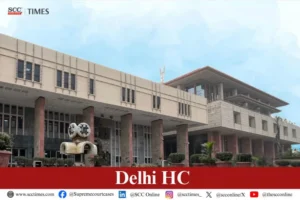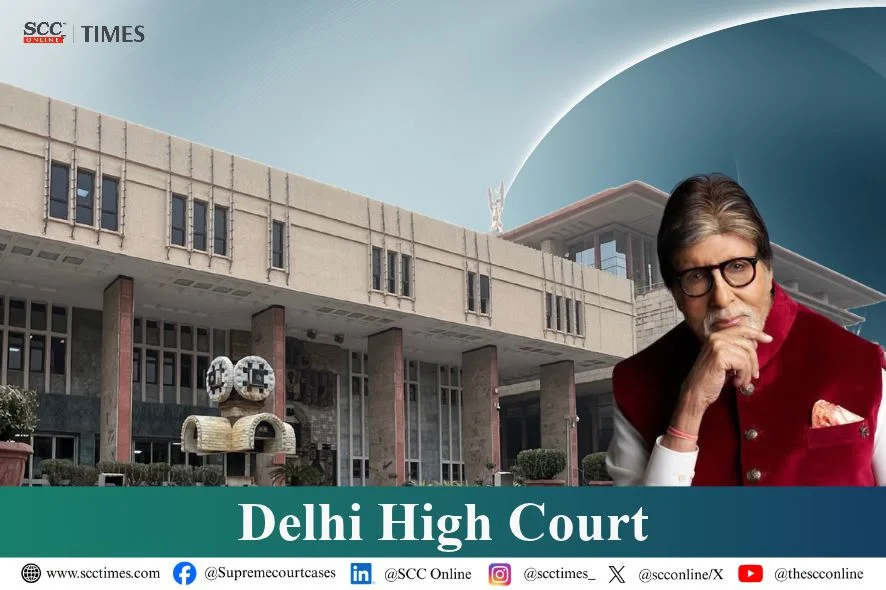
Delhi High Court: While adjudicating a suit filed by Amitabh Bachchan seeking protection of his personality and publicity rights against unauthorised commercial exploitation of his name, image, voice and likeness, a Single Judge Bench of Purushaindra Kumar Kaurav, J., decreed the suit against the defendants, including unidentified infringers (John Does). The Court held that the right to control commercial use of human identity is the right to publicity and observed that the impugned uses of the plaintiff’s name and photographs for commercial gain, without his consent and falsely suggesting his endorsement, satisfied the requirements for infringement of publicity rights. The Court accordingly passed a decree under Order 23 Rule 3 and Order 8 Rule 10, Civil Procedure Code, 1908 (CPC), restraining the defendants from unauthorised use of the plaintiff’s persona.
Background
The plaintiff-Amitabh Bachchan instituted the present suit seeking a decree of permanent injunction restraining the misappropriation of his publicity rights, passing off and damages against several defendants alleged to have commercially exploited his name, image, voice and likeness without his consent. The defendants were alleged to have used the plaintiff’s persona through a mobile application titled “Amitabh Bachchan Video Call”, WhatsApp messages promoting a purported “Kaun Banega Crorepati” lottery, a general knowledge quiz book, T-shirts, wall posters and domain names. The suit was also instituted against unidentified infringers (John Does). Vide order dated 25 November 2022, the Court granted an ex parte ad interim injunction against the defendants, including the John Does, and issued necessary directions to the statutory authorities and Telecom Service Providers.
Analysis
The Court noted that the plaintiff and Defendants 1, 3, 5 and 8 had amicably settled their disputes. The said defendants acknowledged the plaintiff’s publicity rights and right to privacy and undertook not to use his name, image, voice, likeness or any other aspect of his persona without his express permission. The Court observed that Order 23 Rule 3 CPC authorises the Court to pass a decree on a compromise whereby the parties have adjusted the suit wholly or in part, and such decree may be passed so far as it relates to the parties to the suit. Thus, a settlement with some of the defendants could be given effect to qua those defendants alone. Finding that the compromise was lawful, reduced into writing and duly signed by the parties, the Court held that the settlement satisfied the essentials of Order 23 Rule 3 CPC. The Court further observed that the settlement had been entered into voluntarily, without fear or coercion, and that nothing had been pointed out to render it void or voidable under the Contract Act, 1872. The undertakings furnished by the settling defendants would also bind their legal heirs, representatives and assigns-in-business, while the plaintiff had forgone his remaining claims under para 76(d) to (k) of the plaint against them.
With respect to Defendants 2, 4, 6 and 9, the Court noted that despite service, they had failed to appear or file their written statements, and their right to do so had already been closed. The Court emphasised that the power under Order 8 Rule 10 CPC was not to be applied mechanically and ought to be invoked with circumspection, particularly where some of several defendants contest the suit, so as to avoid inconsistent decrees. However, no such situation arose in the present case, as none of the defendants had filed a written statement disputing the plaintiff’s case.
Relying upon Titan Industries Ltd. v. Ramkumar Jewellers1, the Court reiterated that the right to control commercial use of human identity is the right to publicity. It noted that infringement of publicity rights requires satisfaction of 2 elements, namely, validity, i.e., the plaintiff owns an enforceable right in the identity or persona of a human being, and identifiability, i.e., the celebrity must be identifiable from the defendant’s unauthorised use. The Court held that both elements were satisfied, as the impugned uses employed the plaintiff’s very name and photographs for commercial gain, without his consent, and falsely suggested his endorsement.
The Court further observed that the plaint did not disclose any disputed question of fact requiring trial and that no purpose would be served in relegating the plaintiff to lead ex parte evidence, which would merely repeat the plaint. It also took note of Rule 27 of the Delhi High Court Intellectual Property Rights Division Rules, 2022, which enables the Court to pass a summary judgment in such cases.
With regard to Defendant 10 (John Does), the Court observed that the interim injunction dated 25 November 2022 operated against them as well. The plaint disclosed a continuing pattern of anonymous misuse of the plaintiff’s persona through websites, applications, posters and messaging platforms, which the plaintiff could not track to identified persons. Accordingly, the Court held that the decree in terms of para 76(a) to (c) of the plaint would also operate against the John Does.
Decision
Accordingly, the Delhi High Court allowed the application under Order 23 Rule 3 CPC and decreed the suit qua Defendants 1, 3, 5 and 8 in terms of prayers under para 76(a) to (c) of the plaint and the settlement terms. The Court also allowed the application under Order 8 Rule 10 CPC and decreed the suit qua Defendants 2, 4, 6, 9 and 10 in terms of prayers under para 76(a) to (c) of the plaint. The Court granted liberty to the plaintiff to institute fresh proceedings in the event of a fresh cause of action. The ex parte ad interim injunction dated 25 November 2022 was directed to stand merged with the decree. Consequently, the suit, along with all pending applications, if any, stood disposed of.
Also Read: Delhi HC orders takedown in Janhvi Kapoor’s personality rights case | SCC Times
[Amitabh Bachchan v. Rajat Nagi, CS(COMM) 819 of 2022, decided on 13-11-2026]
Advocates who appeared in this case:
For the Plaintiff: Sandeep Sethi, Sr. Adv. with Pravin Anand, Ameet Naik, Madhu Gadodia, Dhruv Anand, Bhavya Verma, Unnati Gambani, Sanjeevi Sishadri, Shreya Sethi, Krisna Gambhir and Ritvik Sharma, Advocates
For the Defendants 1,3,5 and 8: S. C. Singhal, Parth Mahajan, Advocates Vinay Mohan Sharma, Tina Garg, M. K. Ghosh, Annirudh Gupta along with Siddharth Gupta, AR, Kushal Kumr and Tanya Manik, Advocates