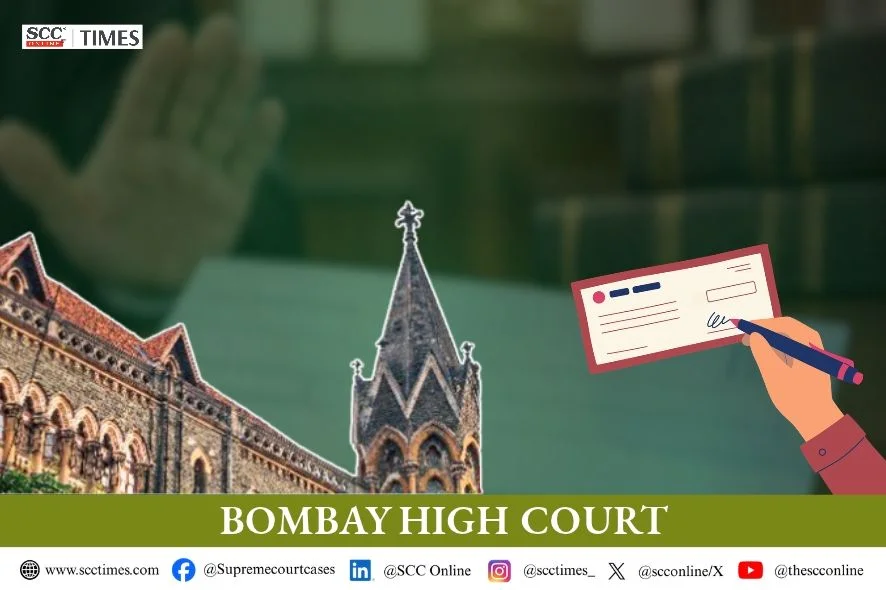
Bombay High Court: While setting aside the Sessions Court order allowing the recall of a witness at the arguments stage in a cheque-bounce matter, a Single Judge Bench of Abhay J. Mantri, J., held that in absence of a cogent reason, it would be inappropriate to recall a witness merely to fill a lacuna in the case. The Court held that, as a complaint under Section 138 of the Negotiable Instruments Act, 1881 (NI Act) rests on the cheque, a complainant who had not proved it cannot be allowed to cure the lapse by invoking Section 311 of the Criminal Procedure Code (CrPC) at the arguments stage, where the application disclosed no cogent reason and the accused had already filed written arguments.
Background
The respondents filed a complaint under Section 138 of the NI Act against the petitioner. After Respondent 1 concluded his evidence, the matter was posted for final arguments. During arguments, the petitioner contended that Respondent 1 had not proved the cheque in question. Respondent 1 therefore moved an application before the trial court seeking to recall himself as a witness in order to prove the original cheque.
The trial court rejected the application, holding that Respondent 1 was not entitled to recall himself merely to fill a lacuna in his case at the stage of final arguments.
Aggrieved by this order, Respondent 1 preferred a revision before the Sessions Court. The Sessions Court allowed the revision, set aside the trial court’s order, and permitted Respondent 1 to adduce evidence to the limited extent of proving the cheque. Aggrieved by this order, the petitioner filed the present writ petition.
Also Read: Section 138 NI Act Explained | Cheque Bounce Law & Criminal Offence
Contentions
The petitioner contended that the complaint was pending for final arguments and that Respondent 1 had filed the application before the trial court only to fill a lacuna in his case. It was further submitted that Respondent 1 had not stated any cogent reason for recalling the witness. Therefore, the trial court’s order refusing recall was just and proper, and the Sessions Court erred in allowing the revision petition without recording reasons. The petitioner accordingly sought quashing of the Sessions Court’s order.
On the other hand, the respondents submitted that Respondent 1 was uneducated and unaware of the English language, and therefore of the contents of the complaint. They further submitted that his advocate was at fault and that Respondent 1 should not suffer for his advocate’s negligence. They therefore prayed for dismissal of the petition.
Issue
Whether the Respondent was entitled to recall himself as a witness under Section 311 CrPC?
Court’s Analysis
The Court noted that, upon being queried, the respondent failed to point out the ground in the application on which he sought to rely. Similarly, when queried, he failed to explain how he was unaware of the contents of the affidavit of evidence, which had been filed in Marathi.
The Court observed that Section 311 of the CrPC empowers a court to recall and re-examine any witness at any stage of an enquiry, trial, or other proceeding if the witness’s evidence appears essential for the just decision of the case. It noted that Respondent 1’s evidence had concluded in 2017 and that his statement under Section 313 of the CrPC had also been recorded. During arguments, Respondent 1 came to know that the cheque had been incorrectly produced on record and therefore filed an application for recall of the witness, which the trial court rejected.
On examining the application, the Court found that it did not disclose any reason for recalling the witness. Nor did it explain why the original cheque had not been produced before the court. In the absence of a cogent reason, the Court held that recalling the witness was not proper. It further observed that the application appeared to have been filed casually, without recording any reasons for the recall.
The Court held that the Sessions Court’s order was contrary to the material on record, as it merely referred to the photocopy of the original cheque annexed to the complaint. The Court could not find any basis on which the Sessions Court had allowed the revision.
The Court disagreed with the view that Respondent 1 could not be denied an opportunity to prove the cheque merely because it had not been formally proved during the trial but before the commencement of arguments. Since the entire complaint under Section 138 of the NI Act rests on the cheque in question, proof of the cheque is essential to the case. As Respondent 1 had not proved the cheque, it would not be appropriate to permit him to fill the lacuna by recalling him to prove it, particularly when the petitioner had already filed written arguments before the trial court.
Also Read: Raj HC: Former school principal not liable under S. 138 NI Act after resignation | SCC Times
Decision
The Court allowed the writ petition, quashed and set aside the Sessions Court’s order, and restored the trial Court’s order.
[Sajid Ahamad Iqbal Ahamad Bhosage v. Ayyub Ilahibaksh Bagwan, Writ Petition No. 231 of 2026, decided on 05-11-2026]
Advocates who appeared in this case:
For the Petitioner: Prabodhan Jadhav, Pratik Jadhav, Advocates.
For the Respondent: Pankaj P. Deokar, Assistant Public Prosecutor; Nishikant Degaonkar, M. S. Mulla, Advocates.