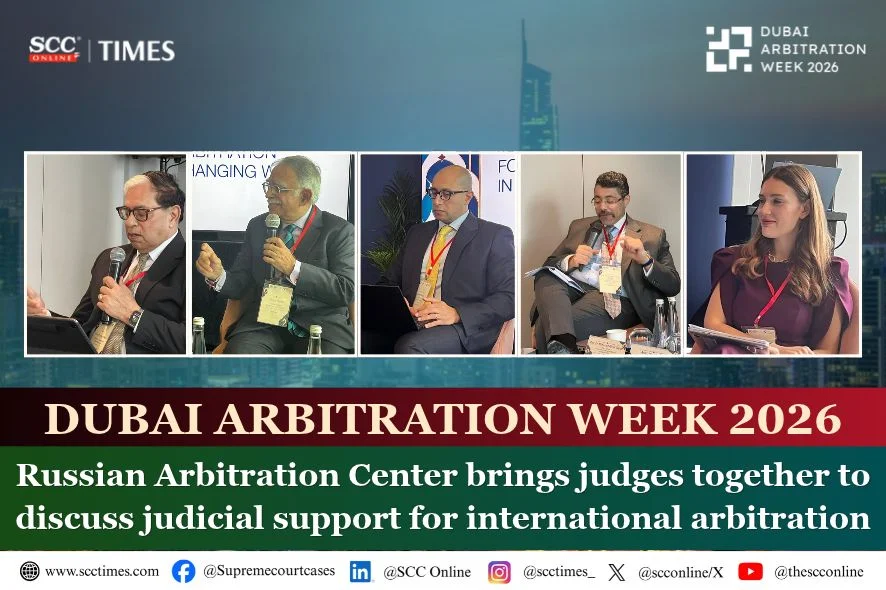
The Russian Arbitration Center (RAC), as part of Dubai Arbitration Week, hosted its annual panel discussion, “Dialogue with Judges: Judicial Support for Arbitration in a Changing World”, on November 11, 2026. Moderated by Prof. Dr. Mohamed Abdel Wahab, Founding Partner and Head of International Arbitration, Construction and Energy Groups at Zulficar & Partners Law Firm, the discussion brought together Justice Ahmed Bakry, former Judge, Abu Dhabi Judicial Department and Egyptian Judiciary; Justice Arjan Kumar Sikri, Judge, Singapore International Commercial Court (SICC); and Justice Sanjay Karol, former Judge, Supreme Court of India. Valeria Senatorova, CEO of the Russian Arbitration Center, also participated in the opening and institutional discussion.

[In the picture: Prof. Dr. Mohamed Abdel Wahab]
The session provided an opportunity for judges and arbitration practitioners to engage directly on judicial approaches to arbitration and the challenges confronting international dispute resolution. The discussion moved across several interconnected themes, including the characteristics of an arbitration-friendly jurisdiction, judicial scrutiny of arbitration agreements, anti-suit injunctions, parallel proceedings, public policy, enforcement of awards, sanctions and the emergence of international commercial courts.
What makes a jurisdiction arbitration-friendly?
Opening the discussion, Mohamed Abdel Wahab observed that while arbitration practitioners frequently describe jurisdictions as arbitration-friendly, the expression is rarely examined in terms of what it actually entails and where its limits lie. He invited the panellists to identify the features that distinguish an arbitration-friendly court.

[In the picture: Justice Sanjay Karol]
Justice Sanjay Karol identified four essential characteristics: clarity, certainty, patience and speed. He emphasised that litigants and lawyers should be able to understand the judicial philosophy guiding a court and the approach it is likely to adopt.

[In the picture: Justice Arjan Kumar Sikri ]
Justice Arjan Kumar Sikri placed particular emphasis on predictability, consistency in enforcement and judicial restraint. He observed that parties and practitioners should not be left uncertain about how a court will approach an award challenge or enforcement proceedings, particularly where similar circumstances produce different outcomes depending on the bench hearing the matter.
He stressed that courts should support arbitration rather than supervise it. Since parties exercise their autonomy in choosing arbitration and constituting the arbitral tribunal, courts should exercise restraint in interfering with the tribunal’s determination of facts and law. Speedy enforcement was equally important, as parties ultimately seek to realise the benefit of their awards.

[In the picture: Justice Ahmed Bakry]
Justice Ahmed Bakry highlighted specialisation as another defining feature, clarifying that establishing a commercial court does not, by itself, make a jurisdiction specialised. Specialisation depends on the judge behind the institution. A judge familiar with arbitration, preferably with experience as an arbitrator, is better placed to understand the difficulties faced by tribunals and the conduct of parties during proceedings.
He also cautioned against treating predictability as the repetition of established decisions. Courts must continually question their existing understanding and revisit their approaches when commercial realities change.
The role of courts, legislatures and arbitral institutions
The discussion then examined whether arbitration-friendly jurisdictions owe their success primarily to legislation, the judiciary or arbitral institutions.
Justice Bakry identified the judiciary as the most decisive factor. While legislation provides general rules, judges determine how those rules apply to the facts of individual disputes. He illustrated this through the UAE experience following the abolition of the DIFC-LCIA arrangement in 2021. Questions arose about whether arbitration agreements referring to the former institution remained capable of being performed. The Abu Dhabi Commercial Court upheld the validity of such agreements despite the institutional change. He also referred to a similar issue before US courts, where the Fifth Circuit reversed a first-instance decision that had declined to compel arbitration.
His point was that the statutory framework did not necessarily need to change; the outcome depended on how the court interpreted the existing law.
Justice Sikri agreed that judges play a particularly important role, while recognising that the legislature provides the underlying legal framework. Describing the relationship through an analogy, he observed that:
“the legislature builds the vessel, counsel sail it, and courts control the waters.”
He referred to the Indian Supreme Court’s decision in Amazon.Com NV Investment Holdings LLC v. Future Retail Ltd., 2021 SCC OnLine SC 145, which recognized the enforceability of emergency arbitrators’ orders despite the absence of express statutory provisions addressing emergency arbitration. He also referred to a decision of the DIFC Court of Appeal in which the appellate court interpreted its powers broadly to grant freezing relief. These examples, he explained, illustrated how judicial interpretation can fill gaps in the legal framework and support the effective functioning of arbitration
Justice Karol added that the Bar also plays an important role in assisting judges in reaching just conclusions. He referred to the Indian courts’ approach in filling legislative gaps and emphasised that judicial effectiveness depends, in part, on competent assistance from counsel.
The moderator further illustrated the importance of judicial interpretation through the experience of France and Tunisia. He observed that judicial decisions helped establish Paris as an arbitration hub before the 2011 French arbitration legislation codified several of those principles. In contrast, Tunisia had enacted a progressive arbitration law decades earlier, but the jurisdiction did not develop into a comparable arbitration hub without a judiciary that actively supported and elevated its principles.
Judicial scrutiny of arbitration agreements: How much is enough?
The second part of the discussion considered the court’s role when a party approaches a court despite the existence of an arbitration agreement. The central question was how far a court should examine the validity and scope of the agreement before referring the dispute to arbitration.
Justice Karol explained that, under the Indian framework, the court’s examination at the appointment stage under Section 11, Arbitration and Conciliation Act, 1996, is confined to a prima facie assessment of whether an arbitration agreement exists. He compared this to checking whether a person has a ticket to enter a room: the court must establish whether the necessary basis for entry exists, rather than investigate every aspect of how the ticket was obtained.
Questions concerning the validity of the underlying contract, its severability and other merits-related issues should ordinarily be left to the arbitral tribunal. These issues may subsequently be examined through the statutory remedies under Sections 34 and 37. He emphasised that courts should examine the agreement through a limited lens rather than undertake a detailed merits review at the threshold.
Justice Bakry discussed the UAE position under Article 4 of the UAE Arbitration Law, identifying challenges concerning the authority of the person signing an arbitration agreement as a recurring issue.
He explained that the difficulty arises from whether a representative of a company must hold a specific mandate expressly referring to arbitration or whether the authority to enter into the relevant commercial transaction is sufficient. In his view, Article 4 requires the representative’s authority to extend to arbitration, but does not necessarily require the document to expressly name arbitration.
He referred to two Abu Dhabi decisions illustrating the differing approaches. In Case No. 185 of 2026, the court held that a party could not enforce a contract while denying the signatory’s authority to agree to the arbitration clause. In Appeal No. 839 of 2025, however, the court treated the arbitration agreement as independent of the main contract and held that authority to sign a subcontract did not automatically extend to its arbitration clause where the relevant power of attorney did not mention arbitration.
Justice Bakry questioned this approach, observing that the principle of separability, which is intended to preserve the arbitration agreement when the main contract fails, should not become a means of invalidating the arbitration clause in circumstances where a party seeks to rely on the contract while denying the agreed forum for resolving disputes.
Justice Sikri approached the question through two considerations: the timing of judicial intervention and its scope.
Explaining the Indian position, he referred to the 2015 amendments to the Arbitration and Conciliation Act, which reinforced the requirement for courts to undertake only a prima facie examination at the referral stage. Questions concerning the existence or validity of the arbitration agreement, arbitrability and limitation are ordinarily left to the tribunal for final determination. He also highlighted the principle of kompetenz-kompetenz and the statutory objective of minimising judicial interference during arbitral proceedings.
Comparing this with Singapore, Justice Sikri explained that judicial intervention can arise at three stages:
-
Before arbitration: Under Section 6 of the International Arbitration Act, the court undertakes a prima facie examination when considering an application to stay court proceedings in favour of arbitration.
-
During arbitration: Section 10(3) permits a party to approach the High Court within 30 days to challenge a tribunal’s ruling on jurisdiction.
-
After the award: A full-fledged examination may take place when the award is challenged.
He noted that, unlike the Indian position, Singapore’s statutory framework provides an opportunity for judicial determination of a tribunal’s jurisdictional ruling during the arbitral proceedings itself.
Parallel proceedings and anti-suit injunctions
The third theme examined the circumstances in which courts should restrain parallel proceedings, particularly where one party seeks to pursue court litigation despite an existing arbitration agreement.
Justice Sikri explained that anti-suit injunctions involve balancing the principle of comity between courts against the need to prevent multiplicity of proceedings and abuse of process.
Referring to the principles applied by Indian courts, he identified three relevant considerations: whether the defendant is amenable to the court’s personal jurisdiction, whether refusing the injunction would defeat the ends of justice or perpetuate injustice, and the need to respect the comity of courts.
Drawing on his experience at the Singapore International Commercial Court, he also outlined four requirements for granting an anti-suit injunction:
-
The defendant must be amenable to the jurisdiction of the court.
-
Singapore must be the natural forum for the dispute.
-
The foreign proceedings must be vexatious, oppressive or an abuse of process.
-
The injunction must not deprive the respondent of a legitimate juridical advantage.
He clarified that anti-suit injunctions operate against parties, rather than against foreign courts.
Justice Bakry discussed the UAE approach through an example from his judicial experience. In a 2023 payment dispute arising out of a supply contract, the respondent sought to rely on an anti-suit injunction issued by another UAE court to have the proceedings before his court dismissed. He explained that the injunction was addressed to a party and did not automatically bind the onshore court.
He ultimately treated the arbitration agreement itself as decisive under Article 8 of the UAE Arbitration Law, declaring the claim inadmissible and disregarding the injunction.
Justice Bakry identified three principal tools available to onshore courts where an anti-suit injunction is not issued:
-
Inadmissibility under Article 8: Where the dispute falls within an arbitration agreement, the court can declare the relevant claim inadmissible.
-
Bifurcation: Where proceedings involve parties who are not all bound by the arbitration agreement, the court can separate the claims. He referred to a case in which claims under the main contract were held inadmissible because they belonged in arbitration, while tort claims against a consultant and claims against a subcontractor remained before the court.
-
Stay of proceedings: Courts may stay proceedings to avoid conflicting decisions and protect the effectiveness of the arbitral process.
He also described a situation involving an arbitration already underway in which a party subsequently brought a tort claim against the parent company of its opponent before a court, seeking recovery for the same loss already claimed in arbitration. The court proceedings were stayed under Article 104, Civil Procedure Law to avoid conflicting decisions.
The discussion also considered the limits of comity. Justice Sikri referred to circumstances in which courts may decline to grant anti-suit injunctions, including where foreign proceedings involve parties not bound by the arbitration agreement, where an application is made after the foreign proceedings have substantially progressed, or where the subject matter is not arbitrable under the law of the foreign forum.
The moderator questioned whether comity requires reconsideration in a world increasingly divided by geopolitical developments. The exchange highlighted that comity remains relevant where courts of different jurisdictions have concurrent jurisdiction and parallel proceedings risk producing conflicting decisions, although its application cannot be divorced from the wider international context.
Recognition, enforcement, public policy and sanctions
The discussion subsequently turned to the enforcement stage, which the moderator described as the point at which parties ultimately seek to realise the benefit of an arbitral award.
Justice Sikri explained that public policy has historically been treated as an uncertain and difficult concept to define. In India, the broad interpretation adopted in the ONGC v. Saw Pipes Ltd., (2003) 5 SCC 705 decision was followed by legislative intervention in 2015, which narrowed the scope of public policy objections in relation to international commercial arbitration awards.
He also discussed the problem of parties attempting to reopen issues at the enforcement stage after those issues have already been considered by the courts at the seat of arbitration. Referring to recent Indian decisions, he observed that courts have shown greater willingness to respect decisions rendered by the courts at the seat rather than permit a second attempt to raise substantially the same objections under the guise of public policy.
On sanctions, Justice Sikri acknowledged that there was no settled or satisfactory solution to the difficulties arising from the enforcement of awards involving sanctioned parties. Addressing a hypothetical situation involving an award applying US or European sanctions that was subsequently presented for recognition in India, he observed that an Indian court could independently examine whether those third-country sanctions aligned with Indian public policy. He clarified that there was, at the time of the discussion, no corresponding Indian decision directly resolving the issue.
Justice Karol emphasised that Indian courts have adopted a narrow approach to public policy in the enforcement of foreign awards. He identified fraud and judicial unsustainability as grounds relevant to the restricted public policy framework.
He reiterated that the purpose of arbitration is not merely to obtain an award but to secure its enforceability. The ultimate objective, he observed, is for parties to be able to realise the monetary benefit of the award without unnecessary delay.
Referring to a Bombay High Court decision concerning an injunction sought in the context of ongoing arbitration and proceedings in other jurisdictions, he explained that the court had declined to allow an injunction that would interfere with the parties’ agreed arbitral process.
Justice Bakry drew an important distinction between unilateral sanctions imposed by individual states, such as the US and EU measures against Russia, and multilateral sanctions adopted by the UN Security Council.
He explained that unilateral sanctions do not form part of UAE public order unless adopted by the UAE through its own legal instruments. In his view, sanctions do not render a dispute non-arbitrable in the UAE. Rather, their applicability is a matter for the arbitral tribunal to determine on the merits, including in relation to issues such as force majeure.
The distinction becomes relevant at the setting-aside and enforcement stages. Where UN sanctions have been implemented in the UAE, they may engage public order. However, foreign unilateral sanctions cannot, merely by virtue of their existence, constitute grounds for setting aside an award or refusing enforcement in the UAE. He referred to Article 53(2)(b) of the UAE Arbitration Law and Article 3 of the new Civil Transactions Law in explaining the domestic public-order framework.
The moderator then posed a hypothetical question concerning a bilateral judicial recognition and cooperation treaty between two states where one state had imposed sanctions through legislation or judicial decisions. The discussion raised the possible tension between treaty obligations, sanctions and the enforcement of arbitral awards. No definitive resolution was reached, with the exchange highlighting the need for careful examination of the relevant treaty provisions.
Counsel conduct and drafting enforcement-ready awards
The panel also examined what makes an arbitral award vulnerable to challenge and what counsel and arbitrators should bear in mind when preparing for enforcement.
Justice Karol explained that judicial review should remain confined to the material placed before the arbitral tribunal and the findings made by it. Counsel should not be permitted to introduce an entirely new case at the enforcement or challenge stage in an attempt to reopen the dispute.
Justice Sikri identified three recurring defects that can undermine an award:
-
Failure to decide an essential issue raised in the proceedings.
-
Deciding a dispute on a basis on which the parties did not have an opportunity to present their case, raising concerns of due process.
-
Failure to demonstrate the tribunal’s independent application of mind in its reasoning.
Illustrating the third concern, he referred to two arbitration proceedings involving the same respondent, the same contractual clause and the same tribunal chair, but different claims and arguments. In the second award, the tribunal reproduced portions of its earlier reasoning without adequately addressing the different arguments advanced by counsel. The award was subsequently set aside by the SICC, and the decision was upheld by the Singapore Court of Appeal.
The example underscored that an award must reflect the tribunal’s independent consideration of the arguments and evidence in the particular proceedings, rather than rely mechanically on reasoning adopted in another dispute.
Justice Bakry observed that certain practices by counsel, including lengthy submissions, excessive document requests, repeated amendments to pleadings and requests for extensions, can create inefficiencies in proceedings. He explained that courts have procedural tools to address such conduct, including imposing fines on lawyers and parties and obtaining documents directly from relevant entities.
He cited the UAE’s internal electronic communication system, which enabled his court to obtain information from the relevant institution within a week in a case where the court had otherwise been waiting for the party to submit the required material for several months.
The discussion also touched on the importance of raising objections concerning arbitrator bias at the appropriate stage. Justice Sikri explained that, under the Indian approach, a bias objection should ordinarily be raised at the first opportunity and not reserved until enforcement proceedings, except where the relevant circumstances become known subsequently. He similarly referred to the need to raise limitation-related objections at the appropriate stage.
Can international commercial courts complement arbitration?
The panel then considered whether the growing number of international commercial courts reflects a loss of relevance of arbitration or the emergence of complementary mechanisms for resolving international disputes.
Justice Karol rejected the suggestion that arbitration was losing its purpose. However, he cautioned against allowing arbitration to become an elitist mechanism. In his view, arbitration should be accessible beyond a limited group of sophisticated commercial participants and should facilitate effective dispute adjudication at different levels.
Justice Sikri similarly maintained that arbitration was not losing its relevance but acknowledged that reforms were necessary. He identified concerns relating to the time and cost of proceedings, which in certain cases had become prohibitive, as well as allegations of arbitrator bias.
He explained that international commercial courts could complement arbitration by providing an alternative forum, particularly in disputes involving substantial financial stakes, questions of sovereignty and concerns about the perceived neutrality of arbitrators.
He also pointed to the significance of the court structure, including the availability of an appellate remedy, which gives an unsuccessful party an additional opportunity to challenge the outcome. In his assessment, these features could explain why certain parties may prefer international commercial courts in particular categories of disputes.
Justice Bakry shared his experience of heading the bilingual chamber at the Abu Dhabi Judicial Department, where judgments were delivered bilingually and a judge from the United States participated. The arrangement enabled parties who did not speak Arabic to appear before a judge who could understand them and ensured that they felt fully heard.
He described the experience as successful and expressed his hope that similar arrangements would develop in the future, particularly within onshore courts, where he observed that most cases were concentrated.
Artificial intelligence and the future of judicial decision-making
During the audience interaction, the discussion turned to the growing use of artificial intelligence in judicial systems and the risks of allowing AI-generated material to influence judicial reasoning without adequate scrutiny.
Justice Bakry explained that the Abu Dhabi Judicial Department had introduced a secured internal AI system that judges could use in their work. He described its usefulness in preparing procedural material and summarising large volumes of information, while cautioning that summaries themselves can influence decisions if they are incomplete or reflect a particular bias.
He explained that, in his own practice, he used AI towards the end of the process to identify possible mistakes and challenge his reasoning, rather than allowing it to undertake the judicial analysis. He also observed that he continued to spend comparable time preparing judgments because the research, verification and reasoning still had to be undertaken independently.
A participant raised concerns about the risk of judges and arbitrators becoming overly dependent on AI-generated material, particularly where younger professionals might begin treating AI as a source of knowledge rather than a tool requiring critical examination.
Justice Sikri highlighted the problem of AI hallucinations, including instances where judgments had referred to judicial precedents that did not exist. He referred to an incident involving a judgment generated using AI in an Indian tribunal, which contained references to non-existent decisions and was ultimately set aside when the matter reached the Supreme Court of India.
He also noted that the Supreme Court of India had issued guidelines clarifying the permissible use of AI by courts, emphasising that AI should not be relied upon for judicial analysis and conclusions.
Justice Sikri further shared his experience of testing AI against an arbitral award he had previously delivered. When AI produced a different answer on a particular issue, he stood by his original conclusion. He cautioned that AI can sometimes generate answers that reinforce the user’s preferred position, making independent scrutiny essential.
Institutional cooperation and support for courts

[In the picture: Valeria Senatorova]
Valeria Senatorova raised the question of whether arbitral institutions could assist judges dealing with applications for the recognition, enforcement or challenge of arbitral awards, and whether there was scope for closer collaboration between institutions and the judiciary. She asked:
“Is there something institutions can do for the benefit of the judges that are considering the applications for enforcement or challenge? Are there any opportunities for collaboration between institutions and judges?”
Adding to the discussion, Valeria referred to the Russian Arbitration Centre’s practice, under which judges are expected to approach the institution directly when they require assistance or information. She explained that the Centre could provide the required material electronically, even where there was no formal order or established system for doing so. She also observed that arbitral institutions could have a more active presence in the judicial process, although such an approach had not yet been developed or implemented.
The discussion also touched upon the importance of engaging with credible arbitral institutions. Participants referred to experiences of communicating directly with institutions, including DIAC and arbitrateAD, to obtain information requested by courts. The use of internal messaging systems was noted as a convenient means of facilitating such communication, while direct access to institutional representatives was described as a useful way of reducing procedural hurdles.
Conclusion
The discussion at Dialogue with Judges: Judicial Support for Arbitration in a Changing World highlighted the importance of judicial restraint, consistency and effective enforcement in sustaining confidence in international arbitration.
Across the different jurisdictions represented, the panellists returned to a common concern: arbitration-friendly legislation and institutional frameworks must be accompanied by judges who understand arbitration, apply the law consistently and recognise the limits of judicial intervention. At the same time, the discussion acknowledged that arbitration must address practical concerns relating to cost, delay, procedural efficiency and the quality of arbitral awards.
The exchanges on sanctions, public policy, parallel proceedings and artificial intelligence demonstrated how the relationship between arbitration and national courts continues to evolve in response to changing legal and geopolitical circumstances.
Ultimately, the session reinforced that the effectiveness of arbitration depends not only on the tribunal and the institutional framework but also on the courts that support the arbitral process and ensure that awards can be meaningfully enforced.
SCC Times is the Official Information & Documentation Partner for Dubai Arbitration Week 2026. Stay tuned for comprehensive coverage, key insights and highlights from the event!