Disclaimer: This has been reported after the availability of the order of the Court and not on media reports so as to give an accurate report to our readers.
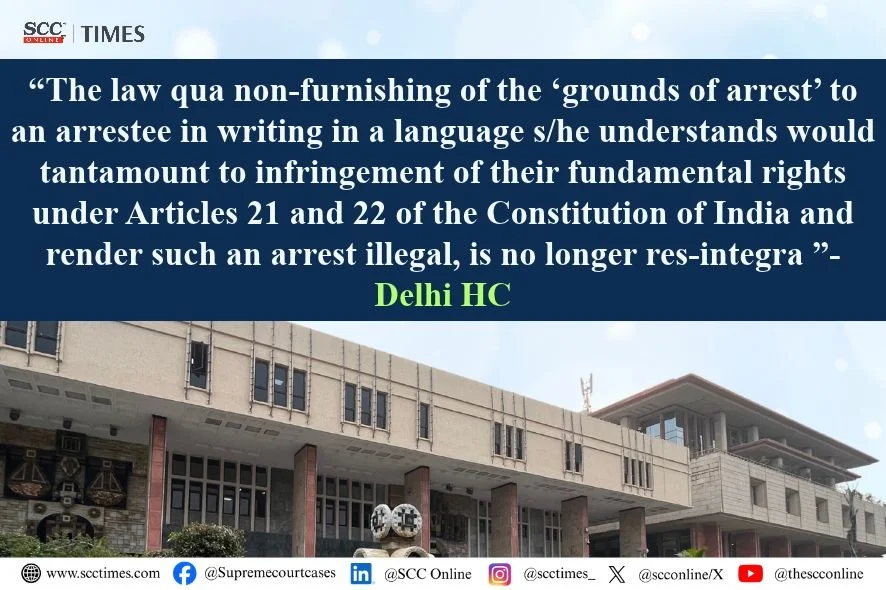
Delhi High Court: In a matter concerning the non-furnishing of grounds of arrest, a Single Judge Bench of Saurabh Banerjee, J., reiterated that failure to furnish the grounds of arrest to an arrestee in writing and in a language understood by them infringes their fundamental rights under Articles 21 and 22 of the Constitution of India and renders the arrest illegal, irrespective of the statute under which the arrest is made. Accordingly, the Court granted regular bail to an accused booked under Sections 363, 366-A, 370, 376, 506, 120-B and 34, Penal Code, 1860 (IPC), Section 6, Protection of Children from Sexual Offences Act, 2012 (POCSO Act), and Sections 3 and 4, Immoral Traffic (Prevention) Act, 1956, after noting that the prosecution had admitted that the grounds of arrest had neither been communicated orally nor furnished in writing to the accused.
Background
The accused sought regular bail under Section 483, Bharatiya Nagarik Suraksha Sanhita, 2023, for offences punishable under Sections 363, 366-A, 370, 376, 506, 120-B and 34 IPC, Section 6, POCSO Act, and Sections 3 and 4, Immoral Traffic (Prevention) Act, 1956. The grounds of arrest had neither been communicated orally nor furnished in writing to the accused. Further, a co-accused, against whom a substantially similar role had been alleged, had already been granted bail by the Delhi High Court.
Arguments
The accused contended that the failure to furnish the grounds of arrest in writing violated the constitutional safeguards under Article 22 of the Constitution. In support of his submissions, he relied on the Supreme Court decisions in Pankaj Bansal v. Union of India, 2023 SCC OnLine SC 1244, Prabir Purkayastha v. State (NCT of Delhi), (2024) 8 SCC 254, Mihir Rajesh Shah v. State of Maharashtra, 2025 SCC OnLine SC 2356, Vihaan Kumar v. State of Haryana, (2025) 5 SCC 799 and Enforcement Directorate v. Subhash Sharma, 2025 SCC OnLine SC 240. He further sought parity with the co-accused, who had already been granted bail by the Court in the same FIR.
Opposing the application, the prosecution admitted that the grounds of arrest had neither been communicated orally nor furnished in writing to the accused. However, citing the gravity of the allegations, he urged the Court to exercise greater care and circumspection before granting bail. He further argued that mere non-furnishing of the grounds of arrest in writing did not ipso facto render the arrest illegal unless it resulted in demonstrable prejudice or deprived the accused of a fair opportunity to defend himself.
Analysis and Decision
The Court noted that the legal position concerning the mandatory communication of grounds of arrest in writing, in a language understood by the arrestee, was no longer res integra. Relying on the Supreme Court decisions in Pankaj Bansal, Prabir Purkayastha, Mihir Rajesh Shah and Vihaan Kumar, the Court reiterated that non-furnishing of grounds of arrest infringes fundamental rights under Articles 21 and 22 and renders the arrest illegal, irrespective of the statute under which the arrest is made.
The Court also took note of its earlier decision in Habibur Molla v. State (Govt. of NCT of Delhi)1, wherein a co-accused in the same FIR, whose alleged role was substantially similar, had been granted bail.
Without separately dealing with the prosecution’s contention that non-furnishing of written grounds of arrest did not automatically render the arrest illegal unless demonstrable prejudice was established, the Court observed that the absence of grounds of arrest in the arrest memo, coupled with the admitted failure to communicate them to the accused, entitled him to regular bail in view of the established legal position.
Accordingly, the Court allowed the bail application and directed the accused’s release on furnishing a personal bond of ₹50,000 along with one surety of the like amount, subject to specified conditions, including restrictions on leaving Delhi without prior permission, cooperation with the investigation, and non-interference with witnesses or evidence. The Court clarified that its observations on the merits were made only for adjudicating the bail application and shall not be construed as expressions on the merits.
[Bhola v. State of NCT of Delhi, Bail Appln. 2434/2026, decided on 9-10-2026]
Advocates who appeared in this case:
For Accused: Mr. Tanishq Sirohi, Mr. Suryansh Vashisth and Ms. Divya Sharma, Advocates.
For Respondents : Mr. Sunil Kumar Gautam, APP, Ms. Anushkaa Arora, Standing Counsel, DHCLSC.
Buy Protection of Children from Sexual Offences Act, 2012 HERE
1. Bail Appln. 3249/2025.