Bombay High Court: In a batch of writ petitions challenging rejection of applications for joint option for pension on higher wages, a Single Judge Bench of Sandeep V. Marne, J. held that trust rules of exempted provident fund establishments cannot defeat right to pension on higher wages under the Employees’ Pension Scheme, 1995 (EPS 1995). The Court set aside the impugned orders of the Employees’ Provident Fund Organisation (EPFO) and directed it to process and allow the petitioners’ joint option applications for higher pension within 8 weeks.
Also Read: Government Expands EPS Eligibility for EPF Members
Background
The petitions were filed by employees and retired employees belonging to various establishments which had, during relevant periods, enjoyed exemption under the Employees’ Provided Fund and Miscellaneous Provisions Act, 1952 (EPF Act). They were members of the EPS 1995. Following the decision of the Supreme Court in EPFO v. Sunil Kumar B., (2023) 12 SCC 701, the petitioners applied for joint option for seeking pension on higher wages under Paras 11(3) and 11(4), EPS 1995. The applications were rejected by EPFO primarily on the ground that the trust deeds or trust rules governing the exempted establishments either restricted employer contribution to the statutory wage ceiling or did not provide for pension contribution on actual wages. In some cases, additional reasons such as non-availability of trust records, Forms 3A and 6A, challans and other supporting documentation were also cited.
The petitioners contended that the issue stood concluded by Sunil Kumar B., wherein the Supreme Court held that an exempted and unexempted establishments stood on a par. It was argued that trust rules operate only in the field of provident fund and have no bearing on employee’s entitlement for pension on higher wages. It was also submitted that trust rules cannot apply once the exemption ceased.
EPFO, on the other hand, submitted that the competent authorities had correctly rejected the applications after duly applying its mind to the available records. It relied upon its Circular dated 14 June 2023 to support the contention that that the regional offices of EPFO need to verify whether employer’s share towards PF contribution is remitted on employee’s pay exceeding the prevalent statutory wage ceiling from the day the pay exceeded the wage ceiling or 16 November 1995, whichever is later till the date of retirement. EPFO further contended that in some cases relevant records had not been produced and in one category of matters the employer had not remitted provident fund contributions on all eligible salary components.
Also Read: EPFO ECR deadline extended to 31 October 2026
Analysis
The Court noted that the EPS 1995 came into effect after an amendment and inclusion under Section 6-A, EPF Act. Rule 11, EPS 1995 originally provide for a ceiling limit of ₹5000 for contributions to the pension fund. Thereafter by way of statutory amendments the limit was increased to ₹6500 and thereafter to ₹15,000. In 2014 an option was introduced under Rule 11 which allowed employers and employees to exercise joint option to avail pension on their higher wages/actual wages by making appropriate contributions as specified. The amendment was later applied with retrospective effect.
The Court relied on Sunil Kumar B., which upheld the validity of the 2014 Amendments to the EPS 1995, including the enhancement of the maximum pensionable salary ceiling to ₹15,000 per month. It was held that an employee who contributed to the provident fund on actual wages exceeding the statutory ceiling, under Para 26(6), EPS 1995, cannot be debarred from exercising the option to contribute on actual higher wages toward the pension fund under Para 11(3). It was further held that the proviso to Para 11(3), as it stood prior to the 2014 Amendment, did not stipulate any cut-off date. Insisting on a rigid cut-off date to reject joint options for higher pension was held to be unjustified, applying the principles established in R.C. Gupta v. EPFO, (2018) 14 SCC 809. It was also held that the requirement under the 2014 Amendment for employees who opt to contribute on salaries exceeding ₹15,000 to make an additional contribution of 1.16 per cent on salary exceeding the ceiling was ultra vires the parent Act. The employees who had retired prior to 1 September 2014 who had exercised the option or were refused the option improperly were granted a fresh window to validate joint options.
The Court noted that the common ground for rejection of joint options made by the petitioners was the non-availment of trust rules of exempted establishment at par with the pension scheme and that the respondents had relied on the Circular dated 18 January 2025, Para 2 whereof directed that the eligibility for pension on higher wages should be determined on the basis of extant trust rules of exempted establishments. The Circular also suggested that applications from trusts whose rules were amended after the Supreme Court’s judgment in Sunil Kumar B. may not be considered.
The Court referred to D. Chandirasegar v. Union of India, 2025 SCC OnLine Mad 5474, where rejection of higher pension claims on the basis of trust rules was disapproved. It was held that trust rules are applicable only to provident fund scheme and that when the statute provides for beneficial scheme of receiving higher pension based on remittance of actual wages, the same cannot be taken away from the employees unless there is statutory bar from claiming the same. It was also observed that even if trust rules prohibited higher contribution to the pension scheme, such provisions would be a contract in violation of statutory provision which would be void in the eyes of the law. Hence, the Circular dated 18 January 2025 was set aside treating it to be violative of Sunil Kumar B.
The Court also referred to Bharath Earth Movers Employees Assn. v. Union of India, 2026 SCC OnLine Kar 9566, where it was held that because the trust rules do not provide for contribution on wages exceeding the ceiling, it cannot defeat the statutory right to exercise joint option recognised under the EPS 1995. The Court also referred to Anuradha Roy v. Union of India, 2025 SCC OnLine Cal 8995, which held that internal provident fund trust rules of exempted establishments cannot override or restrict the statutory provisions of the EPF Act and the EPS 1995, and to Sunil Kumar Mehrotra v. Central Board of Trustee EPFO, 2026 SCC OnLine All 5492, which reaffirmed eligibility for higher pensions based on actual salary contributions.
After examining these decisions, the Court observed that the High Courts across the country had consistently held that it is impermissible to deny the benefit of exercising joint option to contribute to the pension fund in actual wages by citing the trust rules. The Court opined that EPFO’s rejection orders were founded on a premise that had repeatedly been found legally unsustainable and that the Circular dated 18 January 2025 relied upon by the authorities had already been set aside by various High Courts.
The Court further rejected the contention that pending proceedings before the Supreme Court justified withholding relief, observing that the petitioners were retired employees and their claims could not be kept pending indefinitely when several other High Courts across the country have already decided the issue involved in the petitions.
Addressing the objections relating to non-production of records and forms, the Court referred to Kiran Rajaram Jadhav v. EPFO, 2026 SCC OnLine Bom 2221, and Durga Srinivas Kallakuri v. EPFO, 2026 SCC OnLine Bom 2633, wherein it was held that if employer fails to produce record or where records are otherwise not available, alternative means of verification, including giving an opportunity to the employees to be heard should be adopted. Consequently, rejection solely on the ground of non-availability of records was held to be unsustainable.
The Court also found no merit in EPFO’s argument regarding non-remittance of provident fund contribution on all salary components. The Court observed that provident fund contributions exceeding the statutory wage ceiling had in fact been deducted and remitted on basic pay and that EPFO had failed to demonstrate how the cited circulars disentitled the employees concerned from claiming higher pension.
Also Read: Government notifies ₹25,000 wage ceiling under Social Security Code
Decision
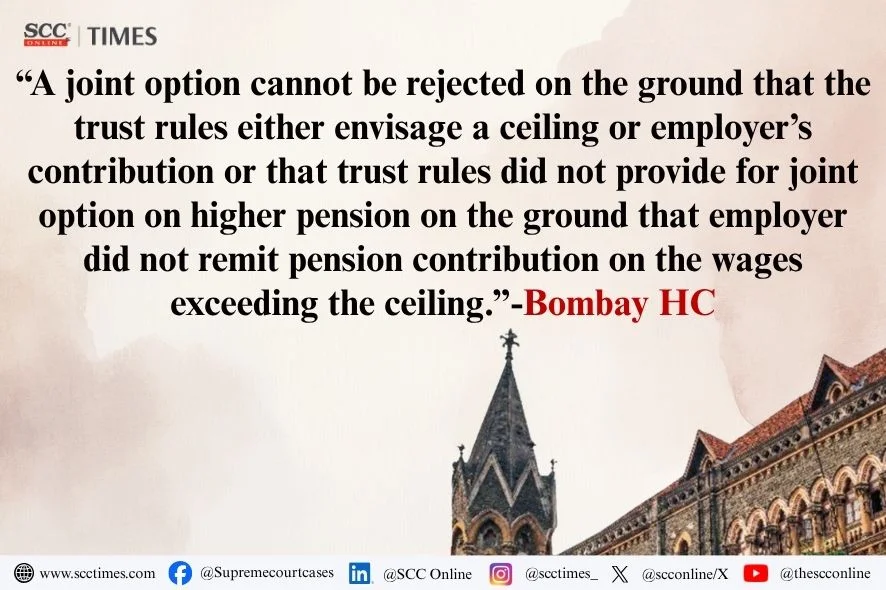
The Court held that rules or deeds of provident fund trusts of an exempted establishment operate only in respect of the provident fund, unless an exemption under Section 17(1)(c), EPF Act read with Para 39, EPS 1995, including joint option, applies to the employees in same manner as the employees of unexempted establishments. Therefore, a joint option cannot be rejected on the ground that the trust rules either envisage a ceiling or employer’s contribution or that trust rules did not provide for joint option on higher pension on the ground that employer did not remit pension contribution on the wages exceeding the ceiling.
Accordingly, the Court set aside the impugned orders passed by EPFO and directed the authorities to process and allow the petitioners’ applications for exercising joint options for pension on higher wages within a period of 8 weeks.
[Amit Gunvantrai Mehta v. EPFO, Writ Petition No. 13752 of 2026, decided on 19-10-2026]
Advocates who appeared in this case:
For the Petitioners: Satyam Surana.
For the Respondent: Payoja Gandhi.