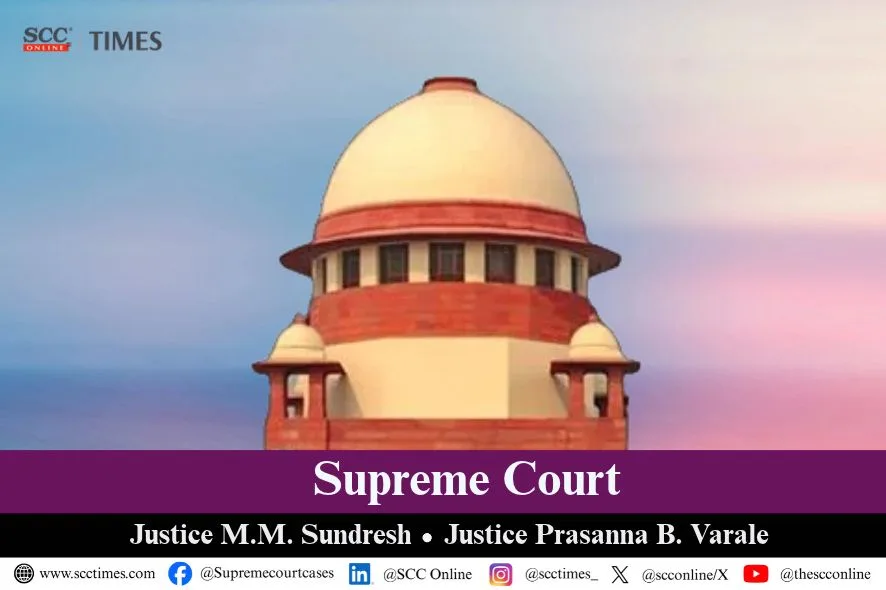
Supreme Court: In an appeal arising from the conviction of persons involved in the brutal crimes committed against Bilkis Bano and her family during the 2002 Gujarat riots, a Division Bench of M.M. Sundresh and Prasanna B. Varale, JJ., considered the appellants’ plea for suspension of sentence and grant of bail pending disposal of their appeal. Taking note of the prolonged period of incarceration, the physical condition of one of the appellants, and the fact that the appeal involved issues requiring consideration on both facts and law, the Court suspended the sentence awarded to the appellants and directed their release on bail, subject to such terms and conditions as may be imposed by the trial court. The Court further directed that the appeal be listed for hearing in its due course.
Background
The case arises from one of the most horrific episodes of violence during the 2002 Gujarat riots. Bilkis Bano, who was pregnant at the time, was gang raped by the convicts. Several members of her family were also subjected to brutal violence. Her mother was gang raped and murdered, and her cousin, who had recently delivered a child, was also gang raped and murdered. The 8 minors, including her cousin’s 2-day-old infant, were killed. Bilkis Bano’s 3-year-old daughter was murdered after her head was smashed against a rock. Her 2 minor brothers, 2 minor sisters, her uncles, aunt, and 3 cousins were among those who lost their lives in the incident.
Following investigation, charges of gang rape, murder, and rioting while armed with deadly weapons and acting with common intention were framed against 12 accused persons, 6 police personnel, and 2 doctors.
Bilkis Bano approached the Supreme Court through a transfer petition seeking transfer of the trial outside Gujarat to a neutral venue. The petition was allowed, and the trial was transferred to Maharashtra. The trial court in Mumbai convicted 11 accused and sentenced them to life imprisonment. It also convicted one police official for deliberately recording the first information report incorrectly. However, the trial court acquitted the remaining 5 police personnel and the 2 doctors against whom serious allegations had been levelled. On appeal, the Bombay High Court overturned those acquittals and convicted the 5 police officials and the 2 doctors by judgment dated 4 May 2017.
After serving over 14 years of imprisonment, one of the convicts approached the Gujarat High Court challenging the non-consideration of his application for premature release under Sections 433 and 433-A, Criminal Procedure Code, 1973 (CrPC). The Gujarat High Court observed that since the trial had been conducted in Maharashtra, the State of Maharashtra would be the “appropriate government” under Section 432(7) CrPC for the purposes of considering remission. Thereafter, both the Special CBI Court and the Gujarat High Court rejected the applications seeking premature release. The other convicts had similarly applied for remission.
Subsequently, one of the convicts filed a writ petition before the Supreme Court seeking a direction to the State of Gujarat to consider his application for premature release under the State’s remission policy dated 9 July 1992, which was in force at the time of the commission of the offence and his conviction. The Supreme Court observed that the applicable policy was the remission policy of 9 July 1992 and held that the convict’s case would be governed by that policy. Pursuant to this direction, the State of Gujarat considered and granted remission to all 11 convicts.
The grant of remission was thereafter challenged before the Supreme Court. In its judgment dated 8 January 2024, emphasising the principles of the Rule of Law and the constitutional limitations on the exercise of remission powers, the Court set aside the remission orders and directed all 11 convicts to surrender before the jail authorities concerned within 2 weeks.
Also Read: Explained| Supreme Court verdict on premature release of 11 convicts in Bilkis Bano gang rape case
Analysis and Decision
The Court noted that the Senior Counsel appearing for the appellants submitted that the appellants had been under incarceration for more than 17 years. It was further contended that one of the appellants had not been named in the FIR and had been implicated after a substantial delay of nearly 3 years from the date of occurrence. It was also brought to the notice of the Court that one of the appellants was severely handicapped. On the other hand, the Additional Solicitor General vehemently opposed the contentions raised on behalf of the appellants, submitting that both the courts below had taken into consideration the relevant material brought on record, particularly having regard to the seriousness of the offences committed.
Having heard the parties and perused the material placed on record, the Court observed that the appellants had been under incarceration for a period of more than 17 years and that one of the appellants was severely handicapped. The Court further noted that there were issues to be decided in the appeal, both on facts and law.
In view of the above and considering the issues involved in the appeal, the Court suspended the sentence and granted bail to the appellants on such terms and conditions as may be imposed by the trial court concerned. The Court further directed that the appeal be listed for hearing in its due course.
[Bipinchand Kanaiyalal Joshi v. State of Gujarat, Special Leave to Appeal (Crl) No(s). 5265-5266 of 2026, decided on 28-10-2026]
Advocates who appeared in this case :
For the Petitioner: Siddharth Luthra, Sr. Adv., Ayush Anand, AOR, Sonia Mathur, Nachiketa Joshi, Ayush Anand, Santosh Kumar, T Bhaskar Gowtham, Pankaj Singhal, Vishal Kumar, Monu Kumar, Shivam Singhania, Sougat Pati, Sai Shashank, Rushika Patil, Nav Prakash Singh Teji, Krishan Kant Kumar, Advocates
For the Respondent: Raja Thakre, A.S.G., Swati Ghildiyal, AOR, Neha Singh, Bharat Bagla, Siddharth Dharmadhikari, Aaditya Aniruddha Pande, AOR, Shrirang B. Varma, Advocates