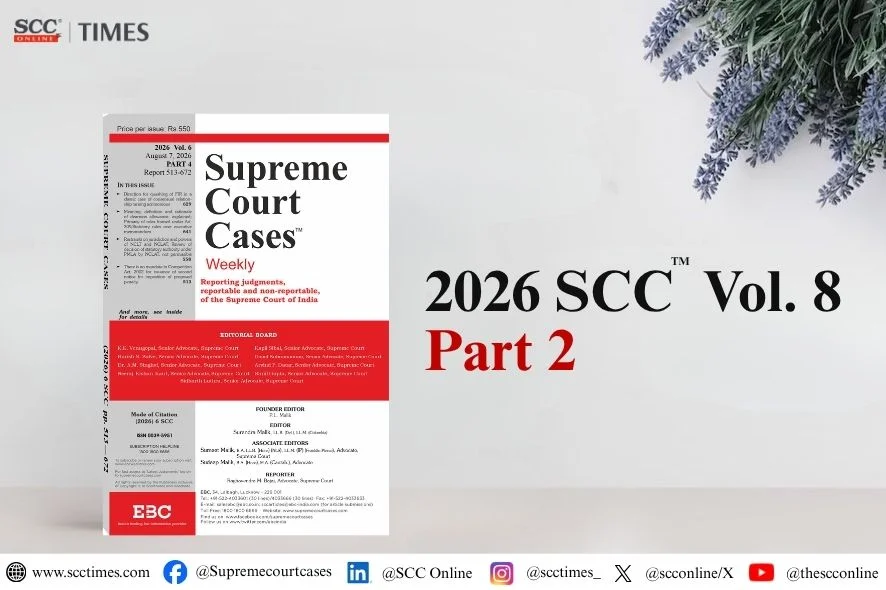
This volume of the Supreme Court Cases (SCC), Part 2 of Volume 8, carries key cases decided by the Supreme Court on issues such as obligation of arresting authority, attack on integrity of judge, illegal sand mining, deficiency in service, and more.
-
Constitution of India — Arts. 22(1) & 21 and Art. 226 — Supply of grounds of arrest at time of arrest — Obligation of arresting authority: Law clarified on scope of extent of detail to be provided by arresting authority while supplying grounds of arrest at the time of arrest, [Kasireddy Upender Reddy v. State of A.P., (2026) 8 SCC 275]
-
Consumer Protection — Services — Banking/Shares/Securities and other Financial Services — Deficiency in service: Failure of Bank to present a cheque within its validity period constitutes “deficiency” in “service” under the Consumer Protection Act, 1986, [Canara Bank v. Kavita Chowdhary, (2026) 8 SCC 163]
-
Contempt of Court — Criminal Contempt — General principles — Scandalise or lower authority of court — Attack on Integrity of Judge: General principles re scandalising or lowering authority of Court, attack on integrity of a Judge and contempt of court, explained, [Nilesh C. Ojha v. High Court of Bombay, (2026) 8 SCC 311]
-
Courts, Tribunals and Judiciary — Judicial Process — Judicial decision/Judicial function/Judicial reasoning — Nature of judicial scrutiny depending on stage at which it is to be exercised: Ex ante and ex post indicates the point at which the State power or judicial scrutiny is exercised. Ex ante, held, means an assessment made before the occurrence of an event, based on anticipation of conduct or harm. Ex post, held, scrutinizes the legality and liability after the relevant act, after the fact. This distinction, held, essential to constitutional safeguards and statutory remedies along with judicial review, [Shephali Chakraborty v. State of W.B., (2026) 8 SCC 192]
-
Criminal Procedure Code, 1973 — S. 439 — Jurisdiction of court under — Scope of: Contours of S. 439, held, do not permit the grant of compensation, [Union of India v. Man Singh Verma, (2026) 8 SCC 303]
-
Criminal Procedure Code, 1973 — Ss. 50(1) and 439 — Bail — Grant of, in offence involving charge of murder, by holding arrest as illegal, because of grounds of arrest being not furnished immediately in writing: Constitutional and statutory framework under Art. 22(1) of the Constitution and S. 50(1) CrPC respectively, held, mandates that the arrested person must be informed of the grounds of arrest. However, neither provision, held, prescribes a specific form or insists upon written communication in every case. Thus, substantial compliance with these requirements, held, sufficient, unless demonstrable prejudice is shown, [State of Karnataka v. Shri Darshan, (2026) 8 SCC 223]
-
Environment Law — Forests, Wildlife and Zoos — Mining and Industry in Forest Area: As rampant illegal sand mining within the bounds of National Chambal Gharial Sanctuary, resulting in severe degradation of critical wildlife habitats, including that of the endangered Gharials, appropriate directions issued to ensure effective compliance with the environmental protection regime and to safeguard the fragile ecosystem in question, [Illegal Sand Mining in the National Chambal Sanctuary & Threat to Endangered Aquatic Wildlife, In re, (2026) 8 SCC 210]
-
Negotiable Instruments Act, 1881 — Ss. 138 and 142(2)(a) (as existing after the enactment of Amendment Act, 2015) and S. 142-A(1) r/w Ss. 46 and 64 — Dishonour of cheque: Law clarified re territorial jurisdiction of courts to try complaint filed under S. 138 NI Act in respect of account payee cheques, [Jai Balaji Industries Ltd. v. HEG Ltd., (2026) 8 SCC 322]