








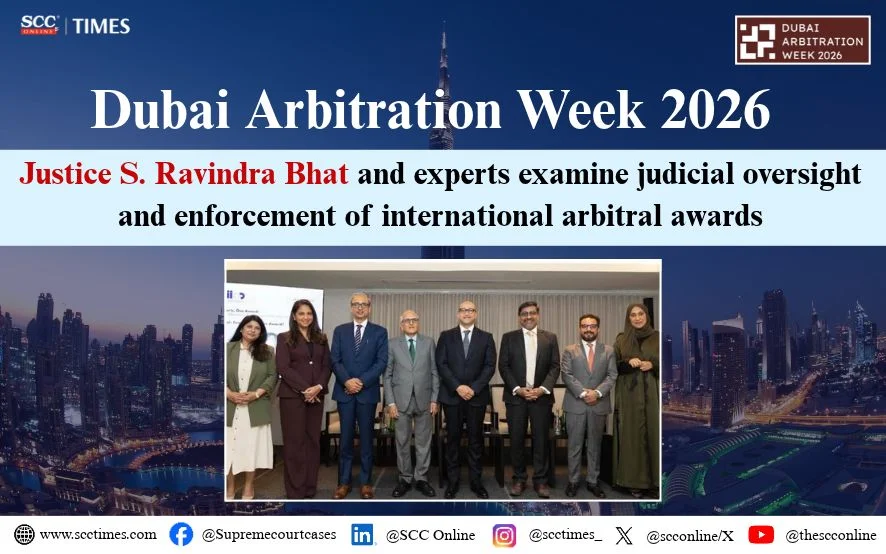
As part of Dubai Arbitration Week 2026, the session titled “Four Courts, One Award: Judicial Perspectives, Cross-Border Advocacy, and The Great Common Law Debate” brought together members of the judiciary and leading arbitration practitioners to examine the evolving relationship between national courts and international arbitration. Held on 12 November 2026, the panel explored the limits of judicial intervention, the interaction between legal traditions, the enforcement of foreign arbitral awards, and the procedural challenges in cross-border disputes.
The discussion was moderated by Mr. Dinesh Pardasani, DSK Legal, and featured:
-
Justice S. Ravindra Bhat, Former Judge, Supreme Court of India;
-
Justice Ahmed Bakry, Former Judge, Abu Dhabi Courts, and Judge, Egypt;
-
Mr. Abraham Vergis SC, Managing Director, Providence Law Asia; and
-
Mr. Sidharth Sethi, Partner, JSA.
Judicial intervention and the foundations of an arbitration-friendly jurisdiction
Opening the discussion, Mr. Pardasani highlighted the central tension in international arbitration between party autonomy, minimal judicial oversight and finality of awards. He observed that judicial intervention becomes particularly complicated in international arbitration, where courts at the seat of arbitration, courts in the parties’ jurisdictions, and enforcement courts may all exercise different forms of jurisdiction.
He identified the need for consistency between these jurisdictions to ensure that the objective of arbitration, namely the final resolution of disputes, is not undermined by repeated litigation before national courts.
The moderator presented two possible approaches to an arbitration-friendly jurisdiction. The first envisaged minimum judicial interference, while the second required courts to ensure that arbitration proceedings did not become oppressive or procedurally unfair to a party. He invited the judicial members of the panel to examine whether courts should refrain from intervention merely because a matter concerns arbitration or should independently examine whether the process satisfies basic standards of justice.
Responding to the question, Justice AhmedBakry observed that neither approach, considered independently, was sufficient. An arbitration-friendly court must apply both approaches at different stages of the proceedings.
Referring to the UAE’s legal position, he discussed a 2025 decision of the Dubai Court of Cassation concerning an application for the appointment of an arbitrator, where one party contended that the arbitration clause had been terminated by a subsequent settlement. The Court examined the arbitration agreement at the preliminary stage, leaving the arbitral tribunal to determine its own jurisdiction. He described this as the principle of the tribunal’s chronological priority in ruling on its jurisdiction.
According to Justice Ahmed Bakry, judicial control does not disappear under this approach but is deferred until the appropriate stage, including proceedings for annulment of an award or applications concerning its recognition and enforcement.
He nevertheless cautioned against interpreting judicial restraint as an abdication of the courts’ responsibility to examine the existence and validity of an arbitration agreement.
He emphasised that where a party had never consented to arbitration, referring the dispute to an arbitral tribunal would not advance the cause of arbitration.
On the question of specialisation, Justice AhmedBakry observed that establishing commercial courts alone did not necessarily ensure specialised adjudication. Specialisation depended on the expertise of the judges hearing the disputes, particularly their understanding of arbitration and, where possible, their experience of having served as arbitrators.
India’s evolving approach to judicial oversight
Justice Bhat traced India’s complicated history with international arbitration, referring to the evolution of its arbitration legislation and judicial interpretation. He noted that earlier interpretations had resulted in the domestic provisions of arbitration law being applied even to foreign awards. This position was subsequently clarified by the Supreme Court in the 2012 decision in Bharat Aluminium Co. v. Kaiser Aluminium Technical Services Inc.1, commonly known as BALCO, which distinguished the domestic and international arbitration frameworks.

Turning to India’s contemporary position, Justice Bhat observed that the expression ‘arbitration-friendly jurisdiction’ had increasingly become part of the legal discourse. He referred to the Supreme Court’s decision in Amazon.com NV Investment Holdings LLC v. Future Retail Ltd.2, which recognised the enforceability of emergency arbitrator awards under the Indian arbitration framework, notwithstanding the absence of an express statutory provision specifically governing emergency arbitration.
He also referred to the decision in MSA Global LLC v. Engineering Projects (India) Ltd.3, involving an international arbitration administered under the ICC Rules, where questions concerning an arbitrator’s disclosure obligations and the fairness of the proceedings led to judicial intervention in India.
Justice Bhat maintained that Indian courts had generally adopted a restrained approach towards intervention in ongoing international arbitrations, although exceptional circumstances could justify judicial intervention.
Addressing the extent of scrutiny in setting aside proceedings, he observed that Indian courts had become increasingly constrained in their examination of arbitral awards. Unless an error was egregious and apparent on the face of the award, courts were generally not expected to undertake an extensive examination of the merits.
He cautioned, however, against allowing the principle of minimal judicial intervention to develop into an absolute rule that could impede the evolution of law.
He raised an important jurisprudential concern: if all disputes were increasingly left to arbitration and courts refrained from examining questions of law, the development of legal principles through judicial adjudication could become stagnant. He observed that concepts relating to damages, technology and emerging legal doctrines required continued judicial engagement.
Justice Bhat also contextualised India’s position by pointing to the institutional challenges faced by its judicial system. With approximately 20,000 courts operating across the country, ensuring a uniform understanding of arbitration principles and public policy remained difficult. Judicial training and the efforts of High Courts were important, but commercial courts themselves faced increasing case backlogs.
He nevertheless acknowledged that India had achieved greater stability in its interpretation of public policy over the preceding decade.
Singapore’s institutional framework and expedited arbitration challenges
Comparing the Indian and Singaporean approaches, Mr. Mr. Pardasani invited Mr. Vergis to explain whether Singapore’s limited rate of setting aside arbitral awards reflected an excessively arbitration-friendly judicial approach.
Abraham Vergis SC explained that Singapore’s approach was shaped not merely by judicial restraint but also by its institutional framework, particularly the Singapore International Commercial Court (SICC).
He highlighted that arbitration-related applications could be filed directly before the SICC, which forms part of the jurisdiction of the Singapore High Court and is staffed by international judges. The composition of the court allows arbitration-related disputes to be heard by judges with diverse international legal experience.
He further explained that the SICC operated with an internal commitment to dispose of arbitration-related challenges within six to nine months of the filing of an application. This reflected the institutional objective of ensuring that a successful party to a properly conducted arbitration was not deprived of the benefits of its award through prolonged judicial challenges or delays.
He illustrated the point by referring to a matter involving an arbitral award exceeding 50 billion US dollars against a foreign State, in which the court prescribed particularly tight timelines for filing responses.
He also explained that appeals from first-instance decisions were confined to one tier, before the Singapore Court of Appeal. Special appellate sittings could include international judges from the SICC panel. Referring to a recent appeal heard by a five-judge bench, he noted the participation of a former Deputy President of the UK Supreme Court, a former Chief Justice of Australia and the Chief Justice of Singapore.
On the substantive approach to setting aside awards, Abraham Vergis SC rejected the perception that Singapore’s arbitration-friendly position meant that awards were virtually immune from challenge.
He referred to a case involving allegations of copying and pasting material from one arbitral award into another, where the award was set aside, and the decision was upheld on appeal. He explained that Singapore courts were prepared to intervene where there were genuine jurisdictional defects, breaches of natural justice, decisions exceeding the scope of submission to arbitration or failures by tribunals to address fundamental issues submitted for determination.
He emphasised that jurisdiction remained a particularly important consideration. Where a tribunal lacked jurisdiction, the seat court had a responsibility to intervene. Conversely, where the arbitration agreement was valid, and the tribunal had jurisdiction, courts were expected to uphold that determination.
He also cautioned against attempts to disguise substantive dissatisfaction with an arbitral award as procedural or jurisdictional objections.
According to him, many challenges were effectively attempting to secure a review of the merits of the dispute under the guise of procedural irregularities. Singapore courts examined the substance of such objections and declined to entertain challenges that merely reflected a party’s dissatisfaction with the tribunal’s decision.
Transnational issue estoppel and enforcement of foreign awards
The panel subsequently examined the challenges arising when parties seek to re-litigate issues already determined by the courts at the seat of arbitration during subsequent enforcement proceedings in another jurisdiction.
Mr. Pardasani referred to decisions involving the Russian Federation and the enforcement of arbitral awards in Singapore and the United Kingdom. He highlighted the importance of the New York Convention’s objective of facilitating consistent recognition and enforcement of foreign arbitral awards and questioned how national courts could avoid divergent approaches when parties attempted to reopen issues already decided by the seat court.
In response, Abraham Vergis SC explained the distinction between two sets of proceedings arising from the Yukos disputes.
The first concerned the Yukos arbitration award against the Russian Federation, issued in 2014 for approximately 50 billion US dollars. Following prolonged litigation in the Netherlands, the award was ultimately upheld by the Dutch courts. During subsequent enforcement proceedings in Singapore, the Russian Federation sought to re-argue the question of sovereign immunity.
The Singapore courts declined to permit the issue to be re-litigated, having regard to the determinations already made by the Dutch courts. Abraham Vergis SC explained that the Singapore proceedings raised a further question concerning the domestic statutory framework governing sovereign immunity and whether the Singapore courts were required to examine the issue afresh.
The Singapore court adopted an approach under which factual determinations made by the seat court could be accepted, while the question of sovereign immunity was examined by applying those facts to Singapore’s domestic law and public policy.
He also referred to proceedings in the United Kingdom, where the Court of Appeal had held that Russia was precluded from re-arguing the issue through the doctrine of transnational issue estoppel. The subsequent application for leave to appeal to the UK Supreme Court was not allowed.
However, a different outcome emerged in the second set of proceedings, concerning the Yukos Capital arbitration award, which had been confirmed by the Swiss courts.
Abraham Vergis SC explained that the relevant distinction was that Swiss law did not recognise the doctrine of issue estoppel in the same manner. Consequently, the English court declined to apply transnational issue estoppel to prevent the matter from being examined.
He clarified that the different outcomes did not necessarily represent a contradiction between the English courts’ approaches. Rather, the applicability of transnational issue estoppel depended, in significant part, on whether the doctrine was recognised in the jurisdiction of the seat court.
Justice S. Ravindra Bhat added a further dimension by referring to the continuing enforcement disputes arising from the Dallah litigation. He observed that even where the seat court had set aside an award, enforcement proceedings in different jurisdictions could produce divergent outcomes.
Referring to proceedings in the United States, he highlighted the importance of examining sovereign immunity under the applicable domestic statutory framework. He agreed that the existence and recognition of issue estoppel in the jurisdiction of the seat court remained an important preliminary consideration.
Anti-suit and anti-arbitration injunctions: When can non-seat courts intervene?
The discussion then turned to the circumstances in which courts other than the supervisory court at the seat of arbitration could intervene in arbitral proceedings.
Mr. Pardasani referred again to MSA Global LLC, where an arbitration was being conducted in Singapore under the ICC Rules, but proceedings were also initiated before Indian courts concerning an arbitrator’s alleged failure to disclose relevant information. The party had first challenged the arbitrator before the ICC, which rejected the challenge. It also approached the Singapore International Commercial Court (SICC), while simultaneously initiating proceedings before the Indian courts. Although the Indian courts acknowledged that they were not the supervisory courts because the arbitration was seated in Singapore, they intervened on the ground that the eventual award could be enforced in India and that the non-disclosure was oppressive to a party.
Mr. Pardasani observed that, while the supervisory court was ordinarily the court empowered to supervise the arbitration and intervene where necessary, the case raised the question of whether courts in jurisdictions other than the seat could intervene in exceptional circumstances, or whether they should ordinarily defer consideration of such issues until the enforcement stage. He invited the panel to consider whether any recognised exceptions justified intervention by non-supervisory courts, including through anti-suit relief.
Justice S. Ravindra Bhat explained that Indian courts recognised the power to grant anti-suit injunctions but exercised it sparingly in accordance with the principles laid down by the Supreme Court in Modi Entertainment Network v. W.S.G. Cricket Pte. Ltd.4 He noted that anti-arbitration injunctions were similarly exceptional, describing MSA Global as an unusual instance of intervention in an international arbitration.
He emphasised that Indian courts had generally adopted a restrained approach towards interference in arbitration proceedings. Intervention could, however, be warranted where the conduct was egregious and the proceedings were completely contrary to basic notions of natural justice or had become oppressive and vexatious. He reiterated that the scope of judicial interference in arbitration remained minimal.
Referring to the position in the United Kingdom, Justice S. Ravindra Bhat observed that anti-arbitration injunctions had also developed there, but courts had declined to restrain arbitration proceedings in certain cases on grounds of comity. This, he noted, reflected the importance of judicial restraint even where the possibility of intervention was recognised.
Justice Ahmed Bakry explained that the civil law approach in the UAE differed from the common law framework in relation to injunctions and parallel proceedings.
Drawing upon a case he had decided in 2023, he explained that a payment claim arising out of a supply contract had been brought before his court. The respondent relied on an arbitration agreement and an anti-suit injunction obtained from the Abu Dhabi Global Market (ADGM) courts, seeking dismissal of the proceedings.
The question was whether an onshore UAE court was bound by an injunction issued by another court within the UAE. Justice Ahmed Bakry explained that he had held that his court was not bound by the injunction and had declared the claim inadmissible under Article 8 of the UAE Arbitration Law. The arbitration agreement itself provided the basis for the decision, and the injunction added nothing to the outcome.
He identified three principal mechanisms available to courts in the UAE when dealing with such disputes:
-
Inadmissibility under Article 8 of the Arbitration Law: Where a dispute is covered by a valid arbitration agreement, the court may declare the court proceedings inadmissible.
-
Bifurcation of proceedings: Where a dispute involves parties who are not all bound by the same arbitration agreement, the court may separate the claims. For instance, in construction disputes, claims against an employer bound by an arbitration agreement may be separated from claims against consultants or subcontractors who are not parties to that agreement.
-
Stay of proceedings under Article 104 of the Civil Procedure Law: Proceedings may be stayed where their determination depends on an issue already pending before an arbitral tribunal.
He further distinguished between different forms of injunctions and their treatment under UAE law.
On anti-suit injunctions, he observed that onshore courts did not issue such injunctions and were not bound by them. However, arbitral tribunals seated in the UAE could issue anti-suit orders. He referred to Appeal No. 657 of 2025, in which the Dubai Court of Cassation upheld an ICC tribunal’s direction requiring a party to discontinue litigation before national courts.
On anti-arbitration injunctions, he explained that an onshore court could not stop an arbitration merely because court proceedings had been instituted. Article 8 of the Arbitration Law contemplated that court proceedings would not prevent arbitration from commencing, continuing or culminating in an award.
Similarly, an anti-award injunction was not recognised as a remedy under the onshore framework. The appropriate course was an annulment action under Article 56 of the Arbitration Law. Filing such an action did not automatically suspend enforcement, although the court could grant a stay where serious grounds were established.
Arbitrator disclosures, independence and procedural fairness
The panel then examined the obligations of arbitrators to disclose potential conflicts of interest and the circumstances in which non-disclosure could justify judicial intervention.
Mr. Pardasani raised the example of an arbitrator nominated by a party who had previously acted for that same party, approximately four years before the arbitration. The ICC had rejected the challenge to the arbitrator, considering the previous engagement insufficiently material. However, Indian courts had intervened on the basis that the non-disclosure could affect the enforceability of the eventual award.
He invited Abraham Vergis SC to explain how Singapore courts would approach such a challenge.
Abraham Vergis SC observed that Singapore courts generally approached non-disclosure challenges with a degree of scepticism, particularly where they appeared to be attempts to destabilise ongoing arbitration proceedings.
He explained that the central consideration would be the prejudice suffered by the challenging party. Courts would examine the circumstances surrounding the non-disclosure, including whether it was inadvertent and whether it had materially affected the rights of the parties.
He cautioned that counsel raising such objections should be prepared to explain precisely how the alleged non-disclosure had prejudiced their client’s position.
Justice S. Ravindra Bhat broadly agreed with this approach but added that Indian law also required consideration of the applicable disclosure obligations under the IBA Guidelines and their incorporation into the domestic legal framework.
He observed that the timing of the disclosure and the point at which the aggrieved party acquired knowledge could have a bearing on whether the arbitrator’s mandate was affected.
He distinguished such cases from unilateral appointment of arbitrators, where Indian courts had adopted a particularly strict approach. He referred to a series of decisions holding that unilateral appointment could go to the root of the arbitral process and undermine the tribunal’s jurisdiction.
He emphasised that the sanctity of the arbitration process had to be protected, particularly where defects in the appointment procedure affected the fundamental fairness and legitimacy of the proceedings.
Cross-border advocacy: Adapting common law and civil law traditions
Turning to the practical aspects of international arbitration, Mr. Pardasani invited Sidharth Sethi to discuss the differences between common law and civil law approaches to advocacy, particularly in relation to witness examination and cross-examination.

Sidharth Sethi explained that the fundamental distinction lay in who controlled the process of fact-finding.
In common law systems, the process was largely party-driven, with parties leading evidence, preparing witnesses, conducting examination-in-chief and extensively cross-examining opposing witnesses. Civil law systems, by contrast, generally followed a tribunal-driven approach, where judges and arbitrators played a more active role in examining witnesses and establishing facts.
These differences continued to influence international arbitral proceedings, particularly where counsel and tribunal members came from different legal traditions.
He identified the IBA Rules on the Taking of Evidence in International Arbitration as an important framework for bridging these differences. The Rules accommodated party-led witness examination, cross-examination and targeted document production.
The Prague Rules, on the other hand, adopted a more restrictive approach towards document production and witness testimony and encouraged tribunals to consider whether disputes could be resolved entirely on the basis of documentary evidence.
Summarising the distinction, he observed:
“For a counsel coming from a common law jurisdiction, IBA rules are the lingua franca and Prague rules is a dialect worth learning.”
He identified three important considerations for counsel appearing in cross-border disputes:
-
Counsel must understand the procedural framework agreed upon by the parties and the preferences of the arbitral tribunal.
-
They must not assume that extensive cross-examination will necessarily be permitted or considered useful.
-
Cross-examination should be confined to issues that genuinely arise from the arbitration rather than testing every statement made by a witness.
He further cautioned against cross-examining witnesses on matters already established through documentary evidence.
Emphasising the importance of understanding the tribunal’s approach, he stated: “Know your tribunal before you know your witness.”
He explained that a civil law-oriented tribunal might prefer a short, focused cross-examination rather than prolonged questioning. Ultimately, the objective of advocacy was not to import domestic procedural traditions into international arbitration but to adapt to the tribunal and assist it in arriving at the correct factual and legal conclusions.
Abraham Vergis SC endorsed this approach and shared his experience as an arbitrator in a dispute involving a French party, French lawyers and Singapore-based lawyers representing Russian parties.
He explained that the French party had presented its case primarily through documentary memorials, without relying extensively on witness statements to substantiate the documents. This approach differed from the English-style presentation, which generally relied on statements of fact supported by witness evidence.
Anticipating that the opposing party might challenge the absence of testimonial evidence supporting the documents, Abraham Vergis SC directed the claimant to have its witnesses specifically address the relevant issues. The direction helped avoid a procedural objection and ensured that both parties could present their cases on an equal footing.
He emphasised that arbitrators should anticipate differences in procedural expectations and clearly communicate their directions concerning the presentation of evidence and arguments.
Document production and the limits of disclosure
The panel next considered document production, which Mr. Pardasani described as another area where common law and civil law traditions differed considerably.
Sidharth Sethi observed that common law jurisdictions were generally associated with broader discovery, whereas civil law systems tended to favour targeted document production.
He explained that the IBA Rules provided a framework for reconciling these approaches, while the Prague Rules encouraged requests for specific documents to prevent unnecessary and disproportionate disclosure.
He highlighted the utility of Redfern Schedules in international arbitration. These schedules set out the documents sought, the reasons for the request, the opposing party’s response and the tribunal’s decision.
He advised counsel to ensure that document requests were closely connected to the issues in dispute. Requests should identify the relevant subject matter, period and likely custodians, while demonstrating the relevance and materiality of the documents sought.
Similarly, objections to disclosure should be supported by specific grounds, including relevance, materiality, burden and proportionality.
He also cautioned that tribunals could draw adverse inferences where a party failed to produce documents despite being directed to do so. Counsel should distinguish confidentiality concerns from claims of legal privilege and consider appropriate protective measures.
Audience interaction: Equality of arms and procedural imbalances
During the audience interaction, a participant raised concerns about the imbalance that could arise where one party was represented by an experienced international law firm, while the opposing party lacked familiarity with international arbitration procedures, particularly document production.
The participant questioned whether such procedural inequalities could subsequently provide grounds for challenging an arbitral award on the basis that one party had not received a fair opportunity to present its case.
Responding, Sidharth Sethi emphasised that equal opportunity was a fundamental consideration across both common law and civil law systems. The applicable procedural rules and the governing law of the underlying contract would be important in determining which documents were relevant and material.
He acknowledged that concealment or non-production of a document going to the root of the dispute could, in appropriate circumstances, become a ground for challenging an award, particularly where the document had been specifically directed to be produced and could materially affect the outcome.
Another participant observed that even within common law systems, document discovery was expected to remain proportionate and confined to relevant material. He emphasised the importance of an arbitrator establishing procedural expectations at the beginning of the proceedings, particularly where parties came from different legal traditions.
Sidharth Sethi agreed that the procedural framework should be clarified at the outset. He reiterated the importance of the IBA Rules in balancing the competing expectations of parties, including their rights to seek relevant documents and the tribunal’s discretion to direct production or appoint experts where necessary.
Abraham Vergis SC supplemented the discussion by identifying three additional areas where cross-border procedural differences could create difficulties.
First, he highlighted ex parte communications between a party and its party-nominated arbitrator. He referred to an instance where matters discussed within the tribunal appeared subsequently in submissions made by one of the parties, raising questions about the arbitrator’s duties and the understanding of the role of a party-nominated arbitrator.
Second, he identified legal privilege as a significant area of divergence, since different jurisdictions adopted different standards for determining what communications or documents attracted protection. He suggested that privilege should be addressed in the first procedural order, commonly referred to as Procedural Order No. 1 (PO1), so that the parties could agree upon the applicable approach or obtain a determination from the tribunal before the issue became contentious.
Third, he highlighted differences in the permissible extent of witness preparation and the limitations on counsel in preparing witnesses for cross-examination.
He observed that these issues required arbitrators to identify potential procedural conflicts early and establish a common framework for the conduct of proceedings.
Enforcement under the New York Convention and divergent national approaches
In the final audience intervention, a participant raised a question concerning the validity of an arbitration agreement under the New York Convention and whether a decision by an enforcement court refusing recognition of an award on that ground could affect its enforcement in other jurisdictions.
Justice S. Ravindra Bhat distinguished between setting aside an award at the seat of arbitration and refusing its enforcement in a particular jurisdiction.
He explained that, where an award had not been set aside by the supervisory court, enforcement proceedings could produce different outcomes across jurisdictions, depending on the applicable legal framework and the grounds raised.
He illustrated this by referring to circumstances where an arbitration agreement might not appear expressly in the principal contract but could be contained in a supplementary document, or where an agreement to arbitrate could be established through the conduct of the parties, including the submission and defence of claims.
He observed that the absence of an express arbitration clause in the principal contract did not necessarily mean that an arbitration agreement was absent. The circumstances and legal basis on which the enforcement objection was raised would be relevant to determining whether the award could be enforced elsewhere.
Procedural discipline and judicial restraint as the concluding themes
Concluding the discussion, Mr. Pardasani identified minimum judicial interference as a central feature of an arbitration-friendly jurisdiction, observing that consistency in the approach of courts across jurisdictions was necessary to preserve the objectives of international arbitration.
He also underscored the importance of the first procedural order, or PO1, in establishing the framework for the conduct of arbitration proceedings. Issues relating to document production, filing procedures and the presentation of evidence should be addressed at the outset to minimise procedural disagreements during the arbitration.

The discussion highlighted that the effectiveness of international arbitration depends not only on party autonomy and the finality of awards but also on the ability of national courts to exercise judicial oversight without unnecessarily reopening disputes already determined by arbitral tribunals. Equally, practitioners and arbitrators must recognise differences between legal traditions and establish procedural frameworks that ensure fairness, efficiency and consistency in cross-border proceedings.
SCC Times is the Official Information & Documentation Partner for Dubai Arbitration Week 2026. Stay tuned for comprehensive coverage, key insights and highlights from the event!








0 replies