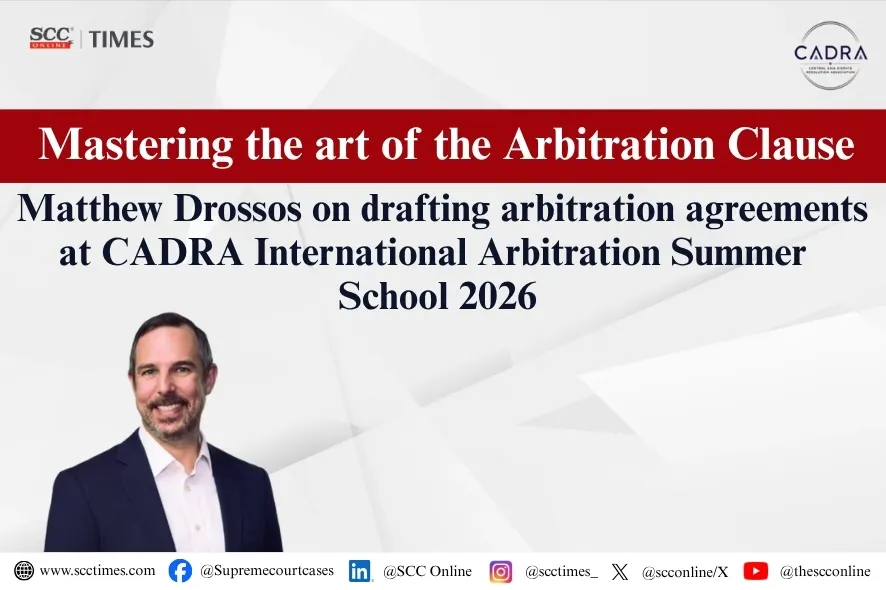
The Central Asia Dispute Resolution Association (CADRA) organized an International Arbitration Summer School, 2026, wherein they conducted several lectures with acclaimed arbitration professionals to provide participants with practical guidance on important aspects of international dispute resolution.
This session titled “Drafting Arbitration Agreements and Choice of Law” was organised on 12 August 2026 and taught by Mr. Matthew Drossos, Partner, White & Case LLP. In this lecture, participants were taught how to effectively draft arbitration clauses and strategically select governing law. Participants explored key considerations in designing enforceable and efficient dispute resolution mechanisms, common drafting pitfalls, and the implications of the choice of law on the conduct and outcome of arbitral proceedings.
Drawing on extensive experience in international arbitration practice, the session examined how carefully drafted arbitration agreements can reduce jurisdictional disputes, enhance procedural efficiency, and provide greater certainty for parties engaged in cross-border transactions.
At the outset, Mr. Matthew Drossos explained the session structure had three core components: first, an examination of the essential elements required to construct a valid arbitration clause; second, an analysis of sample clauses and institutional model language; and third, practical exercises designed to identify and rectify drafting defects.
He began by explaining that apart from the need for a neutral forum, there are other goals of international commercial arbitration, such as efficiency, i.e., minimizing cost and delay, i.e., ensuring enforceability of the award. Herein, party autonomy is central to alternative dispute resolution (ADR) as parties are free to construct their contractual relationship and design their procedure.

What is an ADR clause?
Matthew stated that an ADR clause or dispute resolution clause is an arbitration agreement within a contract. This can be contained in several ways, with the most common one being a specific clause or a specific section in a contractual agreement.
Noting consent and jurisdiction as the foundational principles of ADR, he underscored the fundamental significance of the dispute resolution clause as it forms the basis of the party’s consent to some form of ADR. He quoted Redfern and Hunter on International Arbitration (7th Ed), which said, “The foundation stone of modern international arbitration is consent. Such consent must be reflected by a valid agreement between the parties to submit any disputes to arbitration.”
He emphasized that consent represents the only way that one could go to arbitration or mandatory mediation, and that was what gave the tribunal jurisdiction over the dispute.
Essentials of an Arbitration Agreement/Clause
1. Written Agreement:
Stating that the consent of the parties should be in writing, Matthew stated that the arbitration agreement or clause should be written, as proving oral agreement to arbitrate is incredibly difficult. He traced this requirement to the Convention on the Recognition and Enforcement of Foreign Arbitral Awards (New York Convention), 1958, which mandates that arbitration agreements be evidenced in some written form. While the most common and safest approach is to insert the clause directly into the foundational contract governing the parties’ relationship, the arbitration agreement can be in various forms, such as:
-
A specific clause or section within the contractual agreement
-
A standalone arbitration agreement that is separate from the main contract
-
An exchange of communications (though this creates more issues over establishing consent)
-
Electronic writing
2. Subject Matter Arbitrability:
The subject matter of the dispute must be capable of being settled by arbitration. Matthew explained that while most commercial contracts, whether involving the sale of goods, construction projects, infrastructure development, or financial transactions, are arbitrable, certain categories of disputes are excluded under various legal systems. For example, criminal conduct, i.e., parties cannot agree to settle criminal conduct in arbitration rather than in courts of relevant jurisdiction. Another example was that in the United States, antitrust issues are sometimes arbitrable, sometimes not. This variability underscores the importance of legal due diligence when entering into international contracts.
3. Clear Agreement to Arbitrate:
The third mandatory component is a clear agreement to submit disputes to arbitration. While this requirement sounds straightforward, Matthew cautioned that the manner of drafting can make things unclear. He remarked that in a scenario where the parties disagree, heading towards a dispute and are not willing to come to a middle ground, any little deviation from clear and unequivocal phrasing can raise issues.
4. Substantive Requirements and Defenses:
Beyond the formal requirements, he identified some substantive requirements that must be satisfied for an arbitration agreement to be valid:
-
Free Will: The agreement cannot have been forced or signed under duress.
-
Capacity to contract: Minors cannot agree to arbitrate, and arguments may be raised regarding incapacitation due to drugs, alcohol, or other influences.
-
Legality: An agreement obtained through fraudulent misrepresentation or any other form of illegality is invalid.
5. Other components:
He lastly added that there are other components as well which are not essential or mandatory but can be important at times. This includes the arbitration mechanism, the administrative body, the arbitrator selection, the scope of disputes, the seat and location of hearing, the choice of law, confidentiality and trade secrets, scope of discovery, allocation of fees, and limitations of claims and damages.
Constructing the Clause: Scope, Parties, and Procedural Matters
1. Scope:
Matthew identified two principal approaches to defining the scope of an arbitration clause: broad and narrow.
-
Broad Scope Clauses: Using language like “any and all disputes arising out of or relating to” is a standard language that is intended to encompass anything that could come out of a contractual agreement that is not otherwise restricted by mandatory law. This approach is the safest, as it restricts issues over what type of conflicts can be arbitrated. These can include tort claims.
-
Narrow Scope Clauses: These might limit arbitration to certain issues like the performance, breach, or interpretation of the agreement. The danger with narrow language is that it could exclude some claims that do not actually relate to the decided scope. These can only include contract-based claims.
He suggested that the choice between broad and narrow drafting represents a strategic decision that legal counsel must make with careful attention to the client’s interests and the nature of the commercial relationship.
2. Parties Bound:
Matthew explained that the clarity of who is bound by the arbitration agreement is a critical consideration, particularly in complex transactions involving layered corporate structures. Direct signatories of the contract are bound. This works perfectly in straightforward commercial relationships, for example, in a situation where one company is manufacturing the goods or the widgets, and another company is buying them. However, international commercial transactions increasingly involve layered corporate structures where a special purpose entity is created for a particular commercial transaction. In these scenarios, the signatory may be a subsidiary company, while the actual decision-maker or asset-holder may be a parent company or beneficial owner located elsewhere.
He warned that if the subsidiary companies are signatories, it is harder to include non-signatories. While it is possible to argue before a tribunal that the beneficial owner should be involved due to their exercise of control, the process is more complex. “If you do not have that either clearly laid out in the disputes clause or having them participate as a signatory, you have to go through those extra steps of bringing in a party because the only ones that are clearly and contractually bound are the signatories of a contract.”
3. Rules and Procedures:
Matthew emphasized the importance of making informed choices regarding the procedural framework that will govern any future arbitration. He stated that parties could either make the procedure as and when the issue arises or create a structure beforehand. Though parties could always make rules and procedures later, the risk was that parties become disagreeable and less rational when a dispute arises. Thus, the more clearly and effectively the clause addresses procedural matters upfront, the less likely parties are to engage in costly procedural fights.
This meant that the parties had to consider, while deciding to include ad hoc or institutional arbitration, the number of arbitrators, the seat of the arbitration, and the choice of law governing the arbitration agreement.
Significance of the Arbitration Clause
Matthew underscored that these clauses are drafted by attorneys or business persons themselves with little reference to individuals who are familiar with disputes. Sometimes drafting is done by people who are focused on the business and transactional side of a matter and who want to get the deal done, and they often want to avoid the discussion or negotiation about a dispute. This is why it is essential for attorneys to clearly set out the clause at the drafting stage.
Dispute resolution provisions are drafted hastily at the end of negotiations, often through simple copy-and-paste from previous contracts. These are called the “midnight clause.”
The consequences of this approach are significant, as it later raises several issues about the procedure and content of the clause. Notably, this problem is not confined to small transactions or less sophisticated parties. Thus, poorly drafted arbitration agreements can lead to unwarranted and costly disputes, and defective clauses can cost the entire commercial benefit of the agreement.
Model Arbitration Clauses
To explain how these clauses should be drafted, Matthew shed light on some model arbitration clauses published by major institutions, emphasizing their value in creating robust, defensible dispute resolution provisions. For example, the London Court of International Arbitration’s (LCIA) 2020 Rules provide a detailed arbitration clause that mandates parties to decide the number of arbitrators (1 or 3), the seat or legal place of arbitration (city and/or country), the language to be used in the arbitral proceedings, and which country’s substantive law would govern the contract.
Distinction Between Seat and Venue
Matthew went on to explain the distinction between the legal seat of arbitration and the physical venue where hearings may be conducted.
-
Seat: The former is the legal place where the arbitration proceeds, and the legal place’s national courts have supervisory jurisdiction over the arbitration. Arbitral proceedings can occur outside of the legal seat, and the choice of law does not have to be that of the seat. The law of the seat governs the procedural framework, whereas evidence and discovery rules are governed by soft law.
-
Venue: It is the physical place where the arbitration is conducted, and it may vary based on the parties’ preferences.
He stated that international commercial arbitration is governed by both substantive and procedural law. Substantive law governs the merits of the dispute, whereas procedural law governs the process.
In this regard, he delved into lex arbitri, i.e., the arbitration law in the place of arbitration, and its significance. For example, if the seat of arbitration is in England, then the English Arbitration Act, 1996, will govern the arbitration. He added that though most jurisdictions had now adopted some form of arbitration law, often derived from the UNCITRAL Model Law on International Commercial Arbitration, 1985, there were still some national nuances that should be considered while designating what the seat is versus the substantive law that governs the contract and the interpretation of the contract.
Matthew highlighted that opting for robust jurisdictions with well-developed arbitration infrastructure at the local legal level could save ambiguous or incomplete clauses. Clauses with missing components would be aided by the established jurisprudence of those jurisdictions in a manner that prevents the inability to go to arbitration.
Choice of Law
Underscoring how significant practical implications the choice of law could have, Matthew stated that some common “choice of law” issues are:
-
Substantive law of the underlying contract: Matthew stated that the standard approach was to just state what the substantive law of the contract shall be, for example, English law, Uzbek law, French law, etc. However, the phrasing was important as vague wording could create issues. For example, writing “UK Law” would be problematic because the United Kingdom is made up of multiple jurisdictions. Similarly, in the United States, referencing “U.S. law” could mean federal law, which might differ from individual state laws.
-
Law that applies to the arbitration clause itself: He stated that the law that applies to the arbitration clause could be different from the substantive law governing the contract. Both laws should be separately designated. If a clause simply says “the law governing the contract, the law to be applied is French law,” this could be interpreted as applying to both substantive and procedural matters.
-
Law governing the conduct of the arbitral proceedings
He underscored that if parties have not decided or are conflicted on their choice(s) of law, then they must undertake an analysis. This analysis involves determining what jurisdiction to focus on, where the agreement was made, where it was going to be executed, where it was going to be performed, and different jurisdictions approach this question differently. In complex cross-border transactions, the analysis is rarely straightforward.
Furthermore, if there is no choice of law clause, then the tribunal may decide based on the choice of law analysis or the arbitration rules of the institution, if applicable, such as Article 21 of the International Chamber of Commerce (ICC) Rules of Arbitration, 2021.
Construction of the Tribunal and Procedural Matters
-
Number of Arbitrators: Matthew stated that designating the number of arbitrators is an easy thing to do in the beginning to avoid arguments over how many arbitrators they should have. Typically, model clauses provide for three arbitrators, though for smaller matters, a sole arbitrator may be sufficient. The model clauses generally include language specifying the number, with most adopting three as the default.
-
Appointment Procedures: Beyond specifying the number, parties may wish to include additional details about the appointment process, wherein parties must decide how the arbitrators will be selected, how the president will be decided, etc.
-
Nationality Requirements: Matthew added that nationality requirements represent an important consideration that may need to be expressly included in the clause. In investor-state arbitration under ICSID, the rules require that arbitrators cannot be of the same nationality as the nominating party. However, these requirements are not as commonly seen under the commercial arbitration rules. If the parties want nationality to be a component, then they could include it in the contract.
-
Language of the Arbitration: Language requirements can significantly impact the cost and efficiency of arbitration proceedings, and parties should decide beforehand what language would be a common denominator in international contracts. Matthew suggested that it may be the language of the contract itself, but being clear upfront that you are not arguing about or getting submissions in different languages and then making the tribunal decide how a multilingual arbitration will proceed. While dual-language proceedings are possible, they are expensive because everything must be translated, which increases costs fast.
Optional Components
Matthew identified several optional components that parties may choose to include in their dispute resolution clauses, while cautioning that “the more you put in there, the bigger chance you run of causing some form of an issue.”
-
Confidentiality: He noted that while confidentiality is often seen as a benefit of arbitration, it is not always as clear-cut as saying, yes, arbitration is confidential. There is also a question of maintaining confidentiality versus transparency in certain arbitrations like Investor-State Arbitration. The presence of such nuances requires that parties may put confidentiality needs in writing, especially if confidentiality is important to the case.
Matthew added that while tribunal members are bound by a level of confidentiality where they cannot disclose what they are deciding, their negotiations, and the award, the parties themselves might not be bound by any confidentiality due to lack of clear rules, especially in an ad hoc arbitration. Thus, it was important to consider this while choosing an arbitral institution, as some institutions have general confidentiality provisions and some do not.
-
Escalating Clauses: These are tiered arbitration clauses dealing with multi-party issues and whether you want to join them.
-
Provisions to deal with multi-party issues (joinder, umbrella agreements, consolidation)
-
Renunciation of the right of appeal: Matthew stated that this type of provision is not dealt with by institutional rules, so parties must write them expressly.
-
Interim and conservatory measures
-
Remedies/Cost Allocation: Cost allocation provisions have become increasingly common. Whether or not the parties will agree ahead of time that their legal costs or the costs of the arbitration are going to be borne equally by both sides. They also take away the ability of a tribunal to award costs to one party or the other.
-
Waiver of sovereign immunity: When dealing with state-owned entities, sovereign immunity issues must be addressed. Signing the agreement can certainly give rise to a waiver, an implicit waiver of sovereign immunity, so being expressed saves parties from disputes later.
-
Emergency arbitrator provisions
Separability and Enforceability
Matthew ventured to explain two of the most important aspects of a dispute resolution clause, which are:
-
Separability: It is a legal fiction by which arbitration agreements are presumed to be separable from the contract in which they are found, even if the contract lapses or has been terminated. This provision allows tribunals to determine a contract is invalid and unenforceable without invalidating its authority to make that very determination.
Challenges directed at the arbitration agreement/clause itself may be decided by a court at the outset; but challenges to the contract, as a whole, are a matter for the arbitral tribunal to decide in the first instance.
Matthew added that closely related to separability is the doctrine of Kompetenz-Kompetenz, which is the ability of the tribunal to separate the arbitration agreement and decide its own competence.
-
Enforceability: In most instances when a dispute arises, the parties go straight to arbitration, but there is not always mutual agreement, i.e., preference to litigate, disagreement over scope, etc. Other ways to opt for arbitration are court-initiated like if there is a court order or an anti-suit injunction is granted.
Arbitration agreements are devoid of legal effect if there are common law issues like fraud or duress, and if the arbitration practically cannot take place. Matthew also noted the connection between effective clause construction and enforceability under the New York Convention, the Washington Convention, and local arbitration rules. He stated that the early stages of contract negotiation and drafting are later referenced when one party is losing and wishes to dispute the basis of the agreement itself.
Model Arbitration Agreements
Matthew provided model clauses from several major arbitral institutions, revealing a remarkable convergence in their basic structure. He stated that the UNCITRAL Model Law was an overarching entity that helps guide commercial relationships.
-
International Chamber of Commerce Arbitration Rules, 2021: He stated that the provision has broad language, requires at least one arbitrator, mandates arbitration, and designates the institution and the rules that it will apply.
“All disputes arising out of or in connection with the present contract shall be finally settled under the Rules of Arbitration of the International Chamber of Commerce by one or more arbitrators appointed in accordance with the said Rules.”
-
UNCITRAL Arbitration Rules, 2010: The first three lines are described as “almost parallel” to the ICC example, followed by additional components regarding appointing authority, number of arbitrators, seat of arbitration, and language of proceedings.
“Any dispute, controversy or claim arising out of or relating to this contract, or the breach, termination or invalidity thereof, shall be settled by arbitration in accordance with the UNCITRAL Arbitration Rules. Note. Parties should consider adding: (a) The appointing authority shall be … [name of institution or person]; (b) The number of arbitrators shall be … [one or three]; (c) The place of arbitration shall be … [town and country]; (d) The language to be used in the arbitral proceedings shall be … .”
-
Singapore International Arbitration Centre Model Clause, 2024: He stated that the first sentence was almost identical in all model clauses. The SIAC model clause also includes the possibility to consider questions of validity and existence of the contract.
“Any dispute arising out of or in connection with this contract, including any question regarding its existence, validity or termination, shall be referred to and finally resolved by arbitration administered by the Singapore International Arbitration Centre (“SIAC”) in accordance with the Arbitration Rules of the Singapore International Arbitration Centre (“SIAC Rules”) for the time being in force, which rules are deemed to be incorporated by reference in this clause.
The seat of the arbitration shall be [Singapore].
The Tribunal shall consist of _________________ arbitrator(s).
The language of the arbitration shall be ________________.
The law governing this arbitration agreement shall be _________. “
-
Tashkent International Arbitration Centre Model Arbitration Clause: The language is almost identical to the other arbitral institutions.
“All disputes arising out of or in connection with the present contract, including any question regarding its existence, validity or termination, shall be referred to and finally settled under the Rules of Arbitration of the Tashkent International Arbitration Centre (TIAC) at the Chamber of Commerce and Industry of Uzbekistan. The seat of arbitration shall be […]. The number of arbitrators shall be [please choose one or three]. The language of arbitration shall be […].”
Matthew underscored the importance of designating the institute along with the court where the arbitration will take place to avoid confusion and disputes later.
Mediation and Arbitration Combined: Multi-Tiered Clauses
Matthew stated that there is a significant trend toward tiered arbitration clauses incorporating mandatory mediation, which had several reasons:
-
Growing complaints that the cost and duration of arbitrations have become concerning for users of international arbitration.
-
Mediation is always available to parties, but there is disagreement between parties to opt for it before arbitration. Mediation is treated as negotiation meetings.
-
Rise of specialised mediation centres like the Singapore International Mediation Centre (SIMC) and issuance of mediation rules by arbitration centres such as the ICC and LCIA.
-
A three-tier clause can provide for a round of negotiation, which if unsuccessful, is followed by non-binding mediation, then by binding arbitration. Having this layered structure simplifies the process and increases the probability of reaching an amicable settlement.
He went on to cite examples of such clauses, like the model Arb-Med-Arb or Med-Arb clause issued by SIAC-SIMC. Other institutes like Vietnam International Arbitration Centre, ICC, ICDR, etc., were also publishing samples and versions of these clauses.
Singapore International Mediation Centre
Thereafter, Matthew explored the SIMC, which was established in 2014 by the Chief Justice of Singapore and the Ministry of Law. It was established with the goal of giving Singapore a greater place in the international commercial mediation arena. It works in tandem with SIAC and ICC to provide dispute resolution services.
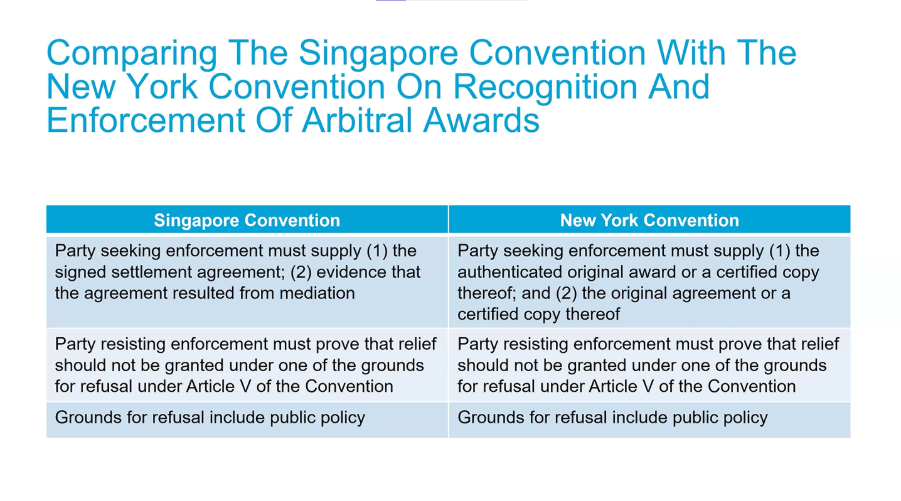
He remarked that the Singapore Convention on Mediation was very similar to the New York Convention, though it only applies to mediation agreements. The convention is meant to provide an international standard for recognition and enforcement of mediation. The settlement agreement reached after mediation under SIMC’s institutional rules is ultimately a contract, and the convention requires State parties to enforce such qualifying settlement agreements. This provides the mediated agreement with similar recognition to that of an arbitration award.
He also noted that countries were increasingly adopting and ratifying the Singapore Mediation Convention. It has influenced the drafting of contracts and the incorporation of mediation as an express form of dispute resolution prior to arbitration, which was unprecedented.
Pathological and Defective Clauses
Matthew stated that there are four essential elements without which an arbitration clause can be pathological:
-
To produce mandatory consequences for the parties
-
To exclude intervention of State courts
-
To give powers to arbitrators to resolve disputes
-
To permit a procedure that can lead to an enforceable award
He then provided a detailed examination of “pathological” or defective arbitration clauses drawn from real contracts, illustrating the practical consequences of drafting errors.
A. Example One: The Ambiguous Alternative
“In the case of dispute, the parties undertake to submit to arbitration, but in the case of litigation, the Tribunal de la Seine should have exclusive jurisdiction.”
Matthew illustrated that the problem here was clear: there is no mandatory language. In fact, there is an alternative that leads to ambiguity about what dispute is going to be pursued in arbitration. If a party decides that they think the Tribunal de la Seine will be more motivated to find in their case, it is a race to start litigation or the arbitration. This is a problem that arises where one party tries to go to arbitration, one has submitted to the Court, and under this clause, if you go to the Court first, it has exclusive jurisdiction, and you cannot arbitrate. This ambiguity leads to the problem.
B. Example Two: The Mediator-Arbitrator Confusion
“In the case of the dispute not being able to be settled, […] both parties agree to try to come to a solution by mediator/arbitrator chosen from the International Court of Arbitration in Paris, France, and acting under the regulations of the International Court of Arbitration in Paris, France.”
He flagged that the “mediator/arbitrator” language creates confusion about whether the parties intended mediation or arbitration. Mediation is very different; a mediator does not decide the dispute. They help parties come to a solution that is contained in a settlement agreement, but an arbitrator is given the power to render a decision.
Additionally, referring to the “International Court of Arbitration” rather than the ICC and its rules creates ambiguity about the applicable rules. The problem is compounded by the fact that parties cannot designate somebody from the court as their arbitrator because then they would be conflicted out of their roles that are done under the ICC in Paris.
C. Example Three: The Named Arbitrator
“Disputes arising in connection with this agreement shall be referred to Mr. Smith-Watson acting as sole arbitrator. The seat of the arbitration shall be London.”
At first glance, this clause appears well-drafted as it uses mandatory wording “shall”, employs broad language “arising in connection with”, designates a seat, and provides for a sole arbitrator. However, Matthew highlighted that the problem lies in designating a specific individual, as:
-
The name may be common, creating ambiguity about which individual is intended.
-
Mr. Smith-Watson may be conflicted if he is affiliated with a law firm representing one of the parties.
-
Mr. Smith-Watson may be deceased or unavailable, rendering the clause impossible to fulfill.
Thus, if the sole appointed arbitrator cannot serve as arbitrator under this clause, parties cannot conform the dispute to the clause and cannot go to arbitration.
D. Example Four: Overly Specific Qualifications
“Unless the parties otherwise agree to the arbitration tribunal, it shall consist of persons with not less than 10 years’ experience of insurance or reinsurance.”
While the qualification requirement may be appropriate for the subject matter, Matthew remarked that the narrower you get, you may run into problems of fulfilling it. He offered a more extreme example: Imagine if this said no less than 10 years’ experience of fuel oil contracts. Maybe there’s plenty of people who do that, but then you would have to find them, and they would have to be not conflicted. Narrowing it down by these arbitrary requirements can really hamper the ability to resolve the dispute.
E. Example Five: The Unrealistic Deadline
“The tribunal shall publish its award within two months of the reference to arbitration.”
Matthew stated that this clause creates an impossible requirement as it is making a mandated procedure of only two months, and that somehow a tribunal will be constituted, a full procedure will be conducted, conforming with due process, and an award can be written all in 60 days.
This creates a fundamental problem: if the requirement is impossible, the agreement cannot be followed, and it is rendered defective. Courts and tribunals are generally reluctant to read down such mandatory language, potentially invalidating the entire agreement.
Conclusion
Thereafter, Matthew engaged with the participants via practical exercises wherein he provided three scenarios and a Q&A session.
The lecture served as a powerful reminder that the clauses themselves are important components of the parties’ agreement. It provided a comprehensive framework for practitioners to navigate this critical aspect of international commercial law, offering both theoretical understanding and practical guidance for the challenges that arise in cross-border transactions.
The session concluded with the observation that the foundation of dispute resolution clauses is a clear, well-drafted, and consensual agreement that reflects the parties’ intentions and anticipates the complexities of future disputes.
“When you are drafting a clause and when you are putting together a contract itself, it shows the importance of being clear. Even though you may be able to go without designating it, doing so alleviates these kinds of problems when you get to the dispute.”