The India Digital ADR Summit 2026, organised by the School of Law, Forensic Justice and Policy Studies, National Forensic Sciences University (NFSU), Gandhinagar, through the International Digital Dispute Resolution Centre (IDDRC), held a panel discussion on “India as a Global Arbitration Hub: Building a Competitive and Technology-Enabled Arbitration Ecosystem” on 12 September 2026, at the NFSU campus in Gandhinagar, Gujarat.
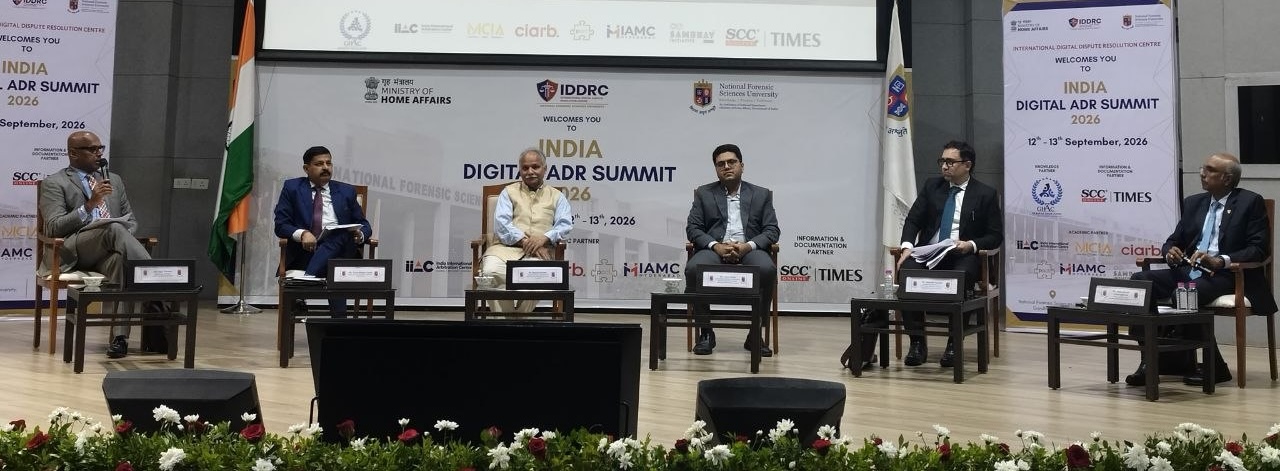
[In the picture from left to right: Mr Ajay Thomas, Mr Navin Kumar Singh, Dr Rajesh Sharma, Mr Arjun Doshi, Mr Saurabh Saraogi and Mr Inbavijayan Veeraraghavan]
The discussion examined the institutional, regulatory, technological and professional changes necessary for India to emerge as a preferred seat for domestic and international arbitration. The panellists considered the importance of trust, institutional arbitration, enforcement, specialised courts, professional training, technology and the need to strengthen India’s domestic arbitration ecosystem before seeking greater international participation.
The panel comprised:
-
Dr Rajesh Sharma, Associate Professor and Director, RMIT Dispute Management Centre, Melbourne, Australia;
-
Mr Navin Kumar Singh, Chief Executive Officer, India International Arbitration Centre, Delhi;
-
Mr Arjun Doshi, International Arbitration Practitioner and Head of Legal, Roads, Metro, Railways and Waterways, Adani;
-
Mr Saurabh Saraogi, Assistant Professor of Law, Birla Institute of Technology and Science, Mumbai, and International Arbitration Expert; and
-
Mr Ajay Thomas, Independent Arbitrator, Alternative Dispute Resolution Consultant and Advocate.
The session was moderated by Mr Inbavijayan Veeraraghavan, Arbitration Practitioner and Managing Partner, KoVe Global LLP.
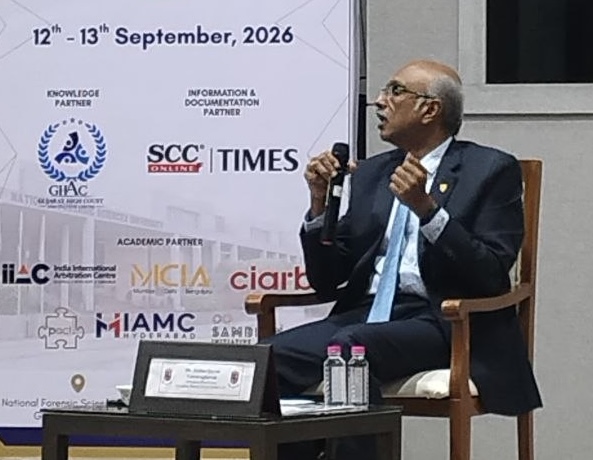
[In picture: Mr Inbavijayan Veeraraghavan]
What makes a jurisdiction an arbitration hub?
Opening the discussion, Mr Ajay Thomas observed that several jurisdictions across the world aspired to become arbitration hubs. Referring to places such as Singapore, Hong Kong and Dubai, he said that the concept of an arbitration hub was closely connected with the confidence that parties placed in a particular jurisdiction.
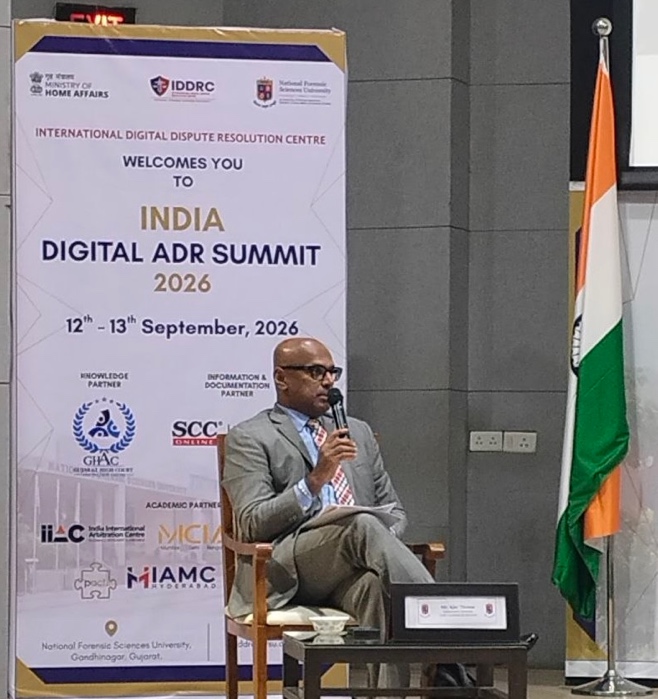
[In picture: Mr Ajay Thomas]
According to him, the choice of an arbitral seat was no longer determined merely by geography. Parties also considered whether they could trust the supervisory courts, the legal system and the overall arbitration environment of that jurisdiction.
He questioned whether India had reached the stage where two parties with no connection to the country would voluntarily choose India as the seat of their arbitration. In his view, India’s immediate priority should be to create a more favourable arbitration environment in which disputes could be resolved in a cost-efficient and time-efficient manner.
Mr Thomas said that India’s aspiration to become a global arbitration hub would have to be supported by a system that parties could trust in practice, rather than merely by legislative ambition.
India has the infrastructure, but perception remains a challenge
Mr Navin Kumar Singh explained that an arbitration hub required a conducive environment supported by appropriate laws, a reliable judiciary, adequate infrastructure and a sound financial ecosystem.

[In picture: Mr Navin Kumar Singh]
He observed that India possessed many of these elements but continued to face a perception problem. According to him, positive developments in Indian arbitration often did not receive the same attention as isolated instances where proceedings or judicial decisions were criticised.
Mr Singh said that the perception surrounding Indian arbitration needed to change through greater awareness, institutional development and consistent implementation of the law. He emphasised that India’s arbitration institutions and practitioners would have to communicate the improvements taking place within the country.
He also cautioned against focusing exclusively on foreign parties coming to India. In his view, Indian parties should first develop confidence in choosing India as the seat of arbitration. The quality of domestic arbitration, the manner in which awards were enforced and the overall experience of parties would eventually influence international perceptions.
Domestic confidence must precede global recognition
Speaking on the meaning of an arbitration hub, Dr Rajesh Sharma said that the concept should be understood in terms of the broader ecosystem surrounding arbitration. A hub, according to him, should provide parties with confidence that disputes could be resolved fairly, efficiently and predictably.
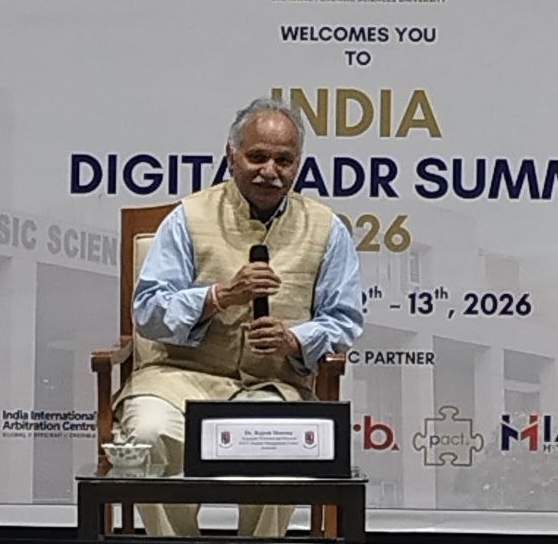
[In picture: Dr Rajesh Sharma]
He observed that improvements in infrastructure and technology had made India more accessible to international users. However, parties still needed clarity about which institution they should approach and where they should conduct arbitration.
Dr Sharma suggested that India should not focus only on attracting international disputes. Domestic disputes should also be resolved effectively within the country so that international users could assess India’s arbitration ecosystem through actual data, institutional performance and enforcement outcomes. He said that the successful resolution of domestic disputes would help demonstrate the strengths of Indian arbitration and gradually build confidence among foreign parties.
“Indianising” international arbitration
Mr Arjun Doshi said that, from an Indian perspective, making India an arbitration hub would involve “Indianising” international arbitration in the best possible sense.
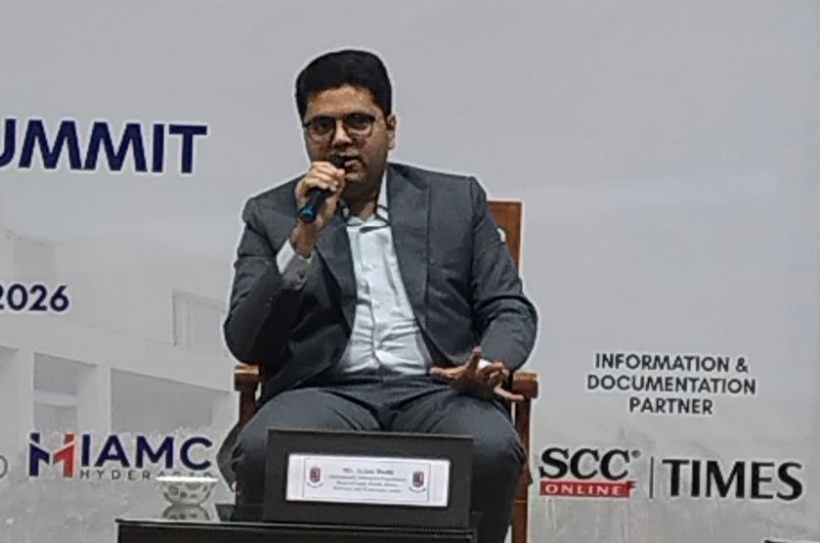
[In picture: Mr Arjun Doshi]
He explained that this would include choosing Indian institutions, Indian arbitrators, Indian governing law and Indian seats wherever appropriate. According to him, the objective should first be to encourage Indian parties to resolve their disputes in India, as several Indian businesses continued to choose seats such as Singapore, London, Germany and France.
“So, from my standpoint, if we have to look at India as the hub of arbitration, it’s basically Indianising the international arbitration in the best sense possible.”
Mr Doshi said that India’s arbitration ecosystem would become stronger when Indian parties began placing greater confidence in domestic institutions and courts. Only after this foundation was established could India effectively seek to attract parties from other jurisdictions.
The arbitration product must offer quality and finality
Mr Saurabh Saraogi observed that the real measure of an arbitration hub was not merely the quality of its legislation but the choices made by sophisticated commercial parties while drafting arbitration clauses.
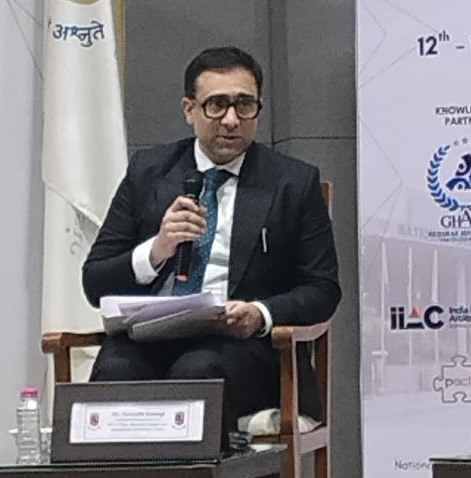
[In picture: Mr Saurabh Saraogi]
He said that India had some of the best arbitration legislation on paper, but the central challenge was credibility and perception. In his view, the arbitration product comprised several interconnected elements, including the institution, arbitrators, seat, technology and finality.
“The real measure of an arbitration hub is not its laws. It’s what the sophisticated commercial party writes in the arbitration clause.”
Mr Saraogi identified several areas that required attention if India was to become a competitive arbitration destination. These included:
-
Moving from legislative reform to effective implementation;
-
Ensuring post-award certainty;
-
Preserving finality while retaining appropriate judicial supervision;
-
Making enforcement more predictable;
-
Making institutional arbitration the default model, particularly for government and large commercial entities;
-
Developing a credible pool of independent and specialised arbitrators;
-
Establishing specialised arbitration courts and seats;
-
Using technology to make arbitration measurably faster;
-
Adopting a governance-based approach to artificial intelligence rather than relying on prohibition; and
-
Encouraging the State to participate more actively in commercial arbitration.
He emphasised that India’s arbitration framework should focus on the actual experience of parties rather than only on the enactment of further amendments.
Trust in the Indian system and the role of institutional arbitration
The moderator raised the concern that Indian parties frequently chose foreign seats, particularly Singapore, despite the legislative and judicial reforms undertaken in India.
Mr Thomas responded that the choice of a seat was largely connected with trust in the supervisory jurisdiction. He said that parties considered whether the courts of a particular jurisdiction would adopt a supportive approach towards arbitration and whether the process would remain efficient and predictable. He acknowledged that India had made considerable progress through the Arbitration and Conciliation Act, 1996 and subsequent amendments. However, he said that these reforms had not yet been sufficient to eliminate concerns about the Indian arbitration system.
Mr Thomas also emphasised the importance of institutional arbitration. He observed that institutional arbitration was frequently praised at conferences, but parties and lawyers did not always incorporate institutional clauses into commercial contracts. He suggested that India should also consider liberalising the legal services sector to give foreign parties greater confidence in India-seated arbitrations, including by allowing them greater freedom in choosing counsel.
Institutional arbitration and professionalisation
Mr Singh disagreed with the suggestion that Indian parties invariably chose foreign seats because they distrusted Indian courts. Drawing from his experience of negotiating commercial agreements, he said that arbitration clauses were often imposed through standard-form contracts prepared by dominant multinational parties.
He explained that Indian companies sometimes had little practical ability to negotiate the seat or institutional rules contained in such agreements. Consequently, the selection of a foreign seat was not always the result of a considered decision that India lacked a reliable arbitration system. Mr Singh said that India had the necessary infrastructure, facilities and pool of professionals, but greater professionalisation was required. He called for arbitration to be treated as a serious, full-time profession, supported by proper training and institutional development. He also emphasised the role of arbitral institutions in educating parties and creating awareness about the benefits of choosing appropriate arbitration clauses and institutions.
Enforcement remains a critical weakness
The discussion then turned to the enforceability of arbitral awards and the difficulties faced by users after an award had been rendered.
Mr Doshi observed that Indian courts had made significant progress in dealing with challenges under Sections 34 and 37, Arbitration and Conciliation Act. He said that courts were increasingly recognising that they were not sitting in appeal over arbitral awards and could not substitute their own interpretation merely because another interpretation was possible.
However, he identified enforcement as a major challenge. According to him, an award had little practical value if the successful party could not obtain the money awarded to it. Mr Doshi also highlighted delays in applications under Section 11, Arbitration and Conciliation Act, stating that in Gujarat such applications could sometimes take more than a year. He explained that the delay in constituting an arbitral tribunal could itself postpone the commencement of arbitration and the eventual award.
He suggested that institutional arbitration could address this difficulty by allowing institutions to make appointments in accordance with their rules, thereby reducing dependence on court-appointed tribunals.
Stamp duty and inconsistent enforcement practices
Mr Doshi further referred to difficulties arising from stamp duty requirements during enforcement proceedings. He stated that different jurisdictions followed different approaches, creating uncertainty for parties seeking to execute awards.
According to him, parties could face delays while determining the stamp duty payable, approaching the relevant authorities and complying with additional requirements. This could result in successful parties spending considerable time identifying a jurisdiction where enforcement was both legally possible and practically effective.
He called for greater uniformity in enforcement procedures across Indian jurisdictions. In his view, inconsistent approaches to stamp duty and execution undermined the certainty that arbitration was intended to provide.
Long delays defeat the purpose of arbitration
Mr Saraogi highlighted the consequences of prolonged litigation following arbitral awards. Referring to his experience with Section 34, Arbitration and Conciliation Act proceedings, he said that some challenges had remained pending for several years and, in certain cases, had continued through multiple stages of litigation. He observed that such delays were inconsistent with the purpose of arbitration as a mechanism intended to provide an efficient and final resolution of disputes.
Mr Saraogi proposed a five-point approach to improve enforceability and reduce unnecessary court intervention:
-
Enforce the statutory one-year disposal period for arbitration-related proceedings;
-
Award actual costs under the applicable provisions of the Arbitration and Conciliation Act;
-
Require parties seeking modification or intervention to identify the relevant portion of the award and the precise basis of their challenge;
-
Allow the same court to handle both the challenge to the award and its execution; and
-
Consider a two-tier arbitral system in which a second look could be undertaken within the arbitral process rather than through prolonged court proceedings.
He stated that several of these measures could be implemented without requiring further legislative amendments.
Simple and clear arbitration clauses
The moderator also raised the issue of why parties did not always adopt model arbitration clauses recommended by arbitral institutions.
Mr Doshi said that many disputes currently before courts arose from older contracts drafted at a time when arbitration practice in India was less developed. Such agreements often contained unclear provisions concerning the seat, venue, governing law or institutional framework. He explained that, in more recent contracts, his organisation had increasingly adopted model clauses recommended by institutions.
In his view, arbitration clauses should be simple and straightforward because excessive detail could create ambiguity and provide opportunities for disputes over interpretation. He said that model clauses made the drafting process easier and reduced the scope for disagreements concerning the institutional framework or seat of arbitration.
Need for institutional and procedural reform
Mr Saraogi emphasised that India’s challenge was not necessarily the absence of legislation but the inconsistent application of existing law. He referred to the problem of multiple rounds of litigation in arbitration matters, including appeals and other proceedings that could substantially delay the final outcome.
He also pointed to the tendency to challenge orders concerning the competence of the arbitral tribunal, despite the principle of competence-competence underlying modern arbitration law. According to him, courts and parties needed to move away from treating arbitration as ordinary civil litigation. The purpose of arbitration would be defeated if every procedural or interim decision resulted in further court proceedings.
Mr Veeraraghavan added that Section 34(4), Arbitration and Conciliation Act already provided an opportunity, in appropriate circumstances, for an arbitral tribunal to address issues identified by the court. He observed that mechanisms allowing the same tribunal to correct or clarify an award could potentially reduce the need for further litigation.
Broadening India’s arbitration ecosystem
Towards the conclusion of the discussion, Dr Sharma said that India’s arbitration ambitions should not be limited to conventional commercial disputes. He suggested that the country should explore specialised areas in which it could develop a distinctive global reputation.
He also reiterated the importance of identifying areas such as intellectual property disputes and examining the scope for resolving such disputes through arbitration or mediation.
Dr Sharma further stressed the need to reconsider established assumptions about where international arbitration should be conducted. He questioned why certain industries continued to prefer traditional seats such as London and suggested that India could develop its own specialised strengths by combining legal expertise, technology, institutional capacity and professional training.
Closing remarks
The panel discussion highlighted that India’s aspiration to become a global arbitration hub would depend not only on legislative reform but also on the practical experience of parties, the credibility of institutions, the quality of arbitrators and the efficiency of courts. The panellists emphasised the need to strengthen domestic confidence in Indian arbitration, promote institutional arbitration, improve the speed of tribunal appointments, ensure uniformity in enforcement practices and develop a professional and specialised arbitration community.
The discussion also underscored that technology could support the arbitration process, but its value would ultimately depend on whether it helped make proceedings faster, more cost-efficient, transparent and reliable. India’s emergence as a competitive arbitration destination would therefore require coordinated progress in law, institutions, professional practice, judicial implementation and enforcement.