Disclaimer: This has been reported after the availability of the order of the Court and not on media reports so as to give an accurate report to our readers.
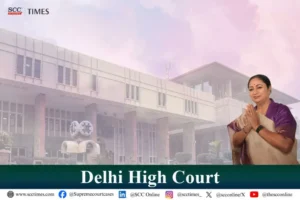
Delhi High Court: In a suit instituted by sitting Chief Minister of National Capital Territory of Delhi, Rekha Gupta, seeking permanent injunction restraining the defendants from publishing, circulating and disseminating defamatory and AI-Generated deep fake contents on social media, damages and take down series of AI-Generated images, videos and posters published from the official and verified accounts of Defendant 1, Aam Aadmi Party, a Single-Judge Bench of Manoj Jain, J., found prima facie case and balance of convenience in favour of the plaintiff as the impugned AI-generated videos and posts had crossed the permissible limits of political satire and constituted defamatory and affected the plaintiff’s dignity. Accordingly, the Court directed the defendants concerned to forthwith take down the offending URLs from X and Facebook.
“Healthy criticism and satirical humour may not raise any eyebrows but AI-generated videos and the posts in question have clearly breached the dividing line as the contents are not only defamatory and offensive but also attack the dignity of a woman, having constitutional authority.”
Emphasising that there is “a thin line between political satire and offensive depiction”, the Court observed that while public office-holders must be prepared to face political criticism and satirical humour, but such freedom cannot be used as a disguise to reduce an individual to “an object of ridicule and insult”.
Factual Matrix
In the instant matter, the plaintiff instituted a suit before the Delhi High Court seeking permanent injunction and damages against the Aam Aadmi Party and other defendants for publishing, circulating and disseminating allegedly defamatory AI-generated images, videos and posters on social media platforms.
The plaintiff also sought removal of a series of allegedly defamatory materials published through the official and verified social media accounts of Defendant 1, Aam Aadmi Party. The impugned content depicted the plaintiff as a liquor vendor, hawker and delivery agent, and as the head of a non-existent scheme titled “Har Har Rekha or Ghar Ghar Theka” Yojana. Certain videos also portrayed her serving liquor to men at night, amidst a brawl and against a romantic soundtrack. Another AI-generated deepfake video depicted the plaintiff along with the Deputy Chief Minister of Delhi, showing them pouring liquor and ice cubes.
The plaintiff contended that the videos and images were highly defamatory, vulgar and offensive, and had the potential to tarnish her personal dignity and moral character. It was further submitted that the content was being widely circulated on social media, generating substantial views, likes, reposts and comments within a short period.
The plaintiff argued that “of course, political bigwigs should have shoulders broad enough to tolerate political humour and satirical criticism”, however the impugned material crossed the permissible limits of political humour and amounted to an offensive portrayal of an individual holding constitutional office. It was further contended that the Court in Raghav Chadha v. Ashok Kumar, 2026 SCC OnLine Del 4838, had ordered take down of explicit contents of some such material, which were found to be profane and vulgar in nature and which fell outside the purview of harmless satirical humour.
Accordingly, the plaintiff sought interim protection under Order 39 Rules 1 and 2 read with Section 151, Civil Procedure Code, 1908, seeking removal of the offending URLs and restraint against further dissemination of the defamatory material.
Issues
-
Whether AI-generated videos and images depicting a public office-holder in a defamatory, vulgar and offensive manner could be protected as permissible political satire under the freedom of speech and expression?
-
Whether the plaintiff had established a prima facie case, balance of convenience and likelihood of irreparable injury warranting an interim injunction under Order 39 Rules 1 and 2 CPC?
Analysis
The Court acknowledged that in a free democratic nation, freedom of speech and expression necessarily encompasses political criticism and satire. Political leaders, particularly those holding public office, must have sufficiently broad shoulders to tolerate criticism, including satirical comments from the public and members of rival political parties.
However, the Court emphasised that there is “a thin line between political satire and offensive depiction”. While the Court may refrain from interfering in matters involving mere humour or satire, an attack upon an individual’s dignity, where the person is tarnished and ridiculed, calls for appropriate judicial intervention.
The Court observed that holding public office automatically invites greater scrutiny, but the dignity of an individual cannot be compromised. It categorically observed that “satire may though hurt conscience of any individual but it cannot be permitted to create irreparable wound on someone’s dignity”.
The Court further held that freedom of speech and expression cannot be used as a disguise to reduce an individual to “an object of ridicule and insult”. Even though modern technology makes the possibilities of depiction limitless, the responsibility for creating and publishing such content remains within human control. Therefore, legitimate boundaries ought not to be transgressed.
Upon examining the allegedly defamatory contents, marked D-1 to D-4, available on the X (formerly Twitter) and Facebook accounts of Defendant 1, the Court noted that the AI-generated videos and images portrayed the plaintiff in a demeaning manner. The video-images appeared so real that they constituted a near-perfect imitation.
The Court observed that the impugned material gave the impression that the plaintiff herself was a liquor vendor, thereby having the evident potential to tarnish her personal dignity and moral character, not merely as a Chief Minister but also as a woman.
The Court distinguished legitimate political criticism from offensive personal portrayal. It recognised that every political party is entitled to criticise governmental policies, decisions and administrative actions. However, the offensive portrayal of a Chief Minister through AI-generated videos, under the garb of expressing disapproval of governmental policy, could not be treated as permissible political satire.
Placing reliance on Raghav Chadha, the Court reiterated that the use of AI on social media platforms for expressing opinions, particularly in the political context, requires judicial scrutiny when a grievance is raised regarding infringement of fundamental rights relating to dignity. In the absence of appropriate stringent legislative regulation of such content, it becomes the judicial duty to examine whether the use of AI has crossed the threshold of infringing an individual’s fundamental rights.
The Court asserted that healthy criticism and satirical humour may not raise any eyebrows, but the AI-generated videos and posts in the present case had clearly breached the dividing line, as they were not merely defamatory and offensive but also attacked the dignity of a woman holding constitutional authority.
On the question of interim relief, the Court found that the plaintiff had successfully established a prima facie case. The balance of convenience was also held to be in her favour, particularly considering the speed at which such content travels through social media platforms. The Court was satisfied that continued circulation of the impugned material could cause irreparable injury to the plaintiff’s dignity.
Decision
The Court held that the impugned AI-generated videos and posts had crossed the permissible limits of political satire and constituted defamatory and offensive material affecting the plaintiff’s dignity.
Finding a prima facie case and balance of convenience in favour of the plaintiff, the Court directed Defendants 3, 4 and 5 to take down offending URLs, comprising 5 posts/videos on X and 1 video on Facebook, forthwith.
The Court also directed compliance with Order 39 Rule 3 CPC and issued summons to all defendants through permissible modes. The defendants were directed to file their written statements within 30 days from receipt of summons, along with affidavits of admission and denial of the plaintiff’s documents.
The Court directed the matter was to be listed on 4 December 2026 for further consideration.
[Rekha Gupta v. Aam Aadmi Party, CS(OS) 1019/2026 & I.A. 31139-31145/2026, decided on 6-11-2026]
Advocates who appeared in this case :
For the Plaintiff: Mr. Sameer Rohatgi, Mr. Nikhil Kohli, Mrs. Ritika Gambhir Kohli, Mr. Tushar Mudgil, Mr. Kushank Garg, Mr. Anwar Shad, Mr. Samarth Kapoor, Mr. Namit Suri, Ms. Tanya Sharma, Ms. Pepakayala Geetanjali and Mr. Anish Singh, Advs.