Non-furnishing of grounds of arrest violates Articles 21 and 22: Delhi High Court grants bail in POCSO case
The Court held that, on the admitted lapse and the bail already granted to a co-accused, regular bail was warranted.

Bringing you the Best Analytical Legal News


The Court held that, on the admitted lapse and the bail already granted to a co-accused, regular bail was warranted.
The Court held that High Court had failed to adequately consider the gravity of the allegations, criminal antecedents, apprehension of witness intimidation, influence of the principal accused and the wider impact upon the medical fraternity.

The Court asserted that continued incarceration of the applicants had to be balanced against their fundamental right to life and personal liberty guaranteed under Article 21 of the Constitution.

Weighing a year in custody against the seriousness of the allegations, the Meghalaya High Court granted bail with strict conditions, including a complete prohibition on contact with the survivor.

The Supreme Court, by order dated 9 May 2014 in Subrata Chattoraj v. Union of India, (2014) 8 SCC 795, had directed the transfer of investigation into the Saradha Chit Fund Scam and other chit fund cases from the State Police to the CBI.
The Court grants bail to the accused amid prolonged incarceration, defective investigation and uncertain identification of the accused.

Supreme Court granted bail the appellant, who was alleged to be an attesting witness to a forged Power of Attorney and subsequent sale deeds, after over 11 months of incarceration.
The Court held that absence of external injuries or pending forensic reports cannot, by themselves, justify grant of bail if the trial court had overlooked material circumstances bearing upon the gravity of the offence and the vulnerability of the victim.
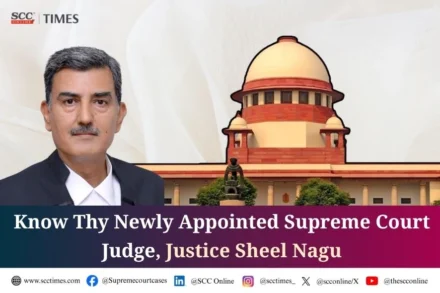
Know Thy Newly Appointed Supreme Court Judge, Justice Sheel Nagu
Justice Sheel Nagu’s elevation to the Supreme Court on 2 June 2026 marks a significant milestone in an illustrious legal and judicial journey spanning nearly four decades.
Manisha Waghmare was arrested by the CBI on 14 May 2026 for her alleged involvement in the paper leak conspiracy.

The Supreme Court set aside bail granted to 3 accused in a hospital murder case, holding that the High Court failed to consider their specific roles and serious criminal antecedents. The Court reiterated that custody period and delay in trial cannot alone justify bail in heinous offences involving armed mob violence.

May 2026 was a landmark month for Indian constitutional law. The Supreme Court upheld electoral integrity, extended protection to trafficking survivors, reformed bail jurisprudence, advanced gender equality in matrimonial law, and settled long-contested questions in arbitration, IBC, and property law
Prima facie, it appears to be a case of civil liability where husband purchased the car in his wife’s name, did not pay cost thereof and subsequently, when the car was returned, the civil suit filed by the complainant de facto was withdrawn.
Upon comparing the allegations against the appellant with those against other co-accused who were granted bail by Supreme Court, the Delhi High Court concluded that there was “no major distinction” between their respective roles.
In the instant case, the petitioner was in jail for almost 4 years, but not a single witness was examined.
“The most invaluable gift that the people of India gave unto themselves through the Constitution was the vision of a casteless society founded upon the principle of substantive equality.”
“The contention that the marriage could not take place due to non-matching of kundalis appears inconsistent with his own conduct and representations made over the years. If the issue of kundali matching was indeed of such determinative importance for the applicant and his family, the same should have been resolved at the threshold before entering into physical relations.”
“Article 32 of the Indian Constitution is deemed to be “heart and soul” of the Constitution as it empowers any citizen to directly approach the Supreme Court for the enforcement of fundamental rights.”
“Custodial interrogation of the accused/applicant is necessary in order to unearth if more children in similar fashion have been trafficked by the accused/applicant for being used in commission of crimes.”
“The proper course is to proceed with the appeal on merits, ensuring representation, while securing presence only in accordance with law upon dismissal or as otherwise required.”