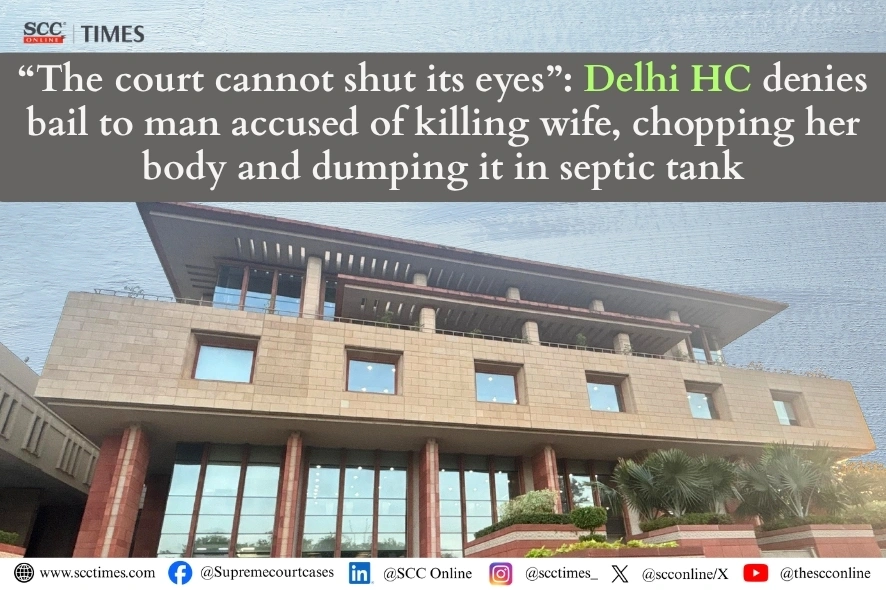
Delhi High Court: In a bail application filed by a husband seeking regular bail in connection with the alleged murder of his wife, followed by the chopping of her body and disposal of the remains in a septic tank, a Single Judge Bench of Girish Kathpalia, J. held that delay in trial, although a relevant consideration for grant of bail, cannot be considered in isolation and is not by itself sufficient to warrant the release of an accused. While exercising its discretion in a bail application, the Court is required to consider the overall circumstances of the case, including the gravity and nature of the alleged offence. Therefore, considering the serious and gruesome circumstances of the alleged offence, together with the other circumstances relied upon by the prosecution, the Court found that the accused had not made out a fit case for grant of bail. Accordingly, the bail application was dismissed.
Background
The prosecution case was that on 22 February 2019, the accused allegedly went to the police station and stated that he had killed his wife, chopped her body into pieces and thereafter disposed of the body parts in a septic tank. While the accused was being interrogated at the police station, a PCR call was received from the brother of the deceased stating that she had been killed and that her body had been recovered from the septic tank.
Based on the statement of the deceased’s brother, the FIR was registered for offences punishable under Sections 302, 201 and 34, Penal Code, 1860 (IPC). The complainant alleged that the deceased had been subjected to torture and dowry demands by the accused and his family members because she had given birth to 3 daughters.
The prosecution further alleged that the accused had subsequently called the mother of the deceased and informed her that he had murdered his wife. The mother did not take the statement seriously at that time. On the following day, when the brother of the deceased visited the accused’s house, he allegedly noticed bloodstains and found the deceased’s body in the septic tank.
The State also relied upon the alleged recovery of the bloodstained weapon used for chopping the deceased’s body, as well as her clothes, jewellery and other articles. These materials had been subjected to forensic examination.
Contentions of the Accused
The accused sought bail primarily on 3 grounds.
First, it was argued that there were material contradictions in the testimonies of the mother and brother of the deceased and that these contradictions weakened the prosecution case.
Second, the accused contended that he had never gone to the police station to confess to the murder and that the investigating agency had wrongly projected such a circumstance against him. However, the accused fairly acknowledged that this particular contention had not been recorded in earlier bail orders.
Third, it was argued that the accused had remained in custody for a considerable period and that the trial was progressing at a slow pace. On this basis, it was submitted that continued incarceration was unjustified and that the applicant should be released on bail.
Contentions of the State
The State submitted that the trial was not proceeding at an unduly slow pace and that the allegations against the applicant were extremely serious.
It was further submitted that the prosecution had recovered the bloodstained weapon allegedly used to chop the deceased’s body, along with her clothes, jewellery and other articles. These materials had also been subjected to forensic examinations.
The State therefore argued that, considering the nature and gravity of the allegations and the material collected during investigation, the applicant did not deserve the discretionary relief of bail.
Analysis and Decision
The Court considered the rival submissions and declined to grant bail. The Court noted that the accused had relied upon alleged contradictions in the testimonies of the mother and brother of the deceased. However, the Court observed that, while considering a bail application, it was not required to undertake a minute or microscopic analysis of the evidence on record. Accordingly, the alleged contradictions could not, at this stage, be treated as sufficient grounds for granting bail.
The Court further noted the contention of the accused that he had never visited the police station to confess to the murder and that the investigating agency had wrongly projected such a circumstance against him. However, the Court observed that the accused had fairly admitted that no such contention had been recorded on his behalf in previous bail orders. In these circumstances, the Court did not find the said contention sufficient to warrant the grant of bail.
The Court acknowledged that delay in trial is a relevant consideration in an application for bail. However, it clarified that delay cannot be considered in isolation and is not, by itself, sufficient to warrant the grant of bail.
The Court also gave due weight to the gravity and circumstances of the alleged offence. It observed that the nature of the allegations was particularly serious and that the circumstances surrounding the alleged offence could not be ignored while exercising discretion in favour of the accused.
“While considering grant or denial of bail, the court cannot shut its eyes to the gruesome manner in which a lady was killed followed by chopping off her body and throwing her in the septic tank.”
Considering the overall circumstances of the case, the Court held that it was not a fit case for grant of regular bail. Accordingly, the bail application was dismissed.
[Ashu Pal v. State (NCT of Delhi), 2026 SCC OnLine Del 6410, decided on 20-8-2026]
Advocates who appeared in this case:
For Petitioner: Raghav Sharma and Vishvendra Singh, Advocates.
For Respondents: Sanjeev Sabharwal, APP for State with Investigating Officer/Inspector Amit Kumar.