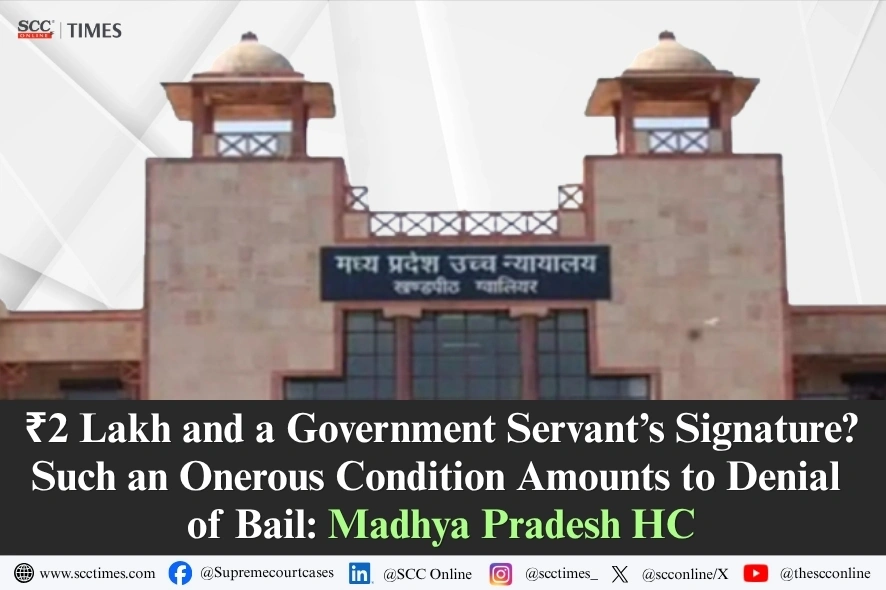
Madhya Pradesh High Court: In a writ petition filed in the nature of habeas corpus for members detained under Section 170, Nagarik Suraksha Sanhita, 2023 (BNSS) with an onerous condition of release on bail that apart from the bail bonds under Section 130 BNSS and surety, a government servant must also furnish the bail of the detenus, due to the detenus’ previous conduct of violent protests, a Division Bench comprising Subodh Abhyankar* and Alok Awasthi, JJ., held that such condition imposed upon detenus amounts to denial of bail and stated that the grant of bail subject to onerous conditions, is ordinarily done in exceptional circumstances and cannot be done as a matter of course, directing that the detenus be released on bail upon furnishing a personal bond in the sum of ₹50,000 each with 1 solvent surety each.
Background
The petitioner, a member of the National Educated Youth Union (NEYU), registered under the provisions of Madhya Pradesh Society Registrikaran Adhiniyam, 1973, filed this writ petition in the nature of habeas corpus for members detained at the instance of the Assistant Commissioner of Police (ACP). The members proposed a peaceful protest, scheduled to be held on 23 July 2026, and sought permission to organise procession in support of the students and show solidarity with the students who were protesting for their demands at Jantar Mantar at New Delhi. A representation was made to ACP Zone 4 which was sent to the police station concerned from where the procession was to proceed.
But instead of granting permission, the members were detained under Section 170 BNSS with a condition of release, the condition being that apart from the bail bonds and surety, a government servant must also furnish the bail of the detenus, to be released on bail, mentioned in the order passed by ACP dated 23 July 2026.
The ACP’s original order dated 23 July 2026 had required the detenus to furnish a surety of ₹1,00,000 and a bond of ₹1,00,000 each (₹2,00,000 in total), in addition to the government-servant condition, failing which they would be sent to jail.
The respondents contended that there is no case for interference by the Court as the petitioner has other remedy against the order passed under Section 170 BNSS and that it was the discretion of the ACP to pass the order and the conditions were imposed taking into account the previous conduct of the detenus in the year 2024, wherein they tried to disturb peace by violent protests. Thus, the detenus were asked to furnish the bail bond under Section 130 BNSS.
Analysis
The Court opined that although the detenus were directed to be released upon providing a bail bond, the requirement in the said order for a government servant to furnish the bond is something that the detenu will likely be unable to meet, as no government servant, concerned about their job, would be likely to provide bail bonds for the detenus. Therefore, such condition imposed upon the detenus amounts to denial of bail.
The Court referred to the judgment in Yashik Jindal v. Union of India, 2023 SCC OnLine SC 417, stating that the grant of bail subject to onerous conditions, is ordinarily done in exceptional circumstances and cannot be done as a matter of course.
The Court observed that the petition was in the nature of habeas corpus, but since the detenus were detained with an onerous condition imposed by the impugned order, the Court allowed the petition with a direction that the detenus be released on bail upon furnishing a personal bond in the sum of ₹50,000 each with one solvent surety each, with an amount to the satisfaction of the trial court/authority concerned for their regular appearance before the said Court/authority concerned during trial, with a condition that they shall remain present before the Court concerned during trial and shall also abide by the conditions enumerated under Section 437(3), Criminal Procedure Code, 1973. This reduced the total financial burden by half from the ACP’s original order and removed the government-servant requirement entirely.
Therefore, the Court did not relegate them to take course of other remedy available to them.
[Ranjeet Jat v. State of M.P., 2026 SCC OnLine MP 23344, decided on 24-7-2026]
*Judgment authored by: Justice Subodh Abhyankar
Advocates who appeared in this case:
For Petitioner: Jayesh Gurnani
For Respondents: Pradyumna Kibe