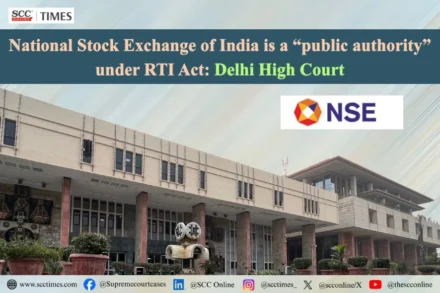
National Stock Exchange of India is a “public authority” under RTI Act: Delhi High Court
The Court held that NSEI would qualify as a “public authority” not only under the second part, but also under the first part of Section 2(h), RTI Act.
CAM successfully represented the BCCI in the present remand- proceedings, where comprehensive arguments were advanced demonstrating that the BCCI does not meet any of the mandatory conditions prescribed under Section 2(h) of the RTI Act, for being classified as a ‘public authority’.
“… what may superficially appear to be an innocuous or isolated disclosure could open the floodgates of indiscriminate demands, motivated by idle curiosity or sensationalism. … The RTI Act was enacted to promote transparency in government functioning and not to provide fodder for sensationalism.”
“The only question before CIC was whether ‘information’, as defined in Section 2(f) of the RTI Act has been denied mala fide, or incorrect, incomplete or misleading information has been knowingly furnished. The impugned order instead expresses policy prescriptions, which are beyond the remit of CIC.”
The Central Information Commission condemned the lack of adherence to the RTI Act provisions and the inadequate checks and balances within the system.
The Court stated that requiring TRAI to retrieve information about individual complaints from Telecom Service Provider will impose an impractical and onerous burden on the TRAI. With a workforce of merely 170 employees, the TRAI lacked the operational capacity to manage or compile data related to the grievances of over 900 million telecom subscribers.
The Delhi High Court said that CIC can only deal with issues relating to information sought under the RTI Act or any other issue that leads to dissipation of information as sought by the applicant.
“The information pertaining to an assessee cannot be granted under the Right to Information Act, 2005 in view of Section 138(1)(b) of the Income Tax Act, 1961.”
This is not a case where sensitive information has been collected by the CBI and the disclosure of which would be prejudicial for the officers involved. This is also not a case where information is so sensitive that it cannot be shared with the public at large.
The petition was filed challenging the order passed by the Central Information Commission which directed the Union of India to upload all the latest amended bare Acts, examine the functionality of its E-mail ID, develop an appropriate RTI filing mechanism and to pay Rs. 10,000 under Section 19(8)(b) of the RTI Act to the library of National Law School of India University, Bengaluru.
The concept of exporting goods into the international market at lower prices came to be known as ‘Dumping’. The General Agreement on Tariffs and Trade (GATT) recognises the right of countries to bring in anti-dumping frameworks to deal with issues relating to dumping.
The Delhi High Court stated that National Green Tribunal is a national tribunal, and hence, its RTI cell should function properly in accordance with the timelines and rules prescribed under the RTI Act and Rules.
A combined reading of the provisions of the RTI Act and the observation of the Supreme Court crystalizes the interpretation and meaning of the word ‘information’ as defined in the section 2(f) of the Act which only refers to such material as is already available in the records of the public authority.
Central Information Commission: In the second appeal filed by the appellant under Section 19 of the Right to Information Act,
Central Information Commission: In a second appeal filed by the appellant being dissatisfied and aggrieved by the reply furnished by
Central Information Commission: In a second appeal filed under Section 19 of the Right to Information Act, 2005 on the ground of
Central Information Commission: In a complaint for an action against the Central Public Information Officer (CPIO) for willfully misleading and furnishing false
Disclosure is the norm and refusal to information, an exception
Central Information Commission (CIC): Saroj Punhani, Information Commissioner addressed a matter with regard to the disclosure of the inspection reports of the
Central Information Commission (CIC): Suresh Chandra, (Commissioner) held that “Section 10 RTI Act reveals that the power of severing the information disclosable