FIRs quashed, pan-India compensation policy directed: Inside Supreme Court’s NEET-UG 2026 Protest order
Supreme Court Quashes FIRs, Invokes Article 142 and Directs Pan-India Compensation for Students’ Families in NEET-UG 2026 Protests

Bringing you the Best Analytical Legal News


Supreme Court Quashes FIRs, Invokes Article 142 and Directs Pan-India Compensation for Students’ Families in NEET-UG 2026 Protests
“On the one hand, the nation prepares ‘Gen Z’, ‘Gen Alpha’ and ‘Gen Beta’ to lead India in 2047 and beyond, on the other hand, the foundational institutions meant to nurture them, particularly the Government Schools in Rural and Village areas continue to suffer from systemic deficiencies.”
Supreme Court clarified that “criminal antecedents” in its NEET 2026 protest order refers only to “grave and heinous offences” and held that NCT of Delhi and other States are at liberty to decide closure or withdrawal of FIRs in accordance with law.
The Supreme Court said that there cannot be a presumption in law that, after marriage, a daughter severs her ties with her parental family and resides with husband in her matrimonial home and that any classification differentiating a daughter from a son is, per se, unconstitutional
The Court directed that all CCTV footage, drone footage, body-worn camera recordings, videography, wireless communication records, and PCR lodge collections related to the students’ protest be preserved.
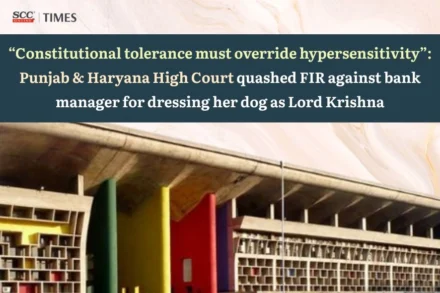
“The case in point is an exemplary instance of misconstruction of intent and a parochially narrow understanding of religious philosophy.”
Supreme Court clarified that compassionate appointment and compassionate financial assistance are distinct benefits under the Haryana Compassionate Assistance Rules, 2019, and held that Rule 23(1) cannot be invoked to defer a claim for compassionate appointment during the pendency of criminal proceedings.
The Court attached significance to the fact that a married son remained part of the family irrespective of his marital status, whereas a married daughter was excluded merely because she was married.
A detailed investigative report published in Rajasthan Patrika titled “शटर डाउन… ‘इमरजेंसी विंडो’ चालू: रात 8 बजें बाद भी धड़ल्ले से बिक रही शराब, supported by photographs, timestamps and field verification, indicated that despite statutory closing hours applicable to liquor vends, liquor sale allegedly continued openly after 8.00 p.m. through concealed openings, restricted access windows and partially shuttered premises at various locations within Jodhpur.
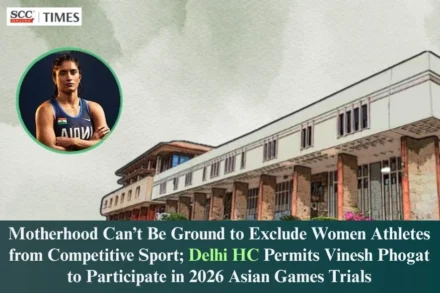
The Court condemned Wrestling Federation of India’s “National Embarrassment” remark against Vinesh Phogat with regards to 2024 Paris Olympic Games mishap, which had led to her disqualification.
“The most invaluable gift that the people of India gave unto themselves through the Constitution was the vision of a casteless society founded upon the principle of substantive equality.”
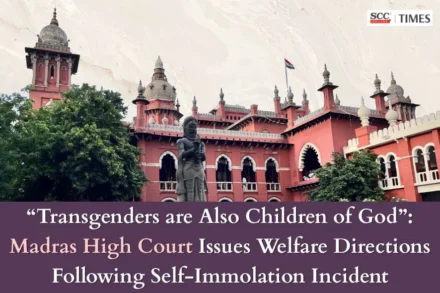
“The members of the transgender community continue to face entrenched social stigma, resulting in deprivation of basic dignity and meaningful livelihood opportunities.”
“The recipient of a concession has no legally enforceable right against the Government to grant of a concession except to enjoy the benefits of the concession during the period of its grant. This right to enjoy is a defeasible one.”
The Supreme Court declined to issue directions either to declare the birth anniversary of Guru Gobind Singh Ji as a nationwide gazetted holiday or to frame uniform guidelines for declaration of holidays.
“The State, as a model employer, cannot adopt artificial classifications to deny statutory benefits. Repackaging contractual engagements under a different nomenclature, while denying regularization, violates the equality mandate under Articles 14 and 16 of the Constitution.”
“The right to human life is to be treated on a much higher pedestal, regardless of a citizen’s religious belief. The mere fact that the petitioners are living in an interfaith relationship would not deprive them of their fundamental right as envisaged in the Constitution, being citizens of India.”
The Court held that decisions relating to eligibility criteria, age limits, and closure of registrations fall within the executive policy domain of the State and are not amenable to judicial review in the absence of arbitrariness, statutory violation, or unconstitutionality.
“The petitioners acted in accordance with the existing Bye Laws and the consistent past practice of CBSE and, therefore, had a legitimate expectation that after passing Class XII examination on 13.05.2025 the right to appear as private candidates for the Additional Subject examination, would be available.”
“Upon a prima facie consideration, it appears to us that some of the provisions of the Impugned Regulations suffer from certain ambiguities, and the possibility of their misuse cannot be ruled out.”