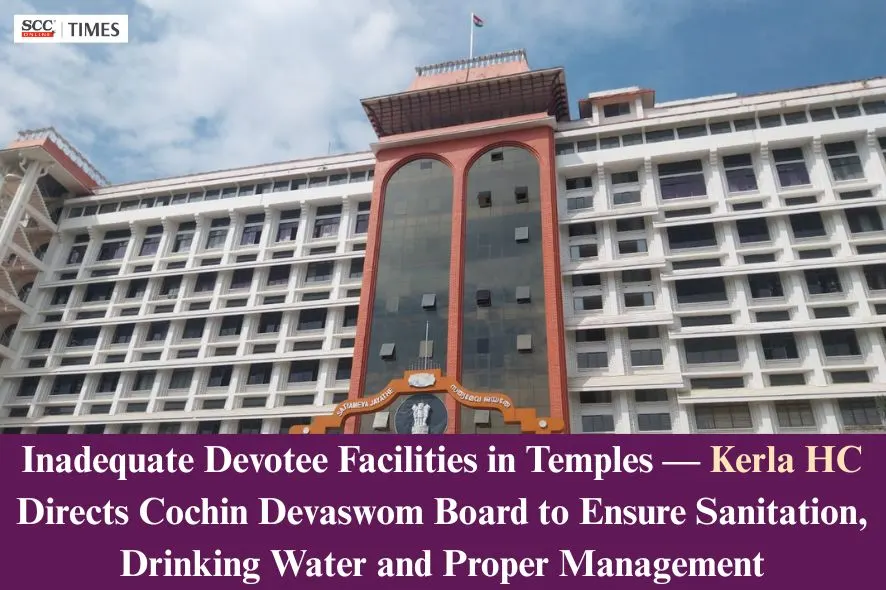
Kerala High Court: While dealing with serious allegations concerning inadequacy of basic amenities, poor sanitation and mismanagement affecting devotees in Kodungallur Sree Kurumba Bhagavathi temple under the control of Cochin Devaswom Board (CDB), the Division Bench of Raja Vijayaraghavan V. and K.V. Jayakumar*, JJ., observed that CDB had given the least priority to the primary and basic needs of the pilgrims and held it duty-bound to ensure basic amenities, hygiene and devotee management in temples and disposed of the proceedings by issuing comprehensive directions to ensure proper amenities, cleanliness and structured devotee management in all temples under the Board’s control.
Background
The proceedings were initiated suo motu based on a complaint submitted by the Convenor, Sree Kurumbamma Bhakthajana Samithi (Samithi) dated 3 November 2025, raising issues regarding the administration of the Kodungallur Sree Kurumba Bhagavathi temple, specifically with respect to the inadequacies of amenities and facilities for the devotees or the pilgrims. The complaint highlighted the lack of proper toilet facilities despite charging Rs 5 from devotees, inadequate and contaminated drinking water owing to poorly maintained water coolers, and denial of satisfactory darshan by temple employees. Allegations were also raised regarding corruption in Prasada Oottu, wherein large amounts were collected from devotees, but the benefit was restricted to a limited number of persons.
It was stated that Sree Kurumba Bhagavathi Temple (also called Kodungallur Bhagavathy Temple) at Thrissur is one of the most ancient and powerful Devi temples in Kerala, dedicated to Bhadrakali, and the Kodungallur Bharani Festival is one of Kerala’s most intense and ancient celebrations, dedicated to the Goddess which symbolises the victory of good over evil and lakhs of devotees visit the temple during the annual festival.
The Standing Counsel for the CDB submitted that Sree Kurumba Bhagavathi Temple is one of the major temples under its control and witnesses a huge inflow of devotees, particularly during the Meenabharani festival season. It was contended that considering the large inflow of devotees, the existing facilities could not be regarded as sufficient. The Senior Government Pleader also underscored the necessity of arranging improved amenities and facilities for devotees.
Also Read: Kerala HC directs State to ensure safe pilgrimage to Sabarimala
Analysis
The Court referred to Section 73-A, Travancore-Cochin Hindu Religious Institutions Act, 1950, which casts a statutory duty on the CDB to ensure proper maintenance, upliftment of temples and establishment of proper facilities for devotees. The Court relied on A.A. Gopalakrishnan v. Cochin Devaswom Board, (2007) 7 SCC 482, wherein the Supreme Court observed that:
“The properties of deities, temples and Devaswom Boards, require to be protected and safeguarded by their Trustees/Archaks/Sebaits/employees. Instances are many where persons entrusted with the duty of managing and safeguarding the properties of temples, deities and Devaswom Boards have usurped and misappropriated such properties by setting up false claims of ownership or tenancy, or adverse possession. This is possible only with the passive or active collusion of the concerned authorities. Such acts of ‘fences eating the crops’ should be dealt with sternly. The Government, members or trustees of Boards/Trusts, and devotees should be vigilant to prevent any such usurpation or encroachment. It is also the duty of Courts to protect and safeguard the properties of religious and charitable institutions from wrongful claims or misappropriation.”
The Court opined that CDB is duty-bound to ensure basic facilities, such as a sufficient number of toilets, access to pure drinking water, proper parking facilities for the vehicles of devotees, and a clean and hygienic environment in and around the temples. The Court condemned the CDB’s attitude and observed that despite repeated directions from the Court, CDB gave the least priority to the primary and basic needs of pilgrims. Consequently, the Court directed CDB to formulate a scheme to ensure basic amenities and facilities for devotees in each of the 409 temples under its control and superintendence.
The Court referred to P.N. Radhakrishnan v. State of Kerala, 2025 SCC OnLine Ker 13048, wherein the Court had issued detailed guidelines for devotee management of Guruvayur Temple and ordered that the directions would be made applicable to all the major temples under the control of CDB mutatis mutandis.
Decision
Accordingly, the Court directed the Board to conduct a detailed assessment of facilities in every temple under its control, formulate appropriate schemes to serve devotees during festive seasons, construct toilet complexes with separate toilets for gents, ladies, transgenders and differently abled persons and also sufficient bio-toilets during the annual festival,within 3 months. The Court also directed the CDB and Devaswom Commissioner to ensure that the temples are clean and tidy and the green protocols issued by the Government are scrupulously followed.
[Court on its own motion v. State of Kerala, 2026 SCC OnLine Ker 4355, decided on 10-4-2026]
*Judgment authored by: Justice K. V. Jayakumar
Advocates who appeared in this case:
For the Respondents: Rashmi K.M., SR. GP., K.P. Sudheer, SC for CDB.