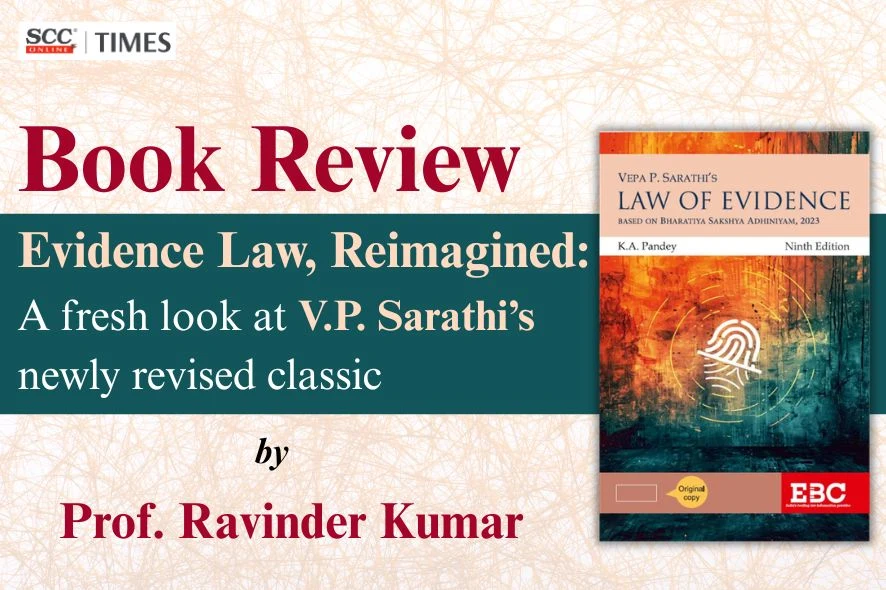
V.P. Sarathi’s Law of Evidence has long occupied an eminent place in Indian legal literature as a reliable exposition of the principles governing proof, admissibility, and judicial evaluation of evidence. The work is widely appreciated for its conceptual clarity, systematic presentation, and close engagement with judicial reasoning. Its sustained relevance lies in its ability to harmonise statutory provisions with evolving interpretative trends, making it a trusted reference for students, practitioners, and members of the judiciary.
The 9th Edition of the book, edited by Dr K.A. Pandey, Associate Professor, Dr Ram Manohar Lohiya National Law University, Lucknow, represents a significant scholarly advancement by comprehensively incorporating the Sakshya Adhiniyam, 2023. The revising author has undertaken the task of revision with notable academic rigour, ensuring that the foundational strengths of the original work are preserved while the text is contemporised in light of legislative reform. Each of the 11 chapters have been precisely drafted within limited words, thereby avoiding prolixity and rendering the language of evidence law more engaging and accessible without compromising doctrinal depth.
The book is particularly intended for undergraduate and postgraduate law students, judicial service aspirants, academicians, legal practitioners, and judicial officers. Its balanced combination of conceptual exposition and judicial application makes it equally useful as a teaching text, a courtroom reference, and a research aid under the new statutory regime.
The introductory chapter effectively contextualises the shift from the Evidence Act, 1872 to the new statutory framework. The chapters on Theory of Relevancy and Relevant Facts of Which Evidence May Be Given demonstrate analytical precision, while the treatment of Facts of Which Evidence Need Not Be Given and Facts of Which Evidence Cannot Be Given clarifies statutory exclusions through well-integrated judicial interpretation. The exposition of relevant facts thoughtfully examines the principle of res gestae under Section 5, Evidence Act, drawing support from the Supreme Court’s judgment in Balu Sudam Khalde v. State of Maharashtra2 which recognises that statements made contemporaneously with the occurrence constitute relevant and admissible evidence as forming part of the same transaction.
The chapter on Burden of Proof is enriched by recent Supreme Court judgments, including Sabitri Samantaray v. State of Odisha3 which elucidates the requirement of proving specific intention under Section 109, Sakshya Adhiniyam, and Dinesh Kumar v. State of Haryana4 along with State of Punjab v. Kewal Krishan5 which reinforce the allocation and discharge of evidentiary burden under the Adhiniyam. The revising author’s contribution lies in carefully analysing these judgments and integrating them with statutory provisions, rather than merely reproducing case law.
The chapter on Witnesses reflects contemporary judicial sensitivity and evidentiary discipline. The admissibility and appreciation of child testimony are examined with reference to Pradeep v. State of Haryana6, wherein the Supreme Court underscored its duty to assess competence and credibility with due care. The book also draws attention to investigative lapses, notably the failure to conduct Test Identification Parade, as highlighted in Vinod v. State of Chhattisgarh7, reflecting judicial insistence on procedural fairness in criminal investigations.
The chapters on Documentary Evidence and Exclusion of Oral by Documentary Evidence are of particular contemporary relevance. The revising author has lucidly addressed the admissibility of electronic records by incorporating Supreme Court judgments such as Ravinder Singh v. State of Punjab8 and Mohd. Arif v. State (NCT of Delhi)9. The legal position regarding certification under Section 63, Sakshya Adhiniyam is clearly explained through Arjun Panditrao Khotkar v. Kailash Kushanrao Gorantyal10 and its reaffirmation in State of Karnataka v. T. Naseer11.
The concluding chapters on Weight and Appreciation of Evidence and Power of an Appellate Court successfully integrate statutory interpretation with principles governing judicial discretion and appellate scrutiny. The appendices on Digital Signature and Electronic Signature and The Schedule add to the practical utility of the book in an era marked by technological transformation of evidentiary processes.
When viewed alongside other standard works on evidence law, this book distinguishes itself through its concise presentation, contemporary statutory alignment, and focused judicial analysis under the Sakshya Adhiniyam. The originality of the present edition lies in its careful reorganisation of classical principles within the framework of the new legislation, coupled with the revising author’s analytical engagement with recent Supreme Court jurisprudence.
The book reflects revising authorial diligence, scholarly precision, and doctrinal balance. The revising author deserves sincere appreciation for harmonising legislative reform with judicial developments while maintaining the intellectual legacy of Mr V.P. Sarathi. The book stands as a concise, authoritative, and engaging exposition of evidence law under the Sakshya Adhiniyam and is poised to remain a standard reference for years to come.
1. Professor at the University School of Law and Legal Studies, Guru Gobind Singh Indraprastha University, Delhi. Prof. Kumar has over 20 years of teaching and research experience and specialises in areas including Constitutional Law, Human Rights, Social Justice, Law and Social Transformation, and Procedural Laws. He has numerous national and international publications and has also been honoured with the National Teacher Award in the field of Education and Public Awareness in 2025.