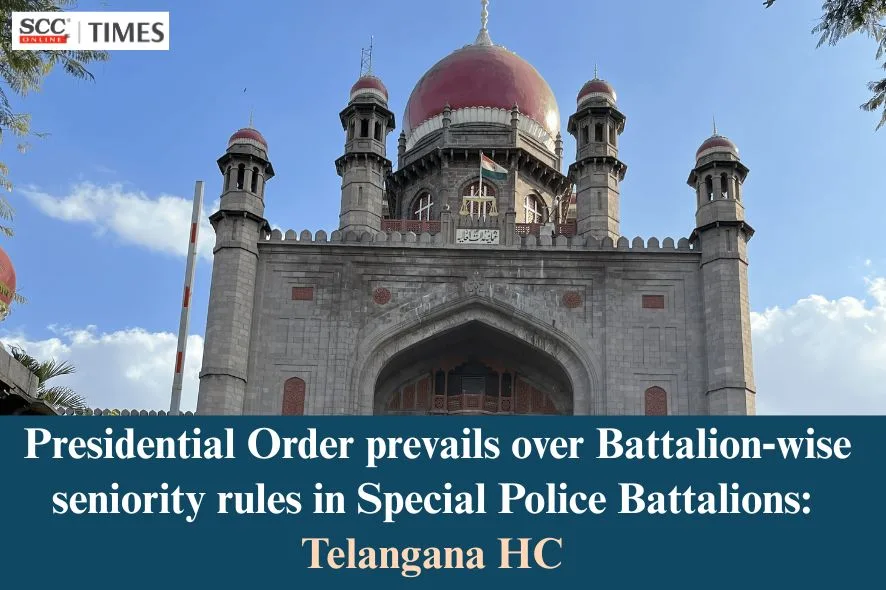
Telangana High Court: While hearing a writ petition challenging the validity of the service rules governing appointment, seniority and promotion in the Special Police Battalions, the Division Bench of Aparesh Kumar Singh, C.J. and G.M. Mohiuddin, J., held that the Presidential Order, issued under Article 371-D, has overriding statutory force and that the impugned rules, insofar as they prescribe battalion-wise seniority and promotions, are inconsistent with the constitutional scheme and hence unenforceable to that extent, and directed the State to frame fresh rules in conformity therewith and to reconsider the petitioner’s claim accordingly.
Background
The petitioner was a member of the Andhra Pradesh Police establishment and was serving as an Assistant Reserve Sub-Inspector (ARSI) in the 8th Battalion of the Telangana State Special Police (TSSP). The service conditions of personnel in the Special Police Battalions were governed by statutory rules issued periodically by the State Government. In this regard, the Government had notified the Special Police Service Rules through GOMs No. 69, Home (Police-D) Department, dated 7 April 1997 (Rules). Rule 3 of these Rules, inter alia, prescribed the method and manner of appointment and promotion to various posts within the Special Police Battalions. Subsequently, GOMs No. 85, Home (Police-D) Department, dated 28 April 1997, was issued, introducing further provisions, including those applicable to promotions within the battalion structure.
The dispute arose in the context of promotions from the cadre of Police Constable to that of ARSI. The petitioner contended that such promotions had been effected on the basis of battalion-wise seniority, in accordance with the aforementioned Rules and Government Orders. He claimed that this method adversely affected his prospects, as it limited consideration for promotion within the confines of a particular battalion rather than across the State.
According to the petitioner, the posts in question were non-ministerial posts within the Special Police Battalions and, therefore, ought to have been treated as State-level cadre posts under the Andhra Pradesh Public Employment (Organisation of Local Cadres and Regulation of Direct Recruitment) Order, 1975 (Presidential Order). He asserted that the impugned Rules and Government Orders, to the extent that they mandated battalion-wise seniority for promotions, were inconsistent with the framework of the Presidential Order.
Aggrieved by the alleged denial of consideration for promotion based on State-level seniority, the petitioner approached the Court under Article
Analysis and Decision
The Court noted that the Presidential Order has overriding statutory force and prevails over any inconsistent subordinate legislation. The Court observed that the Presidential Order expressly exempts non-ministerial posts in the Special Police Battalions from the organisation of local cadres, thereby rendering such posts as State cadre posts to which State-wide seniority must apply.
The Court further observed that the Service Rules framed under GOMs No. 69 and GOMs No. 85 (1997), insofar as they confine appointment, seniority, and promotion up to the rank of Assistant Reserve Sub-Inspector to the battalion level, are clearly inconsistent with the Presidential Order. The Court noted that subordinate legislation cannot override a constitutional instrument issued under Article
Pertinently, the Court took note of the categorical admission made by the respondents, particularly in the communication dated 27 January 2017 by the Director General of Police, acknowledging that the impugned Rules operate against the Presidential Order. The Court observed that such an admission, having not been rebutted, further reinforces the illegality of the existing framework.
On the issue of delay, the Court noted that the plea of laches is not sustainable, as the challenge pertains to a continuing wrong arising from the application of an illegal seniority regime. The Court observed that each denial of promotion based on such a regime constitutes a recurring cause of action. The Court also took note of subsequent developments, including State bifurcation and official acknowledgement of anomalies, which lend renewed cause to the petitioner’s grievance.
At the same time, the Court observed that striking down the impugned Rules with full retrospective effect may result in widespread administrative disruption. The Court noted that while administrative convenience cannot justify perpetuation of illegality, relief must be moulded in a manner that balances legality with practical considerations.
In light of the above, the Court held that the posts of Police Constable, Head Constable, and Assistant Reserve Sub-Inspector in the Special Police Battalions are State cadre posts governed by the Presidential Order. The Court declared that Rule 3 of GOMs No. 69 and Rule 1(b) of GOMs No. 85 (1997), insofar as they prescribe battalion-wise seniority and promotions, are inconsistent with the Presidential Order and are unenforceable to that extent.
However, the Court refrained from striking down the provisions in entirety, having regard to the potential for administrative upheaval, and instead issued the following directions:
-
State must frame and notify fresh Service Rules in conformity with the Presidential Order, ensuring State-wide seniority, within a period of six months.
-
Petitioner’s representation dated 9 March 2020 must be reconsidered afresh and disposed of by a reasoned order within a period of four months, with consequential benefits to follow if the petitioner is found entitled.
-
Pending such reformulation, the respondents shall refrain from effecting promotions solely on the basis of battalion-wise seniority where such action would perpetuate the illegality declared.
[S.P. Kasim Peera v. State of Telangana, 2026 SCC OnLine TS 583, decided on 17-2-2026]
Advocates who appeared in this case:
For the Petitioner: A. Srinath, Advocate.
For the Respondents: B. Krishna, Advocate.