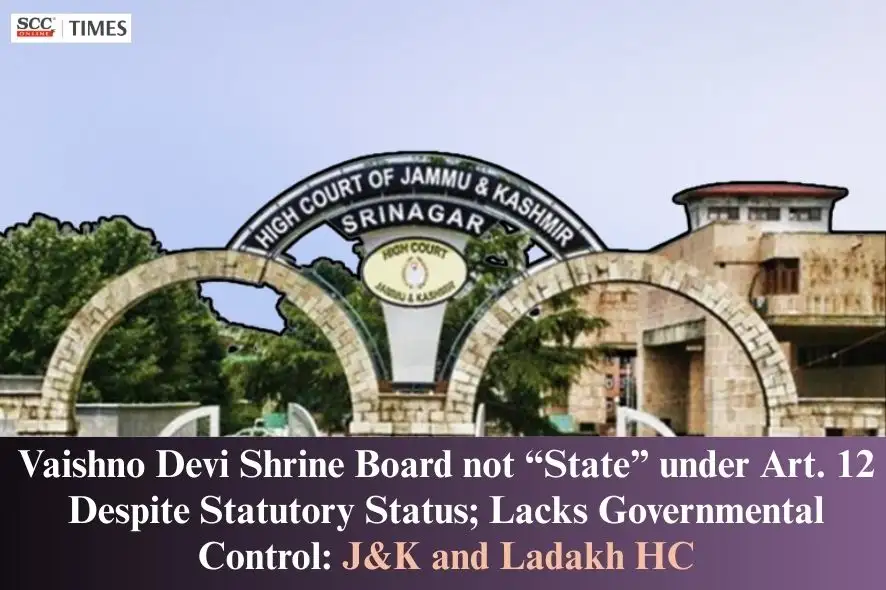
Jammu & Kashmir and Ladakh High Court: In a writ petition challenging the discontinuance of service of an ad hoc employee of the Vaishno Devi Shrine Board (Shrine Board) and assailing Section 14(2), J&K Shri Mata Vaishno Devi Shrine Act, 1988 (1988 Act), a Single Judge Bench of Sanjay Dhar, J. held that the action lacked any public law element and the petitioner’s claim arose purely from a private contractual engagement. The Court held that the writ petition was not maintainable and observed that the Shrine Board was not “State” under Article 12 of the Constitution, despite having a statutory status, as it lacked government control.
Background
The petitioner was appointed as a Pujari on 27 September 1986 on a consolidated salary. By the impugned order dated 30 June 1988, his services were discontinued without any fault on his part. According to him, he was given to understand that the employment was permanent, and he performed his duties with devotion and honesty. He had several dependents to look after. It was stated that no enquiry was held by the respondents before dispensing with his services. He alleged violation of Articles 14, 16 and 311 of the Constitution and submitted that his services could not be terminated without adopting procedure prescribed under law. He stated that he was appointed against a clear vacancy which was still existing and that new posts created in May 1988 were filled by others while he was thrown out. He further contended that Section 14(2), 1988 Act was ultra vires being violative of Article 14 of the Constitution as it conferred vague and unbridled powers on the State.
However, the respondents contended that his engagement was purely ad hoc and conferred no right on him to hold the post. The protection under Article 311 of the Constitution was inapplicable as the Shrine Board was an autonomous body and not the Government. The respondents denied having assured permanency to the petitioner and asserted that no enquiry was required in view of the nature of the impugned order. They also defended the validity of the 1988 Act.
Analysis and Decision
The Court noted that the matter was initially decided by a judgment dated 22 July 1998 and the petitioner’s disengagement was set aside with a direction to reinstate him without back wages. This was challenged by the respondents and eventually the Supreme Court remanded the matter back to the Court for its fresh decision in accordance with law.
The Court referred to Omkar Sharma v. Mata Vaishno Devi Shrine Board, 2005 SCC OnLine J&K 112, wherein while applying the principles of Pradeep Kumar Biswas v. Indian Institute of Chemical Biology, (2002) 5 SCC 111, it was observed that:
“even though the Shrine Board has been constituted under a statute and, therefore, has a statutory status, in the absence of any kind — even an iota of control of the Government — financial, functional or administrative — it cannot be said to be State or an authority within the meaning of Article 12 of the Constitution. It has, therefore, to be held that the writ petitions for enforcement of fundamental rights against the Shrine Board are not maintainable.”
The Court opined that at present the legal position is that writ petitions against the Shrine Board seeking enforcement of fundamental rights are not maintainable. However, the Court emphasised that Article 226 of the Constitution is wide enough and the High Court while exercising its powers under the said article is vested with the jurisdiction to issue writs even against those bodies, who do not qualify to be “State” within the meaning of Article 12 of the Constitution. The Court relied on BCCI v. Cricket Assn. of Bihar, (2015) 3 SCC 251, wherein it was held that the words “any person or authority” in Article 226 of the Constitution not only include the statutory authorities and instrumentalities of the State but also any person or authority performing public duties.
On the issue of maintainability of a writ petition against a body not qualifying as “State”, the Court relied on Andi Mukta Sadguru Shree Muktajee Vandas Swami Suvarna Jayanti Mahotsav Smarak Trust v. V.R. Rudani, (1989) 2 SCC 691, and observed that in a case where the rights sought to be enforced are purely of a private character, the writ petition would not lie. Thus, the guiding factor is the nature of duty imposed upon the person or body against whom a writ is being sought. If the nature of duty imposed on a body is public in nature, it is amenable to writ jurisdiction under Article 226 of the Constitution but if the rights sought to be enforced are purely of a private character, a writ cannot be issued against such body. The Court also referred to Binny Ltd. v. V. Sadasivan, (2005) 6 SCC 657, wherein it was observed that there must be a public law element involved for a writ to be issued, and the High Court cannot exercise judicial review of an action to enforce purely private contracts entered into between the parties.
The Court opined that the petitioner was challenging his termination from service which did not reflect any public element. Rather, the Court noted that he was seeking the enforcement of his rights under a contract of service executed by him with the Shrine Board, which was purely private in character. The Court referred to Showkat Ahmad Rather v. State (UT of J&K), 2022 SCC OnLine J&K 837, wherein it was observed that in absence of violation of statutory provision or breach of public duty by a body or person, writ petition for enforcement of a private contract of service is not maintainable.
On merits, the Court highlighted that the disengagement order revealed that the petitioner was terminated along with two more employees as their services were no more required by the Shrine Board and opined that the order did not cast stigma and was not punitive. The Court noted that the engagement was purely on ad hoc basis and observed that an ad hoc appointee has no vested right to the post against which he is appointed. The employment of an ad hoc appointee ends the moment the purpose or term for which such an employee is hired comes to an end.
Since the petitioner’s services were no longer required, the Court held that he had no right to seek continuation or reinstatement. Accordingly, the Court dismissed the writ petition, holding that it was not maintainable.
[Subash Raina v. State (UT of J&K), 2026 SCC OnLine J&K 186, decided on 12-3-2026]
Advocates who appeared in this case:
For the Petitioner: Harpreet Singh, Advocate.
For the Respondents: Atul Verma, vice Adarsh Sharma, Advocates.
Buy Constitution of India HERE