Procedural lapses do not vitiate inquiry without real prejudice: Bombay HC quashes reinstatement of school peon
The Court held that the School Tribunal’s approach was perverse as it overlooked the actual charges against the peon.

Bringing you the Best Analytical Legal News


The Court held that the School Tribunal’s approach was perverse as it overlooked the actual charges against the peon.
The petition raises a sensitive and classic judicial conundrum: Where does a genuine, conscious personal choice end, and where does administrative coercion begins?

“The guiding factor is the nature of duty imposed upon the person or body against whom a writ is being sought. If the nature of duty imposed on a body is public in nature, it is amenable to writ jurisdiction under Article 226 of the Constitution but if the rights sought to be enforced are purely of a private character, a writ cannot be issued against such body.”

“The nature of the misconduct proved against the petitioner, viewed in the context of the duties and responsibilities attached to the post held, cannot be said to be trivial or inconsequential.”

“The power of review being substantive in nature cannot be applied retrospectively to validate actions taken at a point of time when no such power existed.”

“When a party demonstrates genuine inability to represent itself and seeks professional assistance without mala fides, the Labour Court ought to grant such leave unless strong reasons exist to the contrary.”

“It is well-settled that the reinstatement should be the rule when the order of wrongful dismissal of termination of service was set aside, and the compensation should be an exception.”

“If it was really a case of disability of the petitioner, then she ought to have approached the Commissioner under the Disabilities Act, as it is the Commissioner who has the power under the said Act to grant appropriate relief.”

“In the normal course, we would not have entertained the petition of this nature, but the petitioner is seeking implementation of a relief that he has already got by invoking a remedy under Article 226”
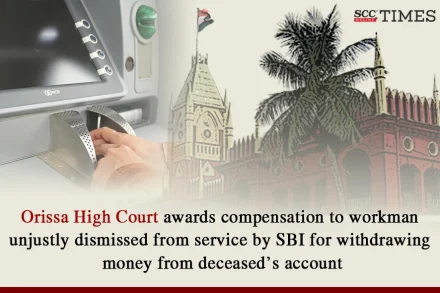
“In the absence of any clinching material showing the Workman’s involvement in the withdrawal of cash, he was inflicted with the punishment of dismissal from service, thus, raising doubts about the fairness of the enquiry conducted against him.”

by Ramkishore Karanam* and Preethi Sivaraman**
“The High Court can interfere with the order of punishment only in case of violation of the provisions of rules or principles of natural justice are proved.”
Petitioner has taken a specific defence that his wife was seriously ill and was under medical treatment for a long time and ultimately, she passed away. The records of the departmental enquiry also suggested that the medical papers of the wife of the petitioner were duly placed on record. The enquiry officer failed to take this account to its proper perspective.

Regarding the reinstatement of other two judicial officers, the Court will hear the matter on 24-09-2024, as the Full Court decided to not revoke their earlier resolutions and would place the adverse remarks and other materials against them before the Supreme Court in a sealed cover.
If the Government servant has been terminated without adhering to Article 311 of the Constitution, then in such a case the provisions cannot be interpreted in favour of the State to deprive the employee of his legitimate claim.
By virtue of Rules 54(2) and 54(3), the petitioner is entitled to full pay and allowances for the period between 9-1-2020 to 29-9-2020 and his absence from service during the said period has to be treated as a period spent on duty for all purposes.
The Court observed that this was not the isolated case where the jurisdictional SSP of State had dispensed with inquiry. As soon as an FIR was registered against the police official, the jurisdictional SSPs opted to dispense with inquiry.
The Court referred to MAT’s finding that the petitioners were empowered to terminate the services of a probationer in case of misconduct, provided that such misconduct is proved after an opportunity of being heard is availed to the respondent. However, the same was not followed by the petitioners.
“Where the job continues without even any performance appraisal or periodical renewal, and the person engaged in the same would be termed as a “trainee”, as it is in the present case, the same would be considered as unfair labour practice.”
“The term ‘serious crime’ connotes a crime beyond the ordinary, inviting a more serious major punishment than what may be given in the case of a minor omission.”