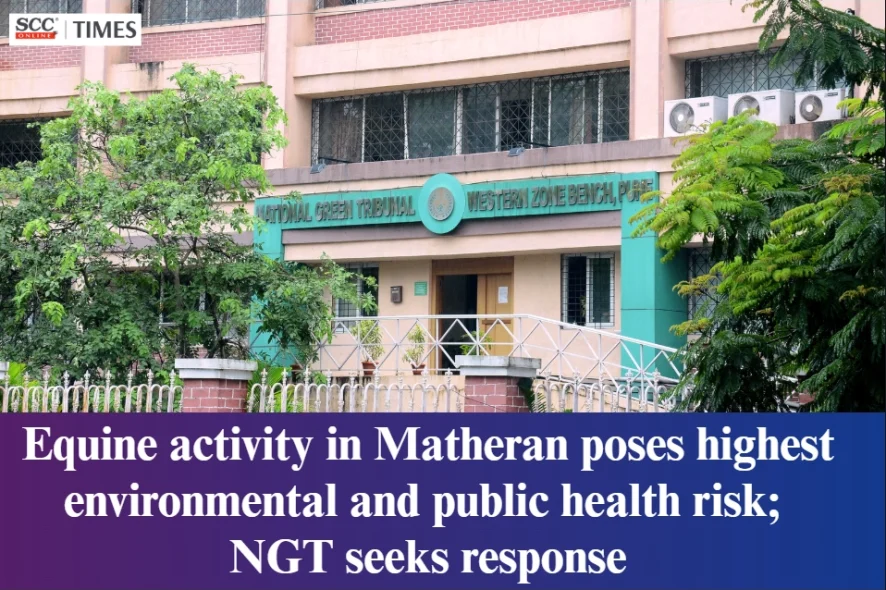
National Green Tribunal (Pune): In an original application concerning environmental degradation within the Matheran Eco-Sensitive Zone, a bench comprising of Dinesh Kumar Singh (Judicial Member), J., and Dr. Sujit Kumar Bajpayee (Expert Member), while holding that equine activity in Matheran poses highest environmental and public health risk, granted two weeks’ time to Respondents 5 to 7 to file objections and directed the Matheran Hill Station Municipal Council to ensure representation with reply on the next date. -Sensitive Zone, a bench comprising of Dinesh Kumar Singh (Judicial Member), J., and Dr. Sujit Kumar Bajpayee (Expert Member), while holding that equine activity in Matheran poses highest environmental and public health risk, granted two weeks’ time to Respondents 5 to 7 to file objections and directed the Matheran Hill Station Municipal Council to ensure representation with reply on the next date.
A joint committee report was filed and served. The Counsel appearing for Respondents 5 to 7 sought time to file objections, and the Tribunal allowed two weeks’ time for the same. The Tribunal noted the non-appearance of Matheran Hill Station Municipal Council, a necessary party, despite sufficient service, and directed the Registrar to write to the Chief Officer to ensure representation on the next date along with their reply, failing which personal appearance of the officer concerned would be directed.
The Ministry of Environment, Forest and Climate Change submitted that it is a formal party, and no relief is sought against it, hence no reply is required. Similarly, the State of Maharashtra stated that it does not want to file reply, being a formal party. The Pollution Control Board, as nodal agency of the joint committee, relied upon the joint committee report.
The Tribunal perused the report and noted that the air quality assessment at the site across pre-monsoon, monsoon and post-monsoon phases revealed that PM₁₀ and PM₂.₅ level breached the CPCB’s standards, with the root cause being equine dung emissions and dust from unpaved roads, while SO₂ and NO₂ pollutants remained under control, indicating non-industrial air pollution in a vehicle-free yet horse-reliant ecosystem. Water sampling from five sites recorded presence of E. coli ranging from 5 to 10 CFU/100 mL at lake sites, up to 25 CFU at a stream site, and 100 CFU at a stagnant tank, which violated drinking water norms as both Bureau of Indian Standards and World Health Organisation mandate 0 CFU/100 mL, confirming faecal contamination from horse dung. The samples also showed the presence of heavy metals. Soil quality assessment in the monsoon phase demonstrated that equine activity in Matheran posed the highest environmental and public health risk during the rainy season, with faecal indicator bacteria and Salmonella widely detected in soils.
The Final Expert Conclusion stated that equine activity in its present scale and spatial form is environmentally unsustainable in the Matheran Eco-Sensitive Zone and that effective protection cannot be achieved through downstream cleaning alone but requires source level intervention including strict regulation and phased reduction of horse numbers, relocation of stables outside ESZ limits, zoning of routes and protection of water catchments, and continuous monitoring to validate outcomes. It suggested that if proper implementation is done, Matheran can evolve into a national model for scientifically managed, pedestrian-only eco-tourism, fully consistent with the precautionary principle, carrying capacity doctrine and ESZ governance framework. Sensitive Zone and that effective protection cannot be achieved through downstream cleaning alone but requires source-level intervention -Sensitive Zone and that effective protection cannot be achieved through downstream cleaning alone but requires source-level intervention
The Tribunal put the matter up for next consideration on 24-3-2026.
[Sunil Ramchandra Shinde v. State of Maharashtra, 2026 SCC OnLine NGT 53, decided on 30-1-2026]
Advocates who appeared in this case:
For the Applicant: Tushar Kumar, Advocate.
For the Respondents: Aniruddha Kulkarni, Pushkal Mishra, Manasi Joshi, Deepali Bagla, Advocates.