








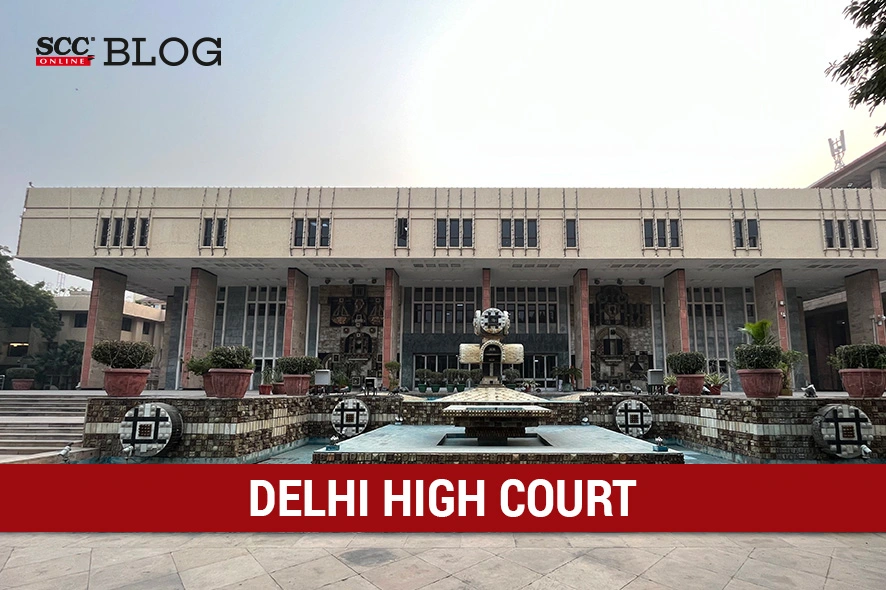
Delhi High Court: A petition was filed by the petitioner (son) under Article 226 challenging an order passed by the Divisional Commissioner, GNCTD affirming the order of eviction passed by District Magistrate in an eviction matter filed by the father. Subramonium Prasad, J., held that no fault can be found with the Tribunal and the Appellate Authority in entertaining the petition and passing the Order of eviction under the Maintenance and Welfare of Parents and Senior Citizens Act, 2007 read with the Delhi Maintenance and Welfare of Parents and Senior Citizens Rules, 2009, as amended from time to time.
Petitioner 1 and 2 are the son and daughter-in-law of Respondent 5, who is presently 90 years old. A complaint was filed regarding a property in question. The ground floor of the same was being used by the petitioner and daughter of respondent 5 for residing, however, a school was being run on the same floor by the daughter and wife of respondent 5.
A complaint was filed on 02-22-2021 by Respondent 5 apprehending a threat to his life and property, subject to continuous fights and demands pertaining to the ownership of the ground floor of the property from the petitioners. The Tribunal for Maintenance and Welfare of Parents and Senior Citizens directed the petitioners to evict the property in question. The petitioners challenged the eviction order before the Appellate Authority of Divisional Commissioner, GNCTD. The Appellate Authority affirmed the order passed by the Tribunal, which is hereby assailed as an unreasoned order in the instant writ petition.
The Court noted that no fault can be found with the Tribunal and the Appellate Authority in entertaining the petition and passing the order of eviction under the Maintenance and Welfare of Parents and Senior Citizens Act, 2007 read with the Delhi Maintenance and Welfare of Parents and Senior Citizens Rules, 2016. As both the legislations aim at providing a speedy and inexpensive mechanism that can be claimed by the suffering parents of the children and Respondent 5 qualifies to get the benefits under the Senior Citizens Act, 2007 and maintenance considering his age and the given circumstances.
The Court further clarified that there’s no question regarding the ownership of the property, as the property is already in the name of Respondent 5, hence the reason given by the Grievance Cell that it is a property dispute is unsustainable under law.
The court concluded that the District Magistrate was well within its rights under the Delhi Maintenance and Welfare of Parents and Senior Citizens (Amendment) Rules, 2016 to pass an Order of Eviction protecting the old parents from harassment at the hands of the son and the daughter-in-law who according to Respondent 5 are only interested in forcing him to vacate the ground floor of the property in question.
Thus, the Court dismissed the petition and did not interfere with the Order dated 05-05-2022 passed by the Divisional Commissioner, GNCTD (Appellate Authority).
[Ashish Randev v State, 2023 SCC OnLine Del 4347, decided on 21-07-2023]
Advocates who appeared in this case :
For the Appellant: Mr. Arun Francis and Ms. Veronica Francis, Advocates for the Petitioner;
For the Respondent : Mr. Sameer Vashisht, ASC for the R-1 to R-4/GNCTD;
Mr. Rajiv Khosla and Mr. Sunil Singh, Advocates for the R-5.









0 replies