








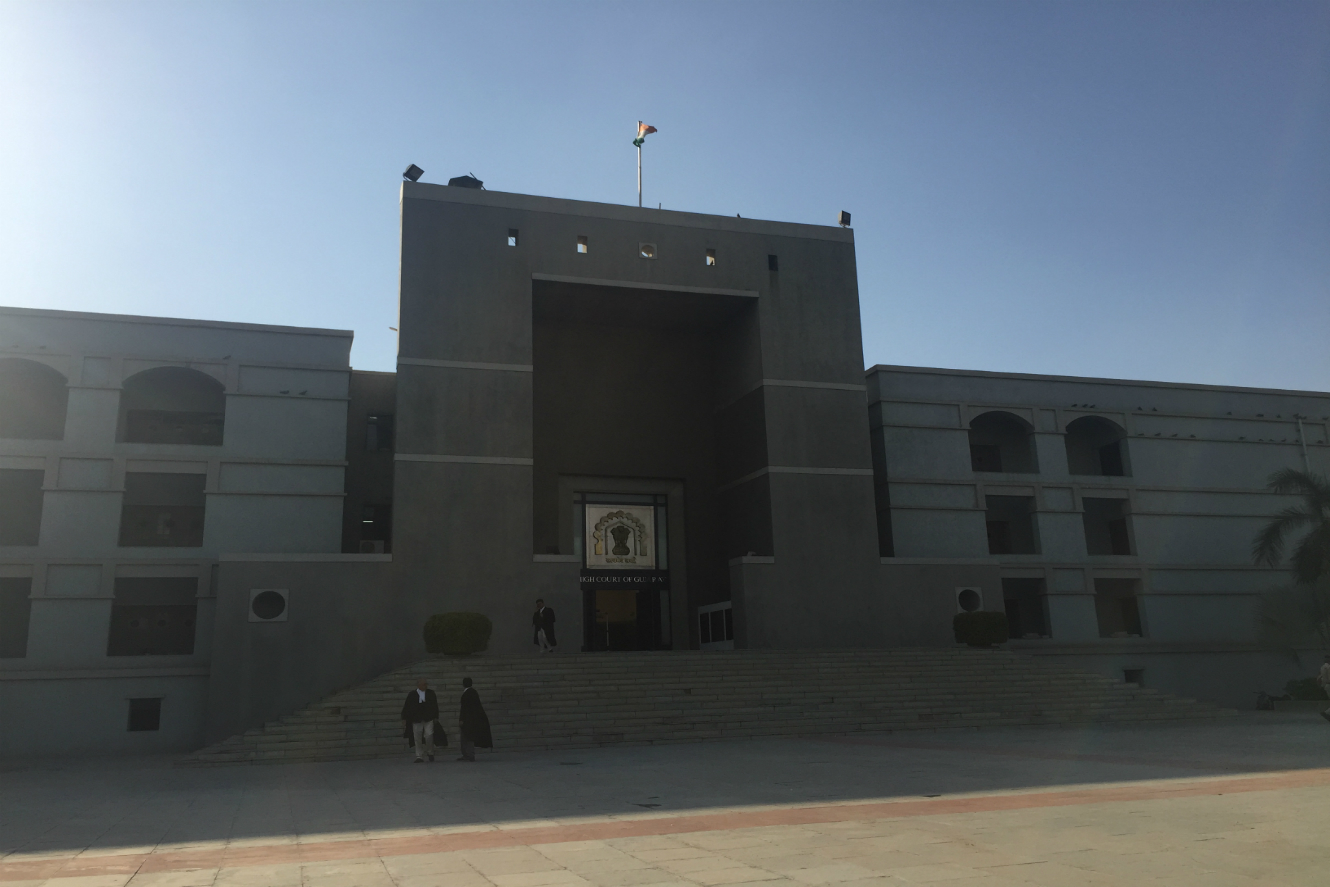
Gujarat High Court: The order being passed by J.B. Pardiwala, J., for application filed under Article 227 of the Constitution by the original accused, who was charged for offences under Sections 302, 147, 148, 149, 452, 504, 506(2), 120-B read with Section 34 of the Penal Code, 1860. The main reason for filing the application being that the first informant had died because of natural reasons, regarding which the accused counsel had argued that the ‘death of the first informant’, makes the investigating officers’ depositions to prove the contents of FIR not permissible in law, but this whole objection was overruled by the trial court. The High Court after considering all contentions, and looking into the trial court’s order, observed that the basic purpose of an FIR is to set the criminal law into motion, and is the initial step in a criminal case and also that the FIR by itself is not a substantial piece of evidence, unless it falls within the purview of Section 32 of the Evidence Act, 1872.
The Court relied on the Supreme Court decision in Damodar Prasad v. State of U.P., (1975) 3 SCC 851 : AIR 1975 SC 757, where it was explained that, if the informant dies, FIR can be unquestionably, used as a substantial piece of evidence, only with the pre-requisite condition that, ‘death of informant’ must have nexus with the ‘FIR’ or somehow must have some link with any evidence regarding FIR, and the contents of FIR must be proved, but if the death was natural, then the FIR cannot be admissible in evidence. The Court held that the trial court was wrong in saying that the police officer in the absence of the first informant can prove the contents of FIR as per Section 67 of the Evidence Act, 1872.
Further relying on Supreme Court judgments in Harkirat Singh v. State of Punjab, (1997) 11 SCC 215 : AIR 1997 SC 3231 and Hazarilal v. State (Delhi Administration), (1980) 2 SCC 390 : AIR 1980 SC 873 and the MP High Court judgment in Umrao Singh v. State of M.P. , 1961 CriLJ 270 the Court further observed that, the police can record three kinds of statements:
· recorded as an FIR
· recorded by police during investigation
· any other statement other than the above two
The Court quashed and set aside the trial court’s order and further directed the court to continue with the recording of evidence of the Investigating Officer keeping in mind the principles of law explained in this judgment. [Bhavanbhai Premjibhai Vaghela v. State of Gujarat, 2017 SCC OnLine Guj 1406, decided on 30-11-2017]









0 replies