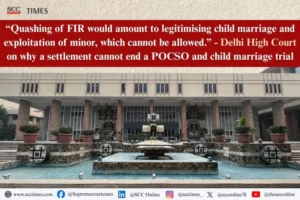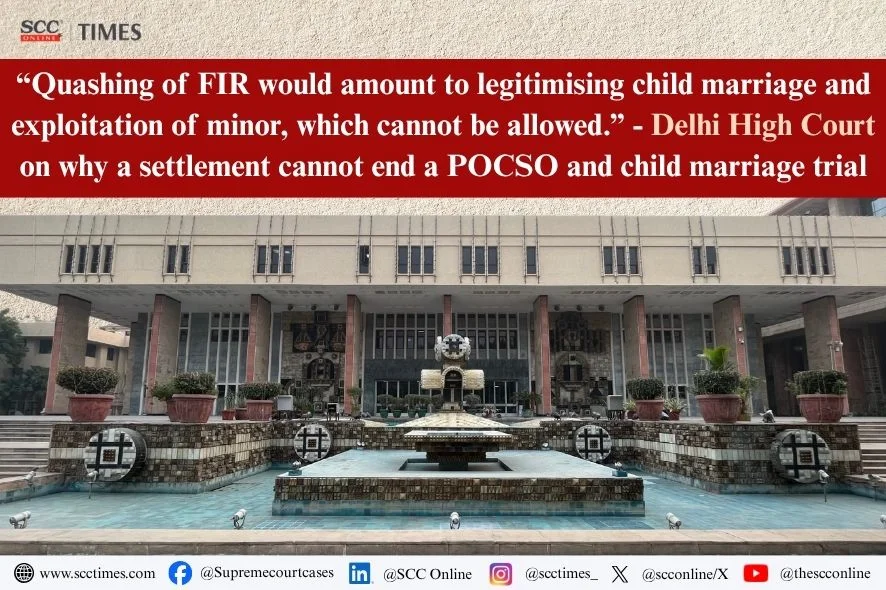
Delhi High Court: In a petition filed under Section 528, Nagarik Suraksha Sanhita, 2023 (BNSS), corresponding to Section 482, Criminal Procedure Code, 1973 (CrPC), a Single Judge Bench of Mini Pushkarna, J., dismissed the petition and directed that the trial shall continue. The Court held that forcing a minor into marriage and physical relations is a grave offence with large societal impact, that there is an overriding element of public interest in continuing the trial irrespective of any compromise, and that quashing the FIR would amount to legitimising child marriage and exploitation of a minor.
Background
The petitioner sought quashing of FIR, registered under Sections 363, 366-A and 376, Penal Code, 1860 (IPC), Section 6, Protection of Children from Sexual Offences Act, 2012 (POCSO Act) and Sections 9 and 11, Prohibition of Child Marriage Act, 2006 (PCM Act), along with the consequential proceedings. The ground urged was that the FIR had been registered due to a misconception and misunderstanding and that the parties had arrived at an amicable settlement. A charge-sheet dated 10 May 2019 had been filed before the Additional Sessions Judge, Patiala House Court, New Delhi, charging the petitioner under all the sections in the FIR and additionally under Section 506 IPC.
As per the documents on record, Respondent 2 was informed by her uncle and father on 7 March 2019 that her marriage had been fixed for the next day in Raebareli, Uttar Pradesh. She was married on 8 March 2019 to the petitioner, who was unknown to her at the time. The petitioner then took her to his brother’s house in Ghaziabad, Uttar Pradesh, where she was unable to contact the police as she had no access to a phone. It was alleged that the petitioner forced her to have physical relations with him on 3 occasions in Ghaziabad, and that on 11 March 2019 he took her to a farmhouse and forced her again. On 12 March 2019, she contacted the police, and the FIR was registered at her instance.
The petitioner’s counsel submitted that the petitioner and Respondent 2 had already married and were living happily together. The Additional Public Prosecutor drew the Court’s attention to the charge-sheet and FIR, which stated that the petitioner was 38 years of age at the time of the marriage on 8 March 2019, while Respondent 2 was approximately 17 years of age.
Issues
-
Whether an FIR and the consequential proceedings under the IPC, the POCSO Act and the PCM Act can be quashed under Section 528 BNSS on the basis of a settlement between the parties?
-
Whether the fact that the parties are living together as husband and wife can defeat the protective objectives of the POCSO Act and the PCM Act?
-
Whether the forced marriage of a minor of about 17 years to a man approximately 20 years older, followed by forced physical relations, can be treated as a private dispute, or whether there is an overriding public interest in continuing the trial?
Analysis and Findings
The Court first noted the settled position that, in exercise of its inherent powers under Section 528 BNSS (corresponding to Section 482 CrPC), it may quash criminal proceedings even in non-compoundable offences where the parties have compromised. However, the Supreme Court has cautioned against exercising this power where the allegations concern serious and heinous offences. Relying on Gian Singh v. State of Punjab, (2012) 10 SCC 303, the Court noted that in respect of serious offences like murder and rape, or offences of mental depravity, a settlement between the offender and the victim can have no legal sanction at all. Relying on Parbatbhai Aahir v. State of Gujarat, (2017) 9 SCC 641, it noted that the High Court must have due regard to the nature and gravity of the offence, and that heinous and serious offences involving mental depravity, or offences such as murder and rape, cannot appropriately be quashed though the victim or her family have settled the dispute, since such offences have a serious impact on society.
As regards the POCSO Act, the Court relied on Ramji Lal Bairwa v. State of Rajasthan, (2025) 5 SCC 117, where the Supreme Court emphasised that such offences cannot ordinarily be treated as purely private disputes amenable to quashing on the basis of a settlement. Quashing proceedings under the POCSO Act at the threshold, except on extremely compelling reasons such as the FIR being ex facie mala fide or initiated solely to settle a score, would go against the legislative intent behind the enactment.
Applying these principles, the Court perused the FIR and the charge-sheet and found the charges against the petitioner to be grave. It observed that, in contemporary society, where girls are encouraged to study and build a good life and where child marriage is prohibited by law, forcing a minor child to marry at the age of 17 years is a serious offence. The Court also took note of the age gap of approximately 20 years between the petitioner and Respondent 2, and of the fact that Respondent 2 approached the police at the first available opportunity.
The Court held that these circumstances must be considered in light of the POCSO Act and the PCM Act, which were enacted to protect minor children, especially girls, from the menace of sexual assault. The protective objectives of these statutes cannot be defeated merely because the parties have subsequently arrived at a settlement or are living together as husband and wife. A forced child marriage with a man approximately 20 years older cannot be considered a private act, as it has large societal impact. Child marriage is a social evil that has been eradicated by legislation, and allowing the parties to settle in such circumstances would be against the interest of society. Settlement in such cases cannot wipe out criminality, and there is an overriding element of public interest in continuing the trial irrespective of any compromise.
The Court further held that the inherent power under Section 528 BNSS is to secure the ends of justice and not to defeat justice. Quashing the FIR would amount to legitimising child marriage and exploitation of a minor, which cannot be allowed. A grave offence, where a minor child is forced to marry a person almost 20 years older and forced to establish physical relations, cannot be condoned in any manner merely on the ground of an alleged settlement.
Decision
The Court held that the petition for quashing based on compromise was liable to be dismissed. It directed that the trial in the matter shall continue and dismissed the petition.
[Sher Bahadur v. State Govt. of NCT of Delhi, CRL.M.C. 3904/2026, decided on 30-9-2026]
Advocates who appeared in this case:
For the Petitioner: Adv. Neeraj Kr. Mishra, Adv.
For the Respondents: Mr. Hitesh Vali, APP for the State, with SI Pooja Yadav and SI Prity, P.S. Vasant Kunj South; Respondent No. 2 in person