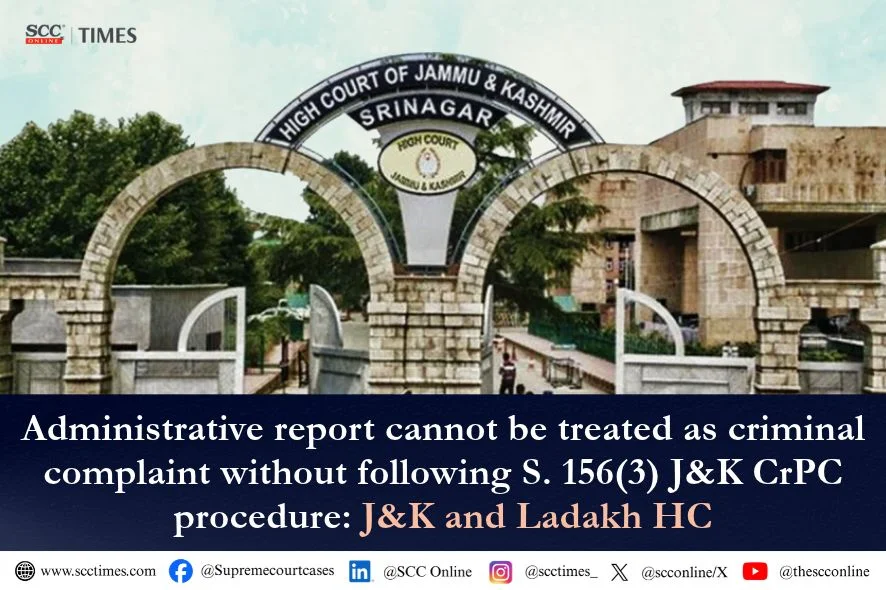
Jammu & Kashmir and Ladakh High Court: While considering a petition challenging an FIR registered for offences under Sections 447-A and 427, Ranbir Penal Code, 1989 (RPC), a Single Judge Bench of Sanjay Dhar, J., held that information supplied by a Court employee to the Presiding Officer regarding an attempt to occupy a portion of land under the Court’s possession was merely an administrative report which could not be treated as a criminal complaint warranting registration of an FIR without following the procedure laid down in Section 156(3), Jammu & Kashmir Criminal Procedure Code, 1989 (J&K CrPC). The Court added that the Magistrate had not followed the procedure laid down by the Supreme Court in Priyanka Srivastava v. State of U.P., (2015) 6 SCC 2871, before directing the FIR under Section 156(3), J&K CrPC. Accordingly, the Court quashed the FIR registered against the public officials.
Also Read: S. 482 CrPC: SC’s 4 step process to check veracity of quashment prayer by accused
Background
The dispute arose from a report submitted by a Chowkidar working in the Court of Munsiff, Thanamandi. The report alleged that, , on 6-7-2018 at about 7:00 pm, certain unknown persons had entered the Court complex, carried out demarcation for purposes of construction of shops and damaged the barbed wire fencing. Upon enquiry, it was allegedly found that employees of the Tehsil Office and Municipality had undertaken the demarcation activity. Pursuant to this report, the Judicial Magistrate First Class directed the SHO concerned to register an FIR against the Tehsildar, Thanamandi, and the Executive Officer, Municipality, Thanamandi (public officials), and investigate the matter.
The public officials challenged the FIR contending that the complainant had not complied with the mandatory requirements under Sections 154(1) and 154(3) J&K CrPC before approaching the Magistrate. It was submitted that neither the police station nor the SSP had been approached before filing the application and that the complaint was not supported by any affidavit. According to them, as per the directions issued by superior Revenue Authorities, they were required to transfer a specified portion of land to a private individual whose land had earlier been acquired for construction of a road under PMGSY. It was argued that the demarcation was undertaken while discharging their official functions and they could not be prosecuted for that.
The investigating agency submitted that during investigation, a site plan had been prepared, statements under Section 161 J&K CrPC had been recorded and revenue records had been collected. It was further submitted that although the land stood recorded in the name of the Revenue Department, it had been under the occupation of the Court for a long period.
Analysis
The Court noted that the documents placed on record showed that the land in question stood recorded in the name of the Revenue Department but was in the possession of the Munsiff Court, Thanamandi. The Court further noted that higher officers of the Revenue Authorities had directed the public officials to hand over a portion of the land to a person whose property had been acquired for construction of a PMGSY road, which prompted the demarcation of land that was already in occupation of the Court establishment.
The Court observed that a careful reading of the Chowkidar’s report revealed that it was not a complaint under Section 156(3) J&K CrPC in the strict sense. The Court highlighted that the Court employee had merely brought to the notice of the Presiding Officer an alleged attempt to occupy a portion of land which remained under the Court’s possession. Significantly, there was no prayer seeking registration of an FIR.
The Court noted that the application submitted before the Presiding Officer appeared to be nothing more than information furnished by a subordinate employee to a superior officer in administrative capacity. The Court observed that the proper course for the Presiding Officer would have been to inform the District Judge and the High Court regarding the alleged attempt to take over a portion of land in occupation of the Court and have the matter dealt with administratively. The Court observed that instead of adopting this course, the Magistrate treated the information as a criminal complaint and directed registration of an FIR against the public officials. The Court opined that such a course was not countenanced in law, and the Magistrate had flouted the procedure laid down by the Supreme Court in Priyanka Srivastava v. State of U.P., (2015) 6 SCC 287. The Court further observed that the learned Magistrate had given a criminal colour to a purely administrative matter.
The Court also noted that the conduct of the public officials in attempting to occupy a portion of land that had admittedly remained in possession of the Munsiff Court for several years, without bringing the matter to the notice of the Presiding Officer or the District Judge, reflected high-handedness on the part of the public officials as well as their superior officers for which they needed to be dealt with on the administrative side.
Also Read: Girlfriend not “relative” under S. 498-A RPC: J&K HC
Decision
Accordingly, while allowing the petition, the Court quashed the impugned FIR and all proceedings emanating therefrom. The Court further directed that the Registrar General of the High Court may take up the matter with the Deputy Commissioner concerned so that the issue could be resolved on the administrative side.
[Qadeer-Ul-Rehman v. State (UT of J&K), CRMC No. 447 of 2018, decided on 5-10-2026.]
Advocates who appeared in this case:
For the Petitioners: Abhinav Sharma, Senior Advocate with Pariyal Dagyal, Advocate.
For the Respondents: Bhanu Jasrotia, Advocate.
1. Ed. Note: In Priyanka Srivastava, the Supreme Court held that an application under Section 156(3) CrPC must be supported by an affidavit and must show compliance with Sections 154(1) and 154(3) CrPC.