The Asian International Arbitration Centre (AIAC) is hosting the eighth edition of its flagship Asia ADR Week from 12th to 16th October 2026 in Kuala Lumpur.
Hosted under the theme “Kainos: Where Vision Transforms Future”, the Asia ADR Week 2026 brings together practitioners, arbitrators, mediators, academics, businesses and stakeholders from Malaysia, Asia and beyond to exchange perspectives on the developments shaping the future of dispute resolution.
In a panel discussion titled “Code, Capital and Compliance: Resolving Disputes in Islamic Fintech”, the esteemed panellists examined the challenges posed by technology-driven financial transactions to Islamic legal principles and the role of alternative dispute resolution (ADR), particularly arbitration, in resolving disputes arising from Islamic financial products. The discussion addressed the Sharia compliance of smart contracts, the risks arising from automated transactions, the importance of procedural fairness, and the suitability of the of the Islamic Arbitration Rules i.e. the AIAC i-Arbitration Rules, 2026 (i-Arbitration Rules) for resolving disputes involving Islamic FinTech.
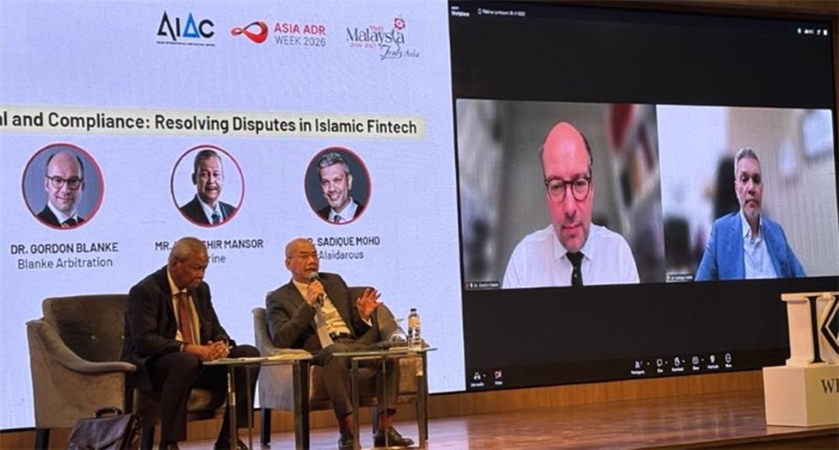
[In picture from left to right: Mr. Mubashir Mansor, Mr. Jalalullail Othman, Dr. Gordon Blanke, and Mr. Sadique Mohd]
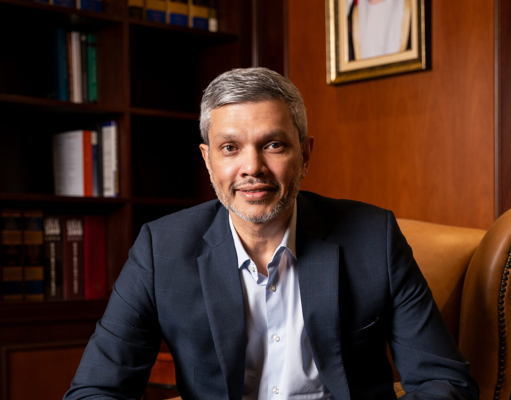
Moderated by Mr. Jalalullail Othman, Independent Director, Shook Lin & Bok, the panel consisted of esteemed professionals, namely Dr. Gordon Blanke, Founding Partner, Blanke Arbitration LLC; Mr. Mubashir Mansor, Partner, Skrine; and Mr. Sadique Mohd, Lead Counsel, Alaidarous.
At the outset, Mr. Othman set the stage and asked the panellists to speak about the inherent attributes or features of FinTech that pose a challenge to Sharia.

A. Challenges posed by FinTech to Sharia
Smart contracts and Sharia compliance: Mr. Mubashir Mansor
Mr. Mubashir Mansor explained that FinTech could be understood as the delivery of Islamic financial documents and transactions through technological platforms, like blockchain. A smart contract, he observed, is a form of such technology in which contractual terms are coded and executed automatically without the need for an intermediary.
However, he identified potential difficulties where the coded terms of a smart contract conflict with the requirements of an Islamic contract. One such concern relates to gharar, or uncertainty, including sales involving uncertain goods or prohibited/ haram subject matter.
Mr. Mansor also referred to the possibility of system failures, particularly the failure of an oracle. In a smart contract, certain contractual terms may depend on events or information external to the coded system, such as world prices, weather conditions, or political developments. An oracle is responsible for transmitting such external information to the system. If that process fails, the smart contract may execute based on information that does not reflect the circumstances contemplated by the parties. This could result in parties being bound by terms that were not intended to apply to their transaction. He considered this risk particularly significant in Islamic finance because of the substantive requirements to avoid riba (unjust gains), interest, uncertainty, and gambling.

Sharia compliance of Islamic financial products: Dr. Gordon Blanke
Dr. Gordon Blanke began by explaining the fundamental principles governing Islamic finance. He stated that Islamic financial products must be halal, i.e., permissible and compliant with Islamic Sharia, rather than haram, i.e., prohibited.
Thereafter, he identified three principal prohibitions: riba (interest or excessive gain), gharar (uncertainty), and maysir (gambling or speculation). He also explained that Islamic finance is based on the principle of profit-and-loss sharing. Sharia-compliant financial products include murabaha (cost-plus financing), mudarabah (trust financing), and ijara (leasing).
He emphasised that Sharia compliance must be maintained throughout the entire lifecycle of a financial product. To achieve this, Islamic financial contracts are routinely examined and approved by corporate Sharia boards.
Dr. Blanke further explained that the compliance requirement extends beyond the underlying financial product to the dispute resolution process itself. Both the process and the outcome of a dispute must be Sharia-compliant. He described the resulting exposure as Sharia risk, which arises when a party argues that the underlying contract or the dispute resolution process is invalid because it does not comply with Sharia.
According to him, this risk may be aggravated by the absence of a codified body of Islamic Sharia. It can also give rise to enforcement difficulties where a court in the jurisdiction in which enforcement is sought treats a violation of Sharia as a violation of public policy. In such circumstances, the judgment or arbitral award may be exposed to the risk of being set aside or refused enforcement.
To mitigate this risk, Dr. Blanke suggested that parties could
-
agree to Sharia-compliant dispute resolution,
-
select a forum capable of addressing Sharia requirements in both substance and procedure, and
-
incorporate an enforceable governing law clause that ensures the application of Islamic Sharia to their dispute.
Speed of FinTech creates challenges for legal processes, but arbitration offers procedural safeguards: Mr. Sadique Mohd
Mr. Sadique Mohd agreed with the concerns raised by the other panellists regarding smart contracts, riba, and gambling. He explained that Islamic finance is increasingly delivered through technology, including digital banking, online investment platforms, blockchain, and smart contracts.
He observed that technology develops at a very high speed, while the underlying financial transaction must continue to satisfy Sharia requirements. This creates a continuing tension between the speed of technological developments and the application of legal principles. However, Mr. Mohd noted that this difficulty is not unique to Islamic FinTech, as the law generally has to respond to technological developments that have already taken place. Thus, he underscored the speed of change in technology as a challenge.
To illustrate the problem, he referred to a cryptocurrency liquidation dispute that he was handling before a common law court in the UAE. In that matter, a claimant alleged that his account had been liquidated within microseconds, with a timestamp recording the event at the nanosecond level. Sadique observed that such circumstances create difficulties for the legal process even before the additional requirements of Sharia are considered.
He referred to qiyas, i.e., reasoning by analogy, as a principle of Islamic law that may assist in applying existing legal rulings to new situations. In his view, the application of existing rulings to technological developments must remain anchored in the underlying reasons supporting those rulings.
Mr. Mohd also observed that arbitration places considerable emphasis on due process and procedural fairness. Arbitrators are concerned with ensuring that each party has an opportunity to present its claim and defence and that the proceedings provide both sides with a fair hearing. He considered these principles consistent with the procedural concerns of Sharia. In this respect, he described Islamic FinTech and arbitration as compatible.
However, he identified a challenge in cross-border disputes, where the applicable legal and Sharia governance frameworks may differ. He emphasised the importance of allowing parties to choose an appropriate decision-maker who can assess the dispute under the applicable substantive law while remaining mindful of the Sharia principles underlying the transaction. Ideally, the decision-maker would possess expertise in both the substantive law and Sharia. He acknowledged that achieving this could be difficult, but considered that it would enable the dispute resolution process to respect both the journey and the ultimate outcome.
B. Features of Islamic ADR that suit FinTech
i-Arbitration Rules for Sharia-compliant dispute resolution: Mr. Mubashir Mansor
Turning to the second part of the discussion, Mr. Mansor explained that the i-Arbitration Rules contain provisions intended to facilitate Sharia-compliant arbitration.
-
Tailored for Sharia compliance: He referred to Rules 1.2 and 1.4, which provide that where a matter is not expressly addressed in the rules, the arbitral tribunal, the parties and the relevant arbitration body are to endeavour to ensure that the resulting award complies with Sharia principles. He also highlighted the rules’ emphasis on conducting proceedings expeditiously and economically.
-
Third-party funding: Mr. Mansor identified third-party funding as an important feature of the rules, but the same was subject to requirements comparable to those applicable in conventional arbitration, including disclosure and information concerning the terms and extent of the funding. He observed that it could assist claimants with limited financial resources who are pursuing claims against established financial platforms or blockchain operators.
-
Availability of virtual proceedings: Given that disputes involving smart contracts are inherently digital, virtual hearings can reduce dependence on paper-based processes and facilitate the handling of digitally generated evidence. He further observed that virtual proceedings could assist in protecting confidential information.
-
Costs: Mr. Mansor drew attention to the costs associated with expedited proceedings. He stated that, under the fast-track procedure, the administrative fees constituted 20% of the arbitral costs, which he considered attractive for parties involved in disputes, particularly those with limited financial resources.
-
Interim Relief: He further emphasised the importance of interim relief in disputes involving rapidly moving financial transactions and assets that may be subject to dissipation or changes in value. The rules provide for an emergency arbitrator before the constitution of the arbitral tribunal and for interim relief once the tribunal has been constituted.
-
Reference to Sharia Council or Expert: Mr. Mansor stressed the feature of the Sharia Advisory Council (SAC). He explained that disputes concerning the interpretation or application of Sharia principles had raised questions before courts, particularly regarding the role of SAC. He referred to Sections 56 and 57 of the Central Bank of Malaysia Act, 2009 (CBMA). Section 56 requires a court or arbitrator dealing with a Sharia issue to refer to established rulings of the SAC under the auspices of Bank Negara Malaysia or, where no relevant ruling exists, to refer the issue to the SAC for a ruling. Section 57 provides that the resulting ruling is binding.
He contrasted these provisions with Rule 38 of the i-Arbitration Rules, which provides that an arbitrator may refer a Sharia issue to a Sharia council or expert. He raised the question of whether an arbitrator was obliged to make a referral under the statutory provisions or could exercise the discretion contemplated by the arbitral rules.
In his analysis, the answer required consideration of the relationship between the relevant legislative frameworks. He referred to the Arbitration Act 2005, including Section 21 on procedural rules, Section 22 on the seat of arbitration, Section 9A on the law governing the arbitration agreement and Section 30 on substantive law.
He argued that where parties chose to arbitrate under the i-Arbitration Rules, they exercised rights conferred by the Arbitration Act 2005. He considered the Arbitration Act a more specific legislative framework for arbitration than the CBMA provisions governing courts and arbitration in this context. On that basis, he expressed the view that an arbitrator applying the i-Arbitration Rules was not necessarily obliged to refer a Sharia issue to the SAC and could decide the issue without referral where the arbitrator possessed the requisite expertise.
He also raised the question of which body should receive a referral where an Islamic FinTech product involved different regulatory areas. He referred to the SAC under the CBMA, the SAC under the Securities Commission Malaysia Act, 1993, and the Labuan Shariah Advisory Council, noting that a financial product could involve banking or capital markets.
He further observed that cross-border transactions may involve a combination of institutional rules, substantive laws, and seats of arbitration from different jurisdictions. Parties could, for example, choose the i-Arbitration Rules while selecting a foreign governing law or seat. In such circumstances, the relevant framework for referring Sharia issues would require careful consideration.
Can conventional arbitration frameworks accommodate Sharia issues: Dr. Gordon Blanke
Responding to Mr. Mansor’s analysis, Dr. Blanke discussed the treatment of Sharia issues in the UAE and the possibility of resolving Islamic FinTech disputes under conventional arbitration rules. He referred to specialist arbitral institutions dealing with Islamic Sharia disputes, including the Islamic International Arbitration Centre, and observed that such institutions may require the appointment of arbitrators with appropriate Sharia qualifications and experience.
Dr. Blanke agreed that where an arbitrator already possessed the necessary Sharia expertise, referral to another body might not always be necessary. However, he distinguished this position from the UAE legal framework. He referred to the UAE Civil Transactions Code, 2025, and its provisions concerning the role of Islamic Sharia in the legal system. He explained that the relevant provisions treated pronouncements on Islamic Sharia as matters of public policy, making compliance with Sharia mandatory.
Accordingly, where an arbitration in the UAE raises a Sharia issue, both the process and the outcome would need to comply with the relevant requirements. Dr. Blanke considered this particularly significant for FinTech disputes, which were likely to raise concerns of Sharia compliance.
Regarding a Sharia-specific arbitration forum or framework, Dr. Blanke opined that such a specific forum or framework was not indispensable for every dispute involving Islamic finance or FinTech. He suggested that conventional arbitration institutions, including the London Court of International Arbitration (LCIA), the International Chamber of Commerce (ICC), and the Dubai International Arbitration Centre (DIAC), could also accommodate such disputes. He explained that conventional arbitration rules provide mechanisms for appointing experts, including tribunal-appointed experts, to assist with issues requiring specialised knowledge. Such mechanisms could be used to address questions of Sharia compliance even where the arbitral tribunal was not itself composed of Sharia specialists.
He also emphasised the significance of the governing law. In his view, arbitration tribunals may apply rules of law, rather than being limited to the national law of a particular jurisdiction. This could allow a tribunal operating under conventional arbitration rules to apply Islamic Sharia where necessary to achieve a Sharia-compliant outcome.
Thus, Dr. Blanke stated that a Sharia-related dispute did not necessarily have to be submitted to a specialist Sharia arbitration institution. Instead, the parties and tribunal would need to ensure that the applicable rules, governing law and available expert mechanisms were used effectively to address the relevant Sharia issues.

Preparation and writing of the arbitral award: Mr. Sadique Mohd
At the outset, Mr. Mohd agreed with Dr. Blanke that conventional arbitration frameworks could be used to resolve Islamic FinTech disputes, particularly given the current availability of experienced Sharia practitioners and adjudicators. He acknowledged that a Sharia-specific institution or process could be ideal, but remarked that the number of individuals with the necessary expertise was still limited.
He cautioned against conflating conventional ADR with Islamic ADR merely because both share principles of due process and procedural fairness. Mr. Mohd explained that, in conventional arbitration, the proceedings before the award are primarily concerned with procedure, including giving parties opportunities to present their cases and be heard. Once the proceedings conclude, the tribunal prepares the award and determines the merits of the dispute. On the other hand, in Islamic ADR, the requirement to comply with Sharia continues during the preparation and writing of the award. Even if an award correctly applies the contractual provisions and procedural law, it may raise a Sharia compliance issue if its substantive reasoning or relief conflicts with Islamic principles. Thus, Sharia compliance must be reflected in the award itself, rather than being treated as a requirement that ends when the evidentiary or hearing stage concludes.
To substantiate his argument, he referred to liquidated damages in construction contracts. Under a conventional contractual arrangement, liquidated damages may be calculated using an agreed daily rate multiplied by the number of days of delay. However, under the relevant Sharia principles, it might be necessary to establish that the employer has actually suffered a loss.
Mr. Mohd also gave examples, such as interest and damages could be awarded under conventional arbitration; riba and other concepts of actual loss, unjust enrichment and prohibited gain must be carefully considered in an Islamic dispute. Thus, in an Islamic FinTech, in the context of ADR, the damages must be scrutinised against Sharia concepts.
Furthermore, he addressed the difficulties associated with interim relief. He observed that both conventional and Islamic ADR may face challenges where urgent relief is required before the tribunal has been constituted or where an application must be made without prior notice to the other party. The difficulty is heightened where the decision-maker must possess sufficient Sharia expertise to determine the application urgently. He identified two considerations concerning such relief: whether the interim order would be enforceable before a court, including a common law court, and whether the order could subsequently be considered by the main tribunal once constituted.
Thus, Mr. Mohd explained that the limited availability of suitably qualified decision-makers created a practical challenge in securing urgent relief that complied with Sharia and remained capable of enforcement.
Adding to Mr. Mohd’s observations, Mr. Mansor returned to Rule 38 of the i-Arbitration Rules. He explained that the provision was principally intended to accommodate arbitrators who did not already possess Islamic qualifications. Where parties appointed an arbitrator with established Sharia expertise, referral to another body might not be necessary because the arbitrator would already be familiar with the relevant principles. However, parties might also prefer an arbitrator who did not have a predetermined position on a particular issue, making the referral mechanism useful in such cases. He compared this with the position of judges who may be required to determine disputes involving Islamic financing documents despite not possessing specific Islamic qualifications.
He further explained that the i-Arbitration Rules were designed to avoid the difficulties that could arise when disputes concerning Islamic financial documents were placed within conventional arbitration rules without sufficient attention to Sharia compliance.
Dr. Blanke responded to Mr. Mohd’s examples by observing that some national legal systems incorporate Sharia requirements directly into their legislation, for example, the UAE. He argued that where the relevant legal provisions already reflected Sharia principles, the risk of non-compliance could be reduced through the correct interpretation and application of the law.
Drawing on his experience in arbitration, including construction disputes, Dr. Gordon stated that some parties may incorrectly interpret UAE law concerning interest or liquidated damages. In his view, a proper interpretation of the applicable legal provisions should help avoid outcomes that conflict with the relevant Sharia requirements.
He also referred to the UAE Civil Transactions Code 2025 and observed that it had changed the approach to interest in a manner that made the UAE framework less liberal in this respect.
Following this exchange, Mr. Othman referred to the development of Islamic standard building form contracts from a Malaysian perspective, noting that these were intended to address some of the issues raised in relation to construction contracts and Sharia principles.
C. Future of Islamic ADR
Turning to the future of Islamic ADR, Mr. Othman asked the panellists whether the i-Arbitration Rules and corresponding developments elsewhere were likely to narrow the gap between FinTech and Sharia compliance.
Incorporation of i-Arbitration Rules in Islamic FinTech: Mr. Mubashir Mansor
Mr. Mansor expressed confidence in the suitability of the i-Arbitration Rules for resolving Islamic FinTech disputes. He stated that the next step was to engage with FinTech platform providers and encourage them to incorporate the Rules into their contractual terms or the coded terms governing smart contracts. For example, disputes could arise where a smart contract was intended to govern an Islamic financial product but selected English law as its governing law. Such a choice could create difficulties if the substantive law did not adequately address the applicable Sharia requirements. These difficulties could become particularly significant at the enforcement stage, where a party might argue that enforcement in an Islamic jurisdiction would violate public policy.
He stated that the i-Arbitration Rules addressed these concerns by providing Sharia compliance in both procedure and substance. He also highlighted their treatment of late payment, including the concepts referred to as ta’widh, or compensation, and gharamah, or a penalty.
In his view, if proceedings were conducted in accordance with the Rules, the resulting award could comply with Sharia both substantively and procedurally, reducing the risk of enforcement difficulties in Islamic jurisdictions.
Clear contractual provisions and investor confidence: Mr. Sadique Mohd
Mr. Mohd acknowledged the detailed and practical approach adopted in the i-Arbitration Rules. He opined that the rules are suitable for Islamic FinTech disputes and observed that compliance with their requirements could reduce the likelihood of the process or award being challenged. He linked this to investor confidence, emphasising that parties must have confidence in both the institution and the rules governing the resolution of their disputes.
However, he also observed that Sharia and other legal systems would continue to face challenges in keeping pace with technological developments. He considered it important to recognise that law cannot develop at the same speed as technology. A practical response required the development of a pool of specialised arbitrators and experts capable of addressing disputes involving digital banking, blockchain, and automated financial products. He further emphasised the increasing importance of interim measures in cross-border digital asset disputes, given the speed with which assets and transactions may change.
Thus, Mr. Mohd identified three things that should be addressed clearly in the contract at the outset: the governing law, the dispute resolution clause, and the Sharia governance provisions. He explained that these provisions should be carefully drafted to ensure that contractual arrangements do not inadvertently include terms that may conflict with the requirements of Sharia. This was particularly important where transactions were drafted using conventional common law approaches that might not adequately account for the Sharia principles underlying the financial product.
In his view, careful drafting at the transaction stage could reduce the risk of disputes and challenges later in the process.
Regulatory oversight and specialised dispute resolution are important developments in the UAE: Dr. Gordon Blanke
Dr. Blanke agreed with the other panellists on the importance of the i-Arbitration Rules and their suitability for Islamic finance and FinTech disputes.
From the UAE perspective, he stated that it was increasingly focused on the regulation of FinTech products. In this regard, he referred to the UAE Central Bank Law, 2025, and explained that entities offering licensed financial activities were brought within the Central Bank’s licensing and oversight framework. FinTech products falling within the relevant licensing requirements would therefore be examined for compliance with Sharia as part of the regulatory process.
He also referred to the role of the Higher Sharia Authority in the UAE, which is responsible for binding Sharia standards and ensuring that the Central Bank’s oversight arrangements address Sharia compliance. He stated that this regulatory approach could help reduce the number or intensity of disputes by ensuring that FinTech products were examined for compliance before they were offered to the market.
Dr. Blanke also highlighted the development of specialised forums for disputes concerning the digital economy in the UAE. In particular, he referred to the Dubai International Financial Centre (DIFC) Digital Economy Court, established in 2021, and its potential role in resolving disputes involving FinTech and digital assets. He observed that the development of a specialised court could make it an attractive forum for disputes arising from the digital economy.
However, he also considered the implications of Sharia compliance in proceedings before the DIFC Digital Economy Court. Referring again to the UAE Civil Transactions Code, he stated that Sharia had been elevated to the status of public policy and that judicial decisions and activities within the DIFC would also be subject to the applicable requirements.
Thus, he concluded by highlighting the significance of regulatory oversight and specialised dispute resolution mechanisms in addressing the challenges posed by the digital economy.
Conclusion
The panel discussion examined the relationship between Sharia principles and FinTech products, with particular attention to the challenges posed by smart contracts, evolving technology, automated transactions, and cross-border digital asset disputes. The panellists underscored the importance of combining appropriate contractual drafting, specialised expertise, and effective dispute resolution mechanisms to address disputes arising from Islamic FinTech transactions.
SCC Times is the official media partner for AIAC Asia ADR Week 2026. Read more about AIAC Asia ADR Week 2026: