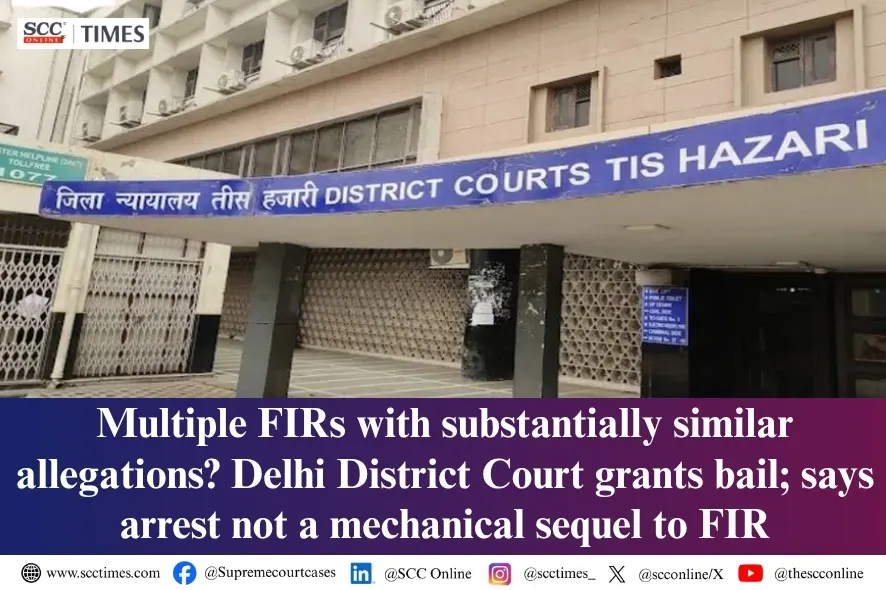
Tis Hazari District Court: In a bail application in one of several FIR involving a sophisticated and high-value real estate fraud, particularly for offences punishable under Sections 316, 318, 335, 336, 338, 340, 341, 342 and 61, Nyaya Sanhita, 2023 (BNS), the Chief Judicial Magistrate Harshita Mishra held that continued detention of the accused in the present FIR would not meaningfully advance the investigation; rather result in an unwarranted and disproportionate restriction upon his personal liberty without any demonstrable investigative necessity.
The Court granted regular bail subject to bail bonds and surety bonds in the sum of ₹50,000 and conditions involving cooperation with the investigation, refrain from influencing witnesses or tampering with evidence, etc.
Background
The present FIR was registered based on a complaint against Mohit Gogia, Shweta Gogia, M/s M.G. Leasing & Finance, the present applicant Abhinav Pathak and others for offences punishable under Sections 316, 318, 335, 336, 338, 340, 341, 342 and 61 BNS.
According to the prosecution, the complainant and her family were induced to invest around ₹3.92 crores on the false assurance that the accused persons would facilitate the purchase of properties, allegedly auctioned by J&K Bank under the Securitisation and Reconstruction of Financial Assets and Enforcement of Security Interest Act, 2002 (SARFAESI), at concessional prices. It was alleged that the present applicant, who was known to the complainant’s family through a prior business association, introduced Mohit Gogia and Shweta Gogia, proprietors of M/s M.G. Leasing & Finance. They represented that they had experience, expertise and connections with J&K Bank to procure distressed assets. The accused allegedly represented that they had themselves purchased similar properties and persuaded the complainant to invest in properties situated at Ansal Villas, Satbari, Hauz Khas and Janpath.
The prosecution alleged that, acting on these representations, the complainant invested approximately ₹3.92 crores through banking channels and was furnished with documents purportedly relating to the auction proceedings, including sale certificates, auction reports, auction completion notices and possession applications. Whenever possession and title documents were sought, the accused allegedly delayed the transactions on one pretext or another. Although Mohit Gogia subsequently executed an agreement acknowledging the transactions and promising a refund if the properties could not be delivered, the complainant alleged that neither the promised properties nor the money was returned.
The alleged fraud came to light when the complainant’s husband approached J&K Bank, Connaught Place, for verification. According to the prosecution, the Bank denied any association with Mohit Gogia, Shweta Gogia or M/s M.G. Leasing & Finance, disowned the auction documents as forged and fabricated, and stated that no payment had been received towards the purported auction properties. It was further alleged that the Bank informed the complainant that a similar attempt had recently been made in respect of the same properties. On these allegations, the present FIR came to be registered against the applicant and the co-accused.
Issue
Whether the arrest effected pursuant to registration of FIR satisfied the test of legality, necessity and proportionality?
Analysis, Findings and Decision
The Court noted the principal submission of the applicant that the present FIR was one of several FIRs arising out of substantially similar transactions involving an identical modus operandi and members of the same family as alleged victims. It was submitted that the applicant had already been arrested in the first FIR and had remained continuously in judicial custody. Despite such custody, the investigating officer formally arrested him in the present FIR without any discernible investigative necessity or corresponding investigative gain. It was further contended that no additional documentary evidence was required to be recovered from the applicant, no custodial interrogation or police custody remand had been sought, and therefore, his continued detention in the present FIR served no legitimate investigative purpose.
At the outset, the Court clarified that, while deciding a bail application, it was not concerned with the legality or maintainability of multiple FIRs or whether the subsequent FIR arose out of the same transaction. The Court observed that such questions fall within the jurisdiction of the Constitutional Courts under Article 226 of the Constitution or under Section 528 BNS. Accordingly, the mere existence of multiple FIRs could neither invalidate the present prosecution nor, by itself, entitle the applicant to bail.
At the same time, the Court held that its inability to examine the validity of the FIR did not absolve it of its obligation to examine whether the applicant’s arrest satisfied the constitutional requirements of legality, necessity and proportionality. It distinguished the legality of an FIR from the justification for an arrest. While the former concerns the authority of the police to investigate a cognizable offence, the latter directly implicates the guarantee of personal liberty under Article 21 of the Constitution.
Reiterating the settled principles governing arrest, the Court observed that arrest is neither an inevitable consequence nor a mechanical sequel to the registration of an FIR. The Court emphasised that the existence of statutory power to arrest is distinct from the necessity of exercising that power. The Court held that every arrest must be justified by objective reasons satisfying the constitutional standards of fairness, necessity and proportionality.
The Court further observed that arrest is not intended to operate as a punitive measure or as an instrument for demonstrating the authority of the investigating agency. It is justified only where custodial interrogation is genuinely necessary, recoveries remain to be effected, or there exists a real likelihood of the accused absconding, influencing witnesses, tampering with evidence, or otherwise frustrating the investigation. The Court also reiterated that personal liberty cannot be curtailed on the basis of routine investigative practices or administrative convenience.
Applying these principles, the Court noted that the applicant had already been arrested in an earlier FIR arising out of substantially similar allegations and had remained continuously in judicial custody. The Court observed that the allegations against the applicant were serious and that the material collected during investigation prima facie suggested that he acted as an introducer between the principal accused and the complainant’s family. The Court held that the gravity of the accusations could not eclipse the requirement of examining whether continued custodial detention served any meaningful investigative purpose.
The Court attached significance to the investigating officer’s concession that, following the applicant’s formal arrest in the present FIR, no additional documentary evidence had been recovered, no fresh recovery had been effected, no new incriminating material had surfaced, no consequential witness statements had been recorded, no disclosure statement had led to the discovery of any material fact, and no police custody remand had ever been sought.
The Court observed that the absence of any request for police custody indicated that even the investigating agency did not consider custodial interrogation of the applicant necessary. It further noted that no material advancement in the investigation could be attributed to his formal arrest in the present case.
In these circumstances, the Court found it difficult to appreciate the investigative necessity for effecting a separate arrest when the applicant was already available to the investigating agency by virtue of his judicial custody in the earlier FIR. The Court observed that the object of arrest is to facilitate investigation and not to multiply or prolong incarceration.
While recognising that each FIR constitutes an independent criminal proceeding and that arrest in 1 case does not bar arrest in another, the Court held that every subsequent arrest must independently satisfy the constitutional requirement of necessity. The Court observed that such necessity cannot be presumed merely because another FIR has been registered. Rather, the investigating agency must demonstrate the distinct investigative purpose sought to be achieved by such arrest.
The Court further held that the apprehension of absconding stood considerably diluted as the applicant was already in judicial custody in another connected case. The Court also found the apprehension of tampering with evidence to be substantially weakened. The Court observed that the prosecution case was predominantly documentary in nature, and the relevant material had either already been secured or could be independently collected. The Court further noted that no particularly vulnerable witness had been identified, and there was no allegation that the applicant had attempted to interfere with the investigation before his arrest or whenever he was not in custody.
The Court reiterated that deprivation of personal liberty cannot rest on vague apprehensions or generalised assumptions. There must be tangible material demonstrating a real and proximate likelihood of interference with the administration of justice.
“The criminal justice system is required to maintain a delicate equilibrium between the legitimate interests of effective investigation and the equally compelling constitutional imperative of preserving personal liberty. Neither objective can be permitted to overwhelm the other. Courts are duty-bound to ensure that investigative powers are exercised to advance the cause of justice and not in a manner that results in avoidable or disproportionate deprivation of liberty.”
On the facts of the present case, it noted that the applicant had remained continuously available to the investigating agency by virtue of his custody in the earlier FIR. No further documentary evidence remained to be recovered from him, no consequential investigation had followed his formal arrest in the present FIR, and even the investigating officer had not considered police custody necessary at any stage.
In view of the foregoing, the Court held that the applicant’s continued detention in the present FIR would not meaningfully advance the investigation. Instead, it would result in an unwarranted and disproportionate restriction on his personal liberty in the absence of any demonstrable investigative necessity.
Accordingly, having regard to the totality of the facts and circumstances, the Court held that the applicant’s continued incarceration in the present FIR was not justified and granted him regular bail, subject to conditions requiring him to cooperate with the investigation, refrain from influencing witnesses or tampering with evidence, intimate any change in his residential address or mobile number, not leave India without prior permission of the Court after depositing his passport, and appear before the trial court on all dates of hearing.
The Court clarified that its observations were confined to the adjudication of the bail application. Nothing contained in the order should be construed as an expression of opinion on the legality of the registration of the present FIR, the maintainability of multiple FIRs, or the merits of the prosecution case.
Also Read: The Law on Clubbing of Multiple FIRs | SCC Times
[State v. Abhinav Pathak, 2026 SCC OnLine Dis Crt (Del) 28, decided on 18-7-2026]
Advocates who appeared in this case:
For the applicant: Prabhav Ralli, Tarun Kumar Bedi and Deeya Mittal, Advocates
For the respondent: Amit Yadav, APP for the State