Disclaimer: This has been reported after the availability of the order of the Court and not on media reports so as to give an accurate report to our readers.
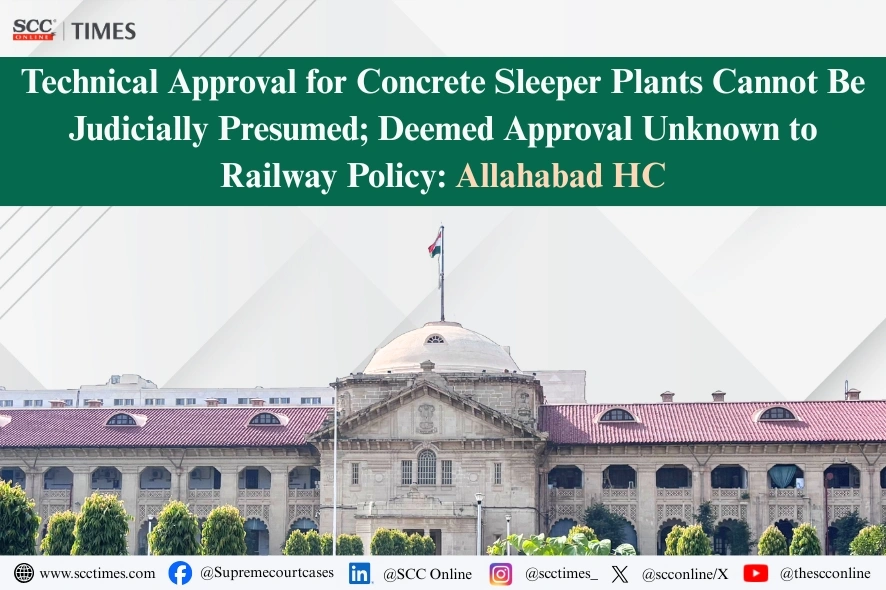
Allahabad High Court: In a writ petition seeking directions to the Ministry of Railways to grant approval/provisional approval for a proposed concrete sleeper plant (CSP), extend the time for commissioning the railway siding, and permit participation in Railway tenders, the Division Bench of Shekhar B. Saraf and Abdhesh Kumar Chaudhary, JJ., dismissed the petition, holding that there is no concept of deemed approval under the Railway policy governing CSPs. The Court observed that approval of a CSP requires satisfaction of technical parameters at multiple stages, which cannot be substituted by judicial determination, and that the benefit of the revised guidelines extending time for commissioning railway sidings is confined to already approved or operational CSPs.
Background
The petitioner-Company on 1 April 2025 applied for approval, to establish a new CSP at Bilaspur, Chhattisgarh and contended that all requisite documents had been furnished by March 2026, but the Railways had not processed its application. Relying upon the Railway Board’s subsequent guidelines granting existing CSPs additional time to commission railway sidings, the petitioner sought similar relaxation along with approval of its plant and permission to participate in Railway tenders. The respondents opposed the petition, contending that the relaxation was applicable only to already approved or operational CSPs and not to fresh applicants.
Analysis and decision
The Court noted that the petitioner was not granted approval by the Railways to manufacture concrete sleepers at its proposed CSP, and its application would complete by the new guidelines issued by the Railways. The Court also noted that granting the relief sought would effectively amount to granting deemed approval, which is impermissible in law. The Court observed that approval of a CSP involves a multi-stage technical process, including scrutiny of documents, verification of source materials, inspection of plant and machinery, gauge checking, mix design approval, testing of samples, and assessment of the plant’s capacity and capability.
“This Court being bereft of any technical expertise cannot step into the shoes of the approving authority to make a technical assessment and grant approval to the petitioner.”
The Court observed that the new Railway regulations made it clear that any person intending to establish CSP, must have a ready for use railway siding and limited relaxation was available only to plants that were already in operation. Since the petitioner’s plant had not been approved, its reliance on the revised guidelines was found by the Court to be wholly misconceived/misplaced.
The Court rejected the petitioner’s claim for approval along with extension of time till 31 December 2026, noting that the benefit of extension was available only to operating CSPs under the Railway policy dated 19 February 2021 or who had been already operational CSPs. The Court observed that since the petitioner had not been granted approval and there is no concept of deemed approval, the petitioner was not entitled to the said benefit. The Court opined that,
“The relief sought by the petitioner seems to be in disguise as it tries to achieve something indirectly (i.e. the approval), which it has failed to achieve directly.”
The Court dismissed the writ petition as being devoid of merit. However, the Court clarified that it had not expressed any opinion on the merits of the petitioner’s pending application for approval of its CSP and directed that the same be decided independently by the competent authority in accordance with law.
[Calcutta Springs v. Union of India, 2026 SCC OnLine All 22860, decided on 17-7-2026]
Advocates who appeared in this case:
For the petitioner: Ram Nath Pandey
For the respondent: A.S.G.I.