About the workshop
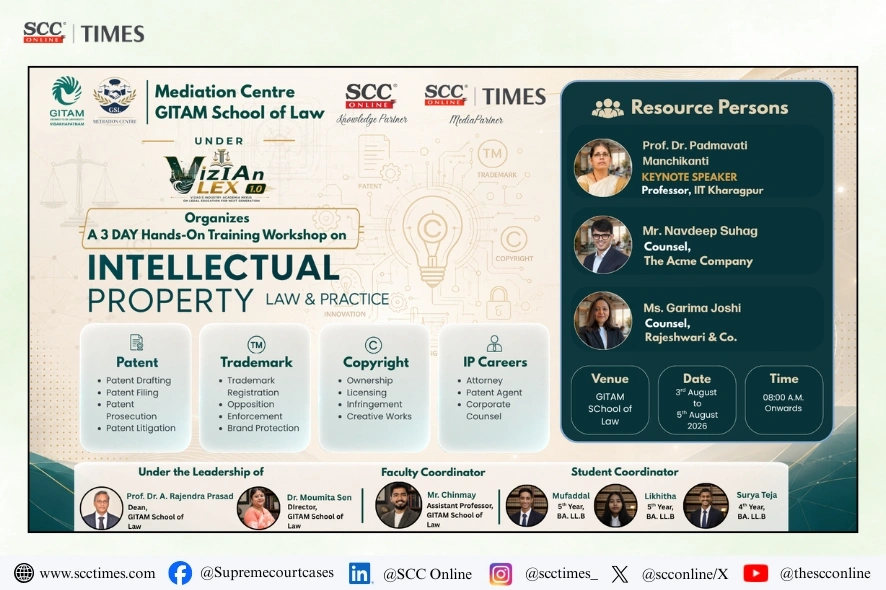
GITAM School of Law is hosting a Hands-on Training Workshop on “Intellectual Property Law and Practice: Prosecution, Litigation, and Professional Roles in Patent, Trademark, and Copyright Matters” from 3 to 5 August, 2026. The workshop is designed as a practice-oriented engagement that moves away from purely theoretical teaching and focuses on procedural realities, drafting tasks, role allocation, and litigation strategy in intellectual property (IP) disputes and registration work.
Chinmay, Assistant Professor at GITAM School of Law, serves as the Organising Faculty Workshop Coordinator for this IP workshop, curating a structure that enables participants to follow IP files from client intake to registration, opposition, infringement action, interim relief, evidence preparation, settlement, and final relief. The programme is being conducted under the academic stewardship of Dr. Moumita Sen, Director, GITAM School of Law, whose broader work under the VizIAnLex project seeks to embed industry-aligned IP practice training within the law school’s curriculum and extension activities.
Objectives
The workshop aims first to explain how patent, trademark, and copyright matters move in practice from client query to enforcement action, highlighting the interplay between prosecution, advisory work, and litigation. It seeks to distinguish prosecution work before the intellectual property office from litigation work in courts, and to sensitise participants to the advisory and risk-assessment roles that connect the two.
A further objective is to help participants identify the practical functions of different professionals—advocates, patent attorneys, patent agents, trademark agents, and clients’ internal teams—in IP matters. The workshop trains participants in recognising and executing drafting and procedural tasks such as filing inputs, examination responses, opposition preparation, pleadings, evidence collation, and interim relief strategy in IP disputes.
Rationale and relevance
IP disputes and registration work have become increasingly practice-driven, demanding familiarity with filing strategies, procedural timelines, evidence management, oppositions, hearings, interim relief, and enforcement choices. Patent and trademark rights involve complex prosecution before the IP office, while copyright practice often centres on ownership documentation, licensing, digital enforcement, and both civil and criminal remedies.
Recognising that professionals in real-world IP practice do not operate in doctrinal silos, the workshop brings together patent, trademark, and copyright matters within a unified training framework. It demonstrates how decisions taken at the prosecution stage affect litigation strategy and enforcement outcomes, thereby bridging the gap between classroom understanding and professional execution in line with VizIAnLex’s industry-collaboration ethos.
Challenges addressed
A key challenge in IP education is that students and young practitioners often learn the statutory provisions of the Patents Act, Trade Marks Act, and Copyright Act without seeing how IP files are actually built, managed, and contested across different forums. Many lack exposure to tasks such as invention harvesting, prior art review, specification drafting, office-action responses, clearance searches, opposition drafting, and digital takedown practice, which collectively define day-to-day IP work.
The workshop addresses these challenges by mapping the lifecycle of IP files and focusing on the division of labour between prosecution teams and litigation teams. It clarifies the document flows involved—from filings and examination responses to oppositions, pleadings, evidence sets, and enforcement measures—so that participants understand not only the law but also the workflow realities underpinning IP practice.
Pedagogy
The workshop adopts a blended pedagogy comprising practice lectures, workflow mapping, document demonstrations, case-file simulations, and intensive Q&A sessions.
Over three days, participants attend two sessions per day, each of approximately two hours, with a 30-minute break between sessions, in an offline mode that encourages active engagement and collaborative learning.
Day 1 focuses on patent practice, with a session on patent prosecution in practice covering client intake, inventor interviews, invention disclosure notes, prior art searching, patentability reviews, drafting pipelines, filing strategies, examination stages, and common mistakes. A second session on patent litigation explores pre-suit assessment, cease-and-desist notices, forum choice, interim injunction strategy, evidence sets in patent disputes, and settlement structures. Subsequent days extend this approach to trademark and copyright practice, maintaining the same emphasis on realistic, file-based learning.
Resource persons
Resource persons for the workshop include Prof. Dr. Padmavati Manchikanti, Professor, IIT Kharagpur, Mr. Navdeep, Counsel, The Acme Company and Ms. Garima Joshi, Counsel, Rajeshwari and Associates bringing in immense expertise,skills and substantial exposure to IP prosecution and litigation.
They’ll guide participants through the technical and strategic dimensions of patent, trademark, and copyright practice, using actual or simulated case files to illustrate common challenges and professional approaches.
Expected outcomes
By the end of the workshop, participants should be able to map the life cycle of a patent, trademark, or copyright file in professional practice—from initial client queries and filing decisions to disputes and enforcement. They will understand what prosecution teams do before disputes arise and what litigators do once conflicts emerge, appreciating the continuity and differences between these roles.
Participants are expected to recognise the core document sets used in filings, oppositions, hearings, pleadings, evidence preparation, and enforcement matters, and to appreciate the division of labour between advocates and registration-side professionals such as patent or trademark practitioners. The workshop also aims to cultivate a practical orientation towards client counselling, risk assessment, and dispute strategy, enabling attendees to contribute meaningfully in IP teams during internships and early professional engagements.
Organizing committee
The IP workshop is organised by GITAM School of Law, Visakhapatnam, under the direction of Dr. Moumita Sen, Director, GITAM School of Law, whose leadership has consistently advanced practice-oriented and industry-linked initiatives, including those under the VizIAnLex project. Chinmay, Assistant Professor, functions as the Organising Faculty Workshop Coordinator, overseeing academic design, resource person engagement, and pedagogical integration across patent, trademark, and copyright practice.
The organising committee consists of faculty members, research staff, administrative personnel and student organizers including Muffadal Tambawala (Student Convenor, GSL Mediation Centre) and Surya Teja (Co-Convenor, GSL Mediation Centre) from GITAM School of Law who handle scheduling, coordination with resource persons, and participant communication. Together, they ensure that the workshop reflects the School’s commitment to high-quality, hands-on training for students, young advocates, and professionals engaging with innovation, media, branding, and technology law.