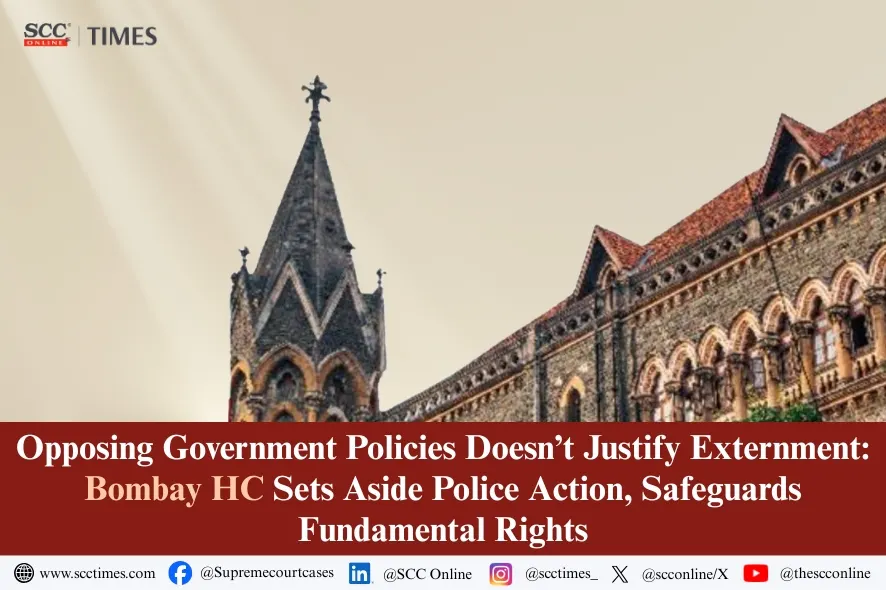
Bombay High Court: While hearing a writ petition challenging externment orders dated 3 December 2025 and 27 March 2026, a Single Judge Bench of Madhav J. Jamdar, J., observed that the allegations against the petitioner were confined to organising agitations, morchas, and dharnas without police permission, an offence under Section 188, Penal Code, 1860 (IPC) carrying a maximum punishment of 1 month’s simple imprisonment. The Court held that such allegations could not justify externment under the Maharashtra Police Act, 1951 (Maharashtra Police Act), and further noted that the State’s action of externing the petitioner merely for opposing government decisions infringed upon his fundamental rights of free speech, expression, and dignity.
Background
The petitioner belongs to the Social Democratic Party of India (SDPI), a political party registered with the Election Commission of India under Section 29-A, Representation of the People Act, 1951, and serves as its Secretary.
In his capacity as Secretary, he had arranged agitations, morchas, and dharnas opposing certain decisions of the Government of India. The externment orders were based on FIRs alleging that such agitations were organised without police permission.
It was contended that the externment orders were passed without any basis with no subjective satisfaction and amounted to mala fide action.
The State submitted that the petitioner had organised protests despite refusal of permission by police authorities, raised slogans, and thereby justified externment action. Reliance was placed on the affidavit of the Deputy Commissioner of Police and the reasons recorded in the impugned orders.
Analysis
The Court emphasised that Section 56(1)(a), Maharashtra Police Act contemplates that if the movements or acts of any person are causing or calculated to cause alarm, danger, or harm to person or property, then action of externment can be taken. Similarly, sub-section (1)(b) of Section 56, Maharashtra Police Act provides that there must be reasonable grounds for believing that such person is engaged, or is about to be engaged, in the commission of an offence involving force or violence, or an offence punishable under Chapter XII, XVI, or Chapter XVII of the IPC and all these offences are against the human body.
The Court noted that in all these FIRs, the allegation is that the petitioner, in his capacity as the Secretary of the Social Democratic Party of India, has arranged agitations/morchas/dharnas opposing certain decisions taken by the Government of India, and the other allegation is that such agitations/morchas/dharnas have been arranged without permission of the police, which is an offence under Section 188 IPC. The maximum punishment for this offence is simple imprisonment of 1 month, but the Court held that it cannot be a ground for passing the externment order under the provisions of the Maharashtra Police Act.
The Court highlighted that the subjective satisfaction recorded by the authorities, that the movements and acts of the petitioner are causing or are calculated to cause alarm, danger, and harm to the public and property, is without any material to support the same. Thus, the subjective satisfaction is vitiated.
The Court referred to Deepak v. State of Maharashtra, (2023) 14 SCC 707, wherein it was held that it is a settled legal position that an order of externment is an extraordinary measure, and the effect of such an order is depriving a citizen of his fundamental right of free movement throughout the territory of India. The Court also observed that Articles 19 and 21 of the Constitution inter alia contemplate that not only do citizens have the freedom of speech and expression, but they also have the right to live with dignity. However, the action taken by the State of externing the petitioner, merely for opposing certain decisions of the Government of India, affects the petitioner’s fundamental right of freedom of speech and expression and also the right to live with dignity.
The Court relied on Anuradha Bhasin v. Union of India, (2020) 3 SCC 637, where it was observed that the power under Section 144, Criminal Procedure Code, 1973 (CrPC) cannot be used to suppress legitimate expression of opinion or grievance or the exercise of any democratic rights. The Court further referred to Mohmmad Kaleem Taufiq Ahmed Siddiqui v. State of Gujarat, 2021 SCC OnLine Guj 3309, wherein an order of externment had been passed against the petitioner in that case for protesting a decision of the Union of India and observed that a citizen cannot be subjected to externment merely for raising grievances against the Government and, therefore, the order of externment was liable to be set aside.
Decision
Accordingly, the Court allowed the writ petition and quashed the externment orders dated 3 December 2025 and 27 March 2026, holding them unsustainable in law.
[Saeed Ahmad Abdul Wahid Chaudhary v. State of Maharashtra, 2026 SCC OnLine Bom 5087, decided on 2-7-2026]
Advocates who appeared in this case:
For the Petitioner: Payoshi Roy a/w Ulkesh Gangurde & Palak Dubey i/b Ibraheem K. M.
For the Respondent: Ms. S. M. Yadav, APP