The jurisprudence around the scope of judicial review at the pre-arbitral stage under Section 11, Arbitration and Conciliation Act, 1996 (Act) has been constantly seen to be developing in India, having significant implications on the foundational principles of party autonomy and judicial non-interference envisaged under the Act. The Supreme Court in its recent landmark seven-Judge Bench judgment of Interplay Between Arbitration Agreements under Arbitration and Conciliation Act, 1996 & Stamp Act, 1899, In re (Interplay, In re) has laid down principles limiting the role of the courts at the stage of Section 11 of the Act to a prima facie examination of the existence of an arbitration agreement.1 In a few recent judgments, however, there appears to be an expansion from the settled stance to an extent, as the court ventures deeper into the level of judicial scrutiny at this stage.
The power under Section 11 of the Act, initially characterised as administrative, was gradually expanded through cases like SBP & Co. v. Patel Engg. Ltd.2 and National Insurance Co. Ltd. v. Boghara Polyfab (P) Ltd.3, thereby allowing the Referral Courts to have considerably wider powers while dealing with preliminary issues. Subsequently, the Law Commission observed that there was a need to reduce judicial intervention at the pre-arbitral stage, i.e., prior to the constitution of the Arbitral Tribunal.4 As a result, Section 11(6-A) was inserted vide the Arbitration and Conciliation (Amendment) Act, 2015 (2015 Amendment Act) which confined the role of the courts at the stage of Section 11 of the Act to the examination of the existence of an arbitration agreement.5
The effect and impact of the 2015 Amendment Act was subsequently clarified by this court in Duro Felguera, S.A. v. Gangavaram Port Ltd.6, which stated that the intention of the legislature in incorporating Section 11(6-A) was to limit the scope of the Referral Court’s jurisdiction to only one aspect, the existence of an arbitration agreement. The 2015 Amendment Act thereby rendered the wide scope of judicial review under Section 11 of the Act as laid down in the cases of SBP & Co. and Boghara Polyfab redundant. Post the 2015 Amendment Act, the court in Vidya Drolia v. Durga Trading Corpn. considerably widened the scope of judicial review and held that the exercise of power of prima facie judicial review to examine the existence of an arbitration agreement also includes going into the validity of the arbitration agreement, and that this does not go against the principles of competence-competence and the presumption of separability.7 This position was clarified and set to rest by the seven-Judge Bench decision in Interplay, In re8, whereby it curtailed the Referral Court’s role at the stage of Section 11, observing that the legislature confined the scope of reference under Section 11(6-A) to the examination of the existence of an arbitration agreement, and that the use of the term “examination” in itself connotes that the scope of the power is limited to a prima facie determination. It further observed that in jurisdictions such as India, which accept the doctrine of kompetenz-kompetenz, only prima facie proof of the existence of an arbitration agreement must be adduced before the Referral Court. The Referral Court is not the appropriate forum to conduct a mini-trial by allowing the parties to adduce evidence in regard to the existence or validity of an arbitration agreement, and the determination of the existence and validity of an arbitration agreement on the basis of evidence ought to be left to the Arbitral Tribunal.
The Supreme Court, in this decision, also elaborated upon the doctrine of negative kompetenz-kompetenz as applied by the Indian Courts, which requires the courts to limit their interference at the referral stage, premised on the idea that the Tribunal should be first allowed to rule on its jurisdiction. Therefore, the scope of judicial review at the stage of Section 11 of the Act as it stands as on date only extends to a prima facie examination of the existence of an arbitration agreement.
In the very recent decision of Maharashtra State Electricity Distribution Co. Ltd. v. R Z Malpani9 the Supreme Court held that a general reference in a letter of intent to a tender document containing an arbitration clause is insufficient to incorporate that clause into a contract.
The prevailing authorities on the aspect of incorporation of the arbitration clause by reference, such as M.R. Engineers & Contractors (P) Ltd. v. Som Datt Builders Ltd.10 and Inox Wind Ltd. v. Thermocables Ltd.11, acknowledged that a general reference to a document incorporated as a whole could, in certain circumstances, carry along an arbitration clause embedded within it, particularly when that general reference is to a standard form of contract of one party.
The ruling in R Z Malpani case, however, draws a firm line, insisting on a specific and express reference to the arbitration clause itself. The court herein observed that the use of the word “contract” when dealing with incorporation of an arbitration agreement from some other document is intentional and consequential. The court further went on to state that since in the said appeal, it was one party’s case than the letter of intent incorporates the arbitration agreement from the terms of the tender documents, both the contractual nature of the letter of intent as well as the validity of incorporation was relevant to their examination.12
The novelty here lies in the court’s willingness to venture beyond a formal examination of whether an arbitration agreement exists on the face of the record wherein it essentially undertakes an examination of the underlying tender documents and commercial arrangements with a degree of analytical depth. Therefore, by delving into the substance of complex, multi-layered tender documents at Section 11 stage, has the Referral Court transgressed the boundaries firmly drawn by the doctrine of kompetenz-kompetenz, as codified in Section 16 of the Act and conducted what may seem as a mini-trial as termed in Interplay, In re?
In another recent decision, namely, Rajiv Gaddh v. Subodh Parkash13, there appears to be a departure of a more doctrinal character. The court has gone beyond a factual enquiry to import, at Section 11 stage the application of the doctrine of public policy, something the Act deliberately reserves for the post-award supervisory stage, and not something that has previously been envisaged as a mechanism to determine access to arbitration at the threshold stage of Section 11.
In the case of Rajiv Gaddh, the respondent had invoked the arbitration clause and secured the appointment of a sole arbitrator but subsequently abandoned the proceedings by expressly communicating to the arbitrator that he would not participate further. He thereafter filed a fresh Section 11 application in 2021, contending that a fresh cause of action had accrued by reason of a subsequent judgment of this court. The court rejected this contention, holding that the dispute between the parties was not the subject-matter of the civil appeal in question and accordingly no fresh cause of action had accrued. It held that the fresh application was based on the same cause of action and was barred on the principles contained in Order 23 Rule 1, Civil Procedure Code, 1908 (CPC), a bar which it held to be “founded on public policy”, and on that ground declared the fresh Section 11 application not maintainable, setting aside the High Court’s order.
It is this invocation of public policy as a threshold bar to arbitration that makes the Rajiv Gaddh case a structurally more interesting decision. The court’s reasoning is initially in line with the settled jurisprudence, acknowledging that Section 11 jurisdiction is primarily confined to the existence of an arbitration agreement and that the issue of res judicata does not arise in Section 11 proceedings. However, the court makes a complete turnaround to hold that the principles of Order 23 Rule 1 CPC which provides that if the plaintiff either abandons the suit or part of the claim, or withdraws the same without leave of the court, he is precluded from instituting a fresh suit in respect of such subject-matter or such part of the claim, would apply to proceedings under Section 11(6) of the Act, and that this bar is founded on public policy.
The court herein observed that the subsequent application filed under Section 11(6) was based on same cause of action and was barred on the principles contained in Order 23 Rule 1 CPC and that the bar contained in Order 23 Rule 1 CPC which applies to proceeding under Section 11 of the Act is founded on public policy principles.14
To appreciate the full weight of why this is relevant, it is important to look at where public policy sits within the Act‘s architecture. Public policy, as a ground of judicial intervention in arbitration, is codified in two specific provisions: Section 34(2)(b), permitting a court to set aside a domestic award conflicting with “the public policy of India” and Section 48(2)(b), containing an analogous ground for foreign awards.
The court herein uses public policy not in its post-award sense, but as a standalone principle of procedural fairness to bar access to arbitration at the pre-reference stage, which amounts to a departure from how the doctrine has been understood and applied under the Act. The public policy ground invoked is difficult to sustain in principle as preventing re-litigation is a general procedural concern and does not amount to the kind of fundamental legal infirmity that public policy under Sections 34 and 48 of the Act is intended to capture. Additionally, on the aspect of re-litigation being dealt with in a decision at the stage of Section 11, the Delhi High Court in Jaiprakash Associates Ltd. v. NHPC Ltd. had refused to refer a claim for a second round of arbitration, on the reasoning that the Referral Court, at the post-award stage, in a supervisory role must curtail “manifest injustice”, and therefore cannot allow a previously adjudicated claim on which an award has been passed, when it was evident that the matter was demonstrably non-arbitrable.15
In the present case however, the court has brought in the principle of the codified conception of public policy in Sections 34 and 48, which primarily finds no mention in Section 11 jurisprudence, but also traverses beyond the two critical rules at the pre-arbitral stage of: 1) generally favouring referral as far as possible, and 2) minimal interference at the referral stage.
The jurisdictional question that arises for consideration in the matter of Rajiv Gaddh is whether a party’s prior conduct in arbitration amounts to an abandonment barring a fresh reference. Therefore, in light of the set judicial precedents, generally favouring referral and emphasising on the importance of the Tribunal’s power to rule on its own jurisdiction, in the presence of a valid arbitration agreement, it may be argued that the Arbitral Tribunal would have been best situated to answer this kind of jurisdictional questions under Section 16 of the Act, rather than being dealtwith at the stage of Section 11.
Both these recent cases, when read together, reveal a pattern of widening the scope of Section 11 judicial review while nominally acknowledging its limits. By adopting a different lens to examine the boundaries of judicial review at the referral stage, these decisions create some uncertainty in the sphere of jurisprudence at the pre-arbitral stage. For a jurisdiction seeking to establish itself as an arbitration-friendly seat, the signal sent through these cases may not be the most encouraging. Unless these stances are clarified by subsequent decisions or legislative intervention, the question remains open as to whether it was necessary to examine Section 11 judicial review through an altogether different lens, as was done in these cases.
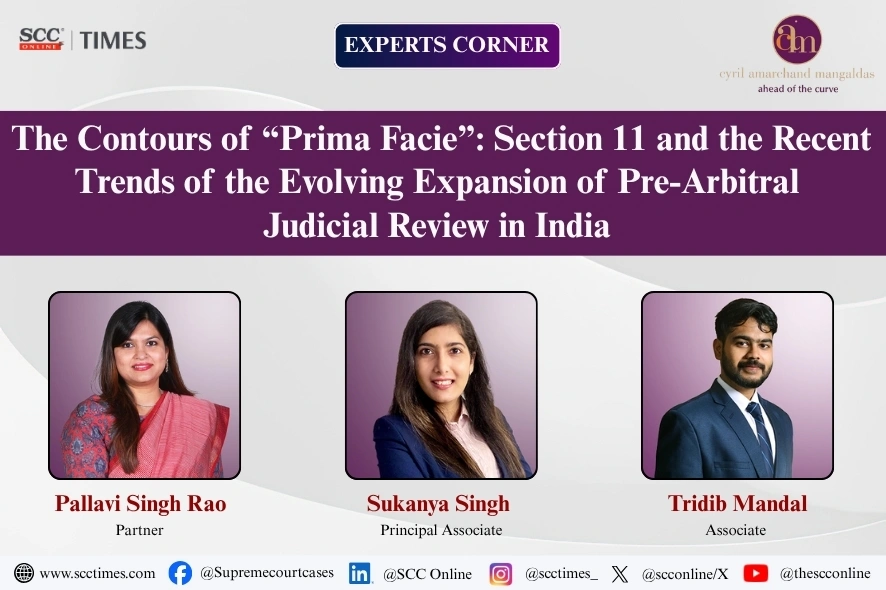
*Partner, Cyril Amarchand Mangaldas.
**Principal Associate, Cyril Amarchand Mangaldas.
***Associate, Cyril Amarchand Mangaldas.
1. (2024) 6 SCC 1, paras 155—156.
2. (2005) 8 SCC 618 : (2005) 128 Comp Cas 465.
3. (2009) 1 SCC 267 : (2009) 1 SCC (Civ) 117.
4. Law Commission of India, Amendments to the Arbitration and Conciliation Act, 1996, Report No. 246(2014).
5. Arbitration and Conciliation Act, 1996, S. 11(6-A) which states:
11. Appointment of arbitrators.—(6-A) The Supreme Court or, as the case may be, the High Court, while considering any application under sub-section (4) or sub-section (5) or sub-section (6), shall, notwithstanding any judgment, decree or order of any court, confine to the examination of the existence of an arbitration agreement.
6. (2017) 9 SCC 729 : (2017) 4 SCC (Civ) 764.
7. (2021) 2 SCC 1 : (2021) 1 SCC (Civ) 549.
8. Interplay Between Arbitration Agreements under Arbitration and Conciliation Act, 1996 & Stamp Act, 1899, In re, (2024) 6 SCC 1, paras 154—155.
10. (2009) 7 SCC 696 : (2009) 3 SCC (Civ) 271.
12. Maharashtra State Electricity Distribution Co. Ltd. v. R Z Malpani, 2026 SCC OnLine SC 553, para 28.
14. Rajiv Gaddh v. Subodh Parkash, 2026 SCC OnLine SC 507, para 19.