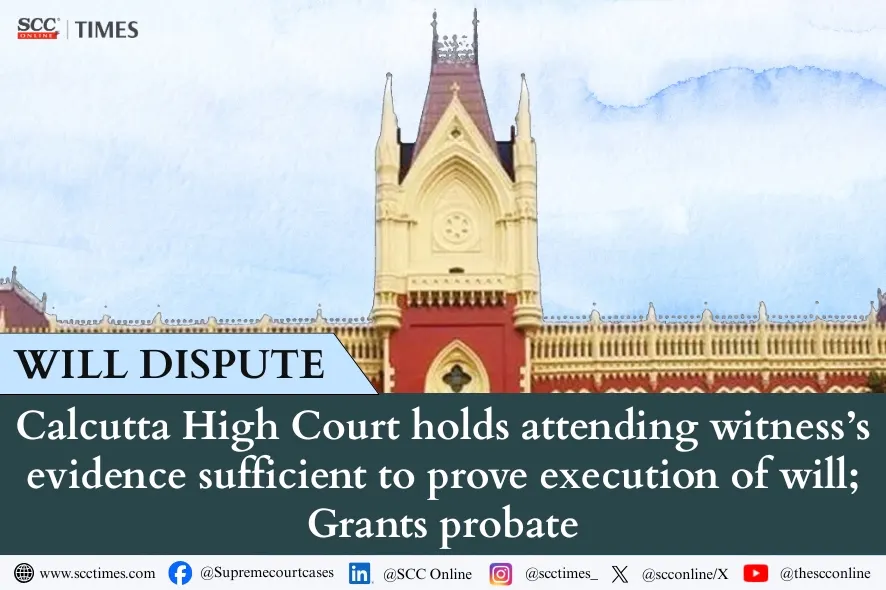
Calcutta High Court: In a matter concerning the validity and due execution of a will, the Division Bench of Debangsu Basak and Md. Shabbar Rashidi*, JJ., while considering the admissibility of evidence under Sections 69 and 71 of the Evidence Act, 1872,(IEA) in relation to the proof of execution of a Will, observed that the evidence of the attending witness had been overlooked by the Single Judge.
The attending witness had testified that the testatrix executed the will in his presence and that both the attesting witnesses signed the will in the presence of the testatrix. He further established that the testatrix was physically fit and mentally alert at the time of execution and possessed the necessary testamentary capacity to make the will.
The Court held that the evidence of the attending witness, along with the other material placed on record, sufficiently proved the execution of the will in accordance with law. The Court observed that it was established that the testatrix and the two attesting witnesses had signed the will after its execution in her presence. Accordingly, the petitioner was able to prove the will in terms of the applicable provisions of the Evidence Act, 1872. The Division Bench allowed the appeal and set aside the impugned judgment and order refusing probate
Background
The testatrix, a Hindu governed by the Dayabhaga School of Jurisprudence, had survived her husband, who had predeceased her. On 2 June 1995, she had executed her last will and Testament in respect of the properties mentioned therein. The will was duly registered before the District Registrar, Barasat, and the petitioners were appointed as joint executors of the will. Upon her demise, she was survived by two sons and two daughters as her legal heirs and successors. The will had subsequently been propounded and sought to be proved in solemn form.
The impugned judgment and order by the Single Judge refused to grant probate to the last will and testament of the deceased. It was contended that the Single Judge erred in holding that the will in question could not be proved in accordance with law and was executed under suspicious circumstances and thereby refusing grant of probate to such will.
The Single Judge attributed suspicious circumstances to the will in question on the ground that it was not a natural will and no interest was proposed to be conveyed on the natural legal heirs of the petitioner of the will. The Single Judge noted that will have to be proved in accordance with Section 68 IEA. If the attending witnesses are not available or cannot be produced to prove the will, the will is required to be proved in accordance with Section 69 of the Act of 1872. It is well settled law that a will has to be proved in accordance with Section 63, Succession Act, 1925 (ISA).
The appellant aggrieved by the impugned order, filed an appeal submitting that one of the attesting witnesses affirmed affidavit in support of the case of the petitioner, which was on record. Since the attesting witness had died prior to the institution of the proceeding, could not be produced before the Single Judge. The appellant specified that the will in question was proved in accordance with law by an attending witness in terms of Section 63 ISA as well as Section 68 IEA.
Decision and Analysis
Th Court examined the evidence placed on record and noted that attending witness, though not an attesting witness, had testified that the Will was executed in his presence. He stated that the testatrix signed the will and that the two attesting witnesses also signed the document in the presence of the testatrix.
The Court further noted that attending witness had established that the testatrix was physically fit and mentally alert at the time of execution and possessed the necessary testamentary capacity to execute the will.
The Court also considered the affidavit of the attesting witness, which formed part of the probate proceedings. In the affidavit, the attesting witness stated that:
-
the testatrix signed the will in his presence;
-
he and the other attesting witness signed the will at the request of the testatrix; and
-
the testatrix was in a sound state of mind and had full testamentary capacity.
The Court observed that the Single Judge had failed to properly appreciate the evidence of the attending witness and the material available on record.
The Court held that the evidence sufficiently established that the will was executed by the testatrix and attested in accordance with law. The Court further observed that merely because the Will contained an unusual disposition, it could not by itself constitute a suspicious circumstance when due execution and testamentary capacity had been established.
Accordingly, the Court held that the will stood proved in accordance with law and allowed the appeal.
[Rama Datta Gupta v. Gopal Das, 2026 SCC OnLine Cal 8284, decided on 24-6-2026]
*Judgment authored by: Justice Md. Shabbar Rashidi
Advocates who appeared in this case:
For the Appellant: Rudradeb Choudhury, Shaswat Nayak, Shoham Sanyal, K. N. Jana, Advocates