Disclaimer: This has been reported after the availability of the order of the Court and not on media reports so as to give an accurate report to our readers.
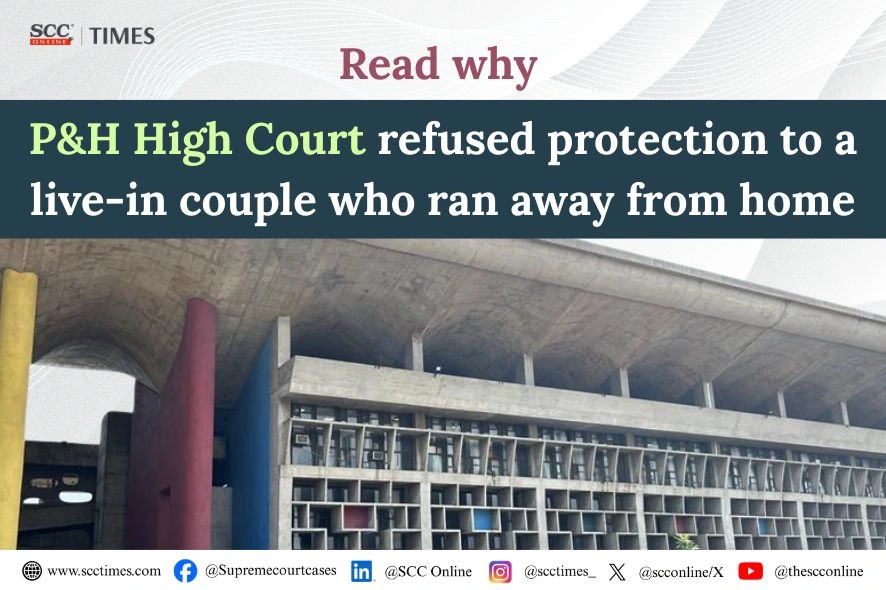
Punjab & Haryana High Court: In a petition filed under Articles 226/227 of the Constitution of India seeking protection from alleged harassment by family members and a direction to permit the petitioners to reside together in a live-in relationship, the Single Judge Bench of Sandeep Moudgil, J., dismissed the petition, holding that constitutional protection cannot be granted merely on the basis of a bald assertion of a live-in relationship when the legal prerequisites for such a relationship are not fulfilled.
Background
The petitioners being major, contended that they love each other and were residing together in a live-in relationship with the intention of solemnising their marriage in the future but they alleged that Respondents 4 to 7 were interfering in their lives, harassing them, and pressurising Petitioner 1, with threats of implicating Petitioner 2 in a false case. It was submitted that since they wished to continue living together until they could marry, they had also submitted a representation to the Superintendent of Police, Patiala, seeking protection. Aggrieved by the alleged threats and interference, they approached the High Court seeking directions to the authorities not to harass them and to safeguard their life and liberty.
Analysis and decision
The Court observed that India is a country with diverse set of principles, traditions, rituals and beliefs, which serves as essential legal sources and that marriage is a holy relationship with legal consequences and great social esteem. The Court noted that with time adoption of Western culture has started, which is majorly different from Indian culture.
“A portion of India appears to have adopted Modern lifestyle, namely, the live-in relationship.”
The Court in context with Article 21, reaffirmed that every person has a right to have their reputation preserved and that it is a right good against all in the world and thus must be preserved as it is sacred under constitutional scheme.
“The concept of right to life and personal liberty guaranteed under Article 21 includes the right to live with dignity and the petitioners by running away from their parental home is not only bringing bad name to the family but also is violating the right of the parents to live with dignity and honour.”
The Court referred to D. Velusamy v. D. Patchaiammal, (2010) 10 SCC 469, and observed that a live-in relationship can be recognised only when the partners hold themselves out as spouses, are legally eligible to marry, and are unmarried. The Court further noted that various Benches of the High Court have consistently declined protection to couples in live-in relationships, observing that granting such protection in every case could disturb the social fabric of society.
The Court noted that the petitioners were residing together in a live-in relationship with the intention of marrying each other. However, Petitioner 2 had not yet attained the marriageable age and proposed to marry Petitioner 1 upon attaining the requisite age. The Court held that a live-in relationship can be accorded legal sanctity only when the partners satisfy the conditions prescribed by law, a mere assertion of living together for a few days is insufficient to establish a genuine live-in relationship, and granting police protection in such circumstances would amount to indirectly approving to such illicit relationship.
Since the protection sought could not be granted under Article 21 outside the framework of law, the petition was dismissed.
[Lisha v. State of Punjab, CRWP-6747-2026, decided on 5-6-2026]
Advocates who appeared in this case:
For the petitioner: Komal Sidhu, Advocate
For the respondent: Rajiv Verma, Addl. AG, Punjab