


Disclaimer: This has been reported after the availability of the order of the Court and not on media reports so as to give an accurate report to our readers.
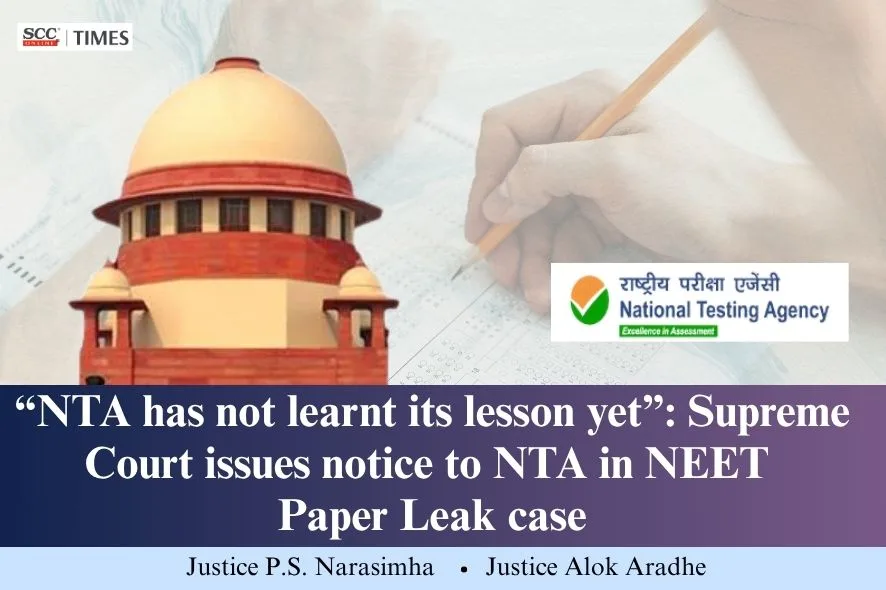
Supreme Court: In a petition filed by the Federation of All India Medical Association (FAIMA) against National Testing Agency (NTA), raising issues surrounding the recent NEET-UG exam, the Division Bench of P.S. Narasimha and Alok Aradhe, JJ., issued notice and directed NTA to file an affidavit detailing the steps taken to implement the recommendations of the High-Level Committee of Experts
Also Read: NEET 2026 Paper Leak Controversy Explained | SCC Times
FAIMA filed a writ petition against the NTA, raising issues regarding its conduct of the NEET-UG examination.
The Court issued notice in the matter and permitted dasti service in addition to regular service upon all respondents, and orally observed that “NTA has not learnt its lesson yet”. The Court further directed the NTA to file an affidavit indicating the status of the Monitoring Committee constituted on 14 November 2024.
The Court also directed Dr. K. Radhakrishnan to file an affidavit detailing the steps taken to implement the recommendations of the High-Level Committee of Experts submitted in October 2024. Both affidavits were directed to be filed within 3 days. The matter was thereafter listed for further hearing on 29 May 2026.
Also Read: NEET 2026 Paper Leak: Law, Merit, and Exam Integrity | SCC Times
Origin of High-Level Committee of Experts
The High-Level Committee of Experts referred to in the order was constituted in response to the NEET-UG 2024 controversy and allegations of paper leak. It was constituted by the Ministry of Education under the chairmanship of K. Radhakrishnan. The Committee was tasked with recommending reforms concerning:
-
examination processes,
-
data security protocols, and
-
the structure and functioning of the NTA.
Its terms of reference included reviewing the entire examination process, strengthening SOPs and monitoring mechanisms, improving cybersecurity and question paper handling systems, and restructuring the NTA’s grievance redressal and institutional framework.
The Committee reportedly submitted its report on 21 October 2024. According to government disclosures, it recommended:
-
strengthening NTA’s institutional framework,
-
enhanced monitoring systems,
-
AI/ML-based grievance redressal,
-
tighter testing-centre allocation protocols,
-
stronger question-paper security mechanisms,
-
standardised SOPs for pen-and-paper and CBT exams, and
-
institutional coordination with States.
[FAIMA v. NTA, 2026 SCC OnLine SC 958, ordered on 25-5-2026]
Advocates who appeared in this case:
For the petitioner: AOR Tanvi Dubey with Yash Dubey and Mekala Ganesh Kumar Reddy, Advocates
AOR Ritu Reniwal with Mahendra Kumawat, Charu Mathur, Uma Prasuna Bacchu, Yashpal, Abhinav Srivastava, Ram Bhadauria, Robin Khokhar and B N Dubey, Advocates
AOR P. V. Yogeswaran with Ashish Kumar Upadhyay, Y. Lokesh, V. Kandha Prabhu, Dhatri Singh, Maitri Goal, Hari Preethi, Guneswaran Pv, Satya Narayan, Advocates
For the respondents: N/A

Based on 2 nd pu marks and state based exams for admissions instead of neet