Delhi High Court: While hearing a petition challenging an arbitral award dated 28 August 2024 concerning deduction on account of shortfall in Minimum Guaranteed CENVAT Credit (MGCC) and reimbursement of excise duty under contracts for setting up a Hot Dip Galvanising Line (HDGL) and an Electrolytic Cleaning Line (ECL), the Single Judge Bench of Avneesh Jhingan, J., upheld the arbitral award and dismissed the petition, holding that the tribunal had adopted a plausible interpretation of the contract terms, particularly Clause 14.5.6 of the General Conditions of Contract (GCC), and that no ground for interference under Section 34 was made out.
Facts and Background
The parties had entered into contracts for setting up HDGL and ECL facilities. The projects were commissioned and final acceptance certificates were subsequently issued. The contract provided for a MGCC to be passed on by the respondent to the petitioner. Disputes arose when deductions were made by the petitioner on account of alleged shortfall in MGCC, leading to arbitration proceedings.
Before the arbitral tribunal, the respondent challenged the deductions and also sought reimbursement of excise duty. The tribunal decided the issue against the petitioner by relying upon the earlier decision of the Court in SAIL v. Primetals Technologies India (P) Ltd., 2020 SCC OnLine Del 2496, wherein it had been held that deductions on account of shortfall in MGCC were to be made from the gross contract price and not the net contract value.
Per contra, the petitioner contended claim 1 relating to deduction for shortfall in MGCC was barred by limitation. It was argued that under Clause 12.1.6 of the GCC, payment was required to be made within 45 days of submission of invoices dated 3 April 2017, 10 September 2018 and 30 October 2018, and therefore the cause of action had arisen immediately upon expiry of that period. Since arbitration was invoked only on 2 March 2022, the claim was asserted to be time-barred. Similar objections were raised in respect of Claim 2 concerning reimbursement of excise duty, where the petitioner argued that invoices issued between 28 November 2009 and 7 December 2016 ought to have been paid within 45 days and the arbitration invocation beyond three years was barred by limitation. The petitioner further submitted that Clause 14.5.6 permitted deduction of the shortfall in MGCC from the net contract value and that the tribunal had ignored the contractual terms while interpreting the clause.
Analysis and Decision
The Court examined Clauses 12.1.6 and 14.5.6 of the GCC along with the note contained in Appendix I. The Court held that Clause 12.1.6 merely prescribed the time for release of payments against invoices and did not govern disputes concerning deductions made on account of MGCC shortfall. The Court agreed with the tribunal that the cause of action for Claim 1 arose only when the deduction was actually effected on 9 March 2019. Consequently, invocation of arbitration on 2 March 2022 was held to be within limitation.
With regard to reimbursement of excise duty, the Court observed that conciliation proceedings between the parties had continued till 14 February 2022 and the petitioner had refused reimbursement only thereafter. Therefore, the right to invoke arbitration accrued upon failure of conciliation proceedings, and the claim was not barred by limitation.
On the interpretation of Clause 14.5.6, the Court noted that while the clause itself referred to deduction for shortfall in MGCC, the accompanying note in Appendix I specifically stated that the “balance shortfall shall be deducted from the contract price item Sl. No. 12 above”. The Court held that Sl. No.12 referred to the gross contract price inclusive of taxes and duties. Relying upon the earlier judgment in SAIL v. Primetals Technologies India (P) Ltd., 2020 SCC OnLine Del 2496, the Court reaffirmed that deductions could only be made from the gross contract value and not the net contract value.
The Court rejected the petitioner’s contention that deductions could be made from either the gross or net contract value. It reasoned that the net contract price was arrived at after deducting MGCC from the gross contract value. If the shortfall were again deducted from the net contract price, it would effectively amount to a double deduction, since the unreimbursed MGCC amount already remained with the petitioner.
The Court further reiterated the limited scope of interference under Section 34, Arbitration and Conciliation Act, 1996. Relying upon decisions of the Supreme Court in Ramesh Kumar Jain v. BALCO, 2025 SCC OnLine SC 2857, Indian Oil Corporation Ltd. v. Shree Ganesh Petroleum, (2022) 4 SCC 463 and Parsa Kente Collieries Ltd. v. Rajasthan Rajya Vidyut Utpadan Nigam Ltd., (2019) 7 SCC 236, the Court emphasised that it could not sit in appeal over an arbitral award merely because another interpretation was possible. Interference was permissible only where the award suffered from patent illegality, perversity, or conflict with the public policy of India.
Applying these principles, the Court concluded that the Arbitral Tribunal had adopted a plausible interpretation of the contract and that the award did not suffer from any patent illegality or perversity. Since the tribunal’s view had also been consistent with the earlier decision of the Court on an identical contractual clause, no ground for interference under Section 34 was made out. Accordingly, the petition and all pending applications were dismissed.
[SAIL v. Primetals Technologies India (P) Ltd., 2026 SCC OnLine Del 629, decided on 18-2-2026]
Advocates who appeared in this case:
For Petitioner: Rajshekhar Rao, Senior Advocate, Samaksh Goyal, Advocate
For Respondent: Rajesh Markanda, Keshri Kumar, Arshdeep Singh, Saurav Markanda, Advocates
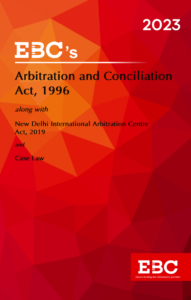
Buy Arbitration and Conciliation Act, 1996 HERE