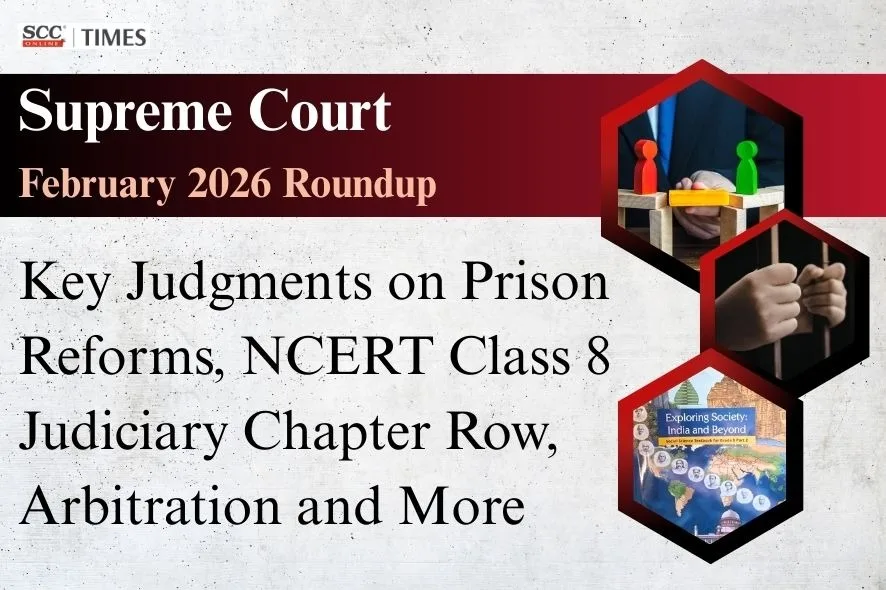
Supreme Court in February 2026 delivered judgments on myriad issues like ordering resolution of a long-standing property dispute via mediation and directing a husband’s employee to deduct wife’s maintenance from his salary. February was dominated by Supreme Court’s effective stand on addressing overcrowding in prisons and uniform governance of Open Correctional Institutions; the Court took a firm stand need for NCERT books to maintain pedagogical balance and institutional responsibility. The Court allowed Judges from Jharkhand and Odisha to take part in WB SIR claims adjudication.
This Supreme Court February 2026 Roundup highlights the month’s most important judgments, key legal developments, and institutional updates, along with features on judicial appointments, collegium recommendations, and the popular Know Thy Judge series.
Do not miss out on the latest Supreme Court Judgments published in SCC Weekly!
Top Stories
The writ petition, instituted under Article 32 of Constitution, raised serious concerns regarding overcrowding in prisons and the resulting inhuman conditions of detention, which were asserted to violate the fundamental rights of prisoners. A Division Bench of Vikram Nath and Sandeep Mehta,* JJ., held that Open Correctional Institutions (OCIs) embody this constitutional promise by recognising that trust, responsibility and graded liberty are essential for meaningful reform. [Suhas Chakma v. Union of India, 2026 SCC OnLine SC 317]
Taking serious note of contents of a Grade-8 Social Science textbook published by the National Council of Educational Research and Training (NCERT), a three-Judge Bench comprising the Surya Kant, CJI and Joymalya Bagchi and Vipul M. Pancholi, JJ., initiated suo motu proceedings observing that educational material must maintain pedagogical balance and institutional responsibility. The Court ordered nationwide withdrawal of the book and issued contempt notices to education authorities. The Court observed that the inclusion of material allegedly undermining the institutional dignity of the judiciary in a foundational school curriculum warranted a rigorous review of its pedagogical suitability and its potential impact on the institutional standing of the Judiciary as a whole. [Social Science Textbook for Grade – 8 (Part-2) Published by NCERT & Ancillary Issues, In re, 2026 SCC OnLine SC 318]
While considering this petition highlighting the concerns regarding completion of the ongoing Special Intensive Revision (SIR) in the State of West Bengal, the 3-Judge Bench of Surya Kant, CJI., and Joymalya Bagchi and Vipul M. Pancholi, JJ., issued several clarifications and directions regarding the SIR process. The Court importantly stated that the Chief Justice of Calcutta High Court may consider requisitioning Judges from the neighbouring States of Jharkhand and Odisha to take part in the SIR process. Additionally, the Court further permitted Civil Judges (Senior and Junior Division) in West Bengal with service experience of not less than 3 years, to participate in the process. [Mostari Banu v. Election Commission of India, 2026 SCC OnLine SC 304]
In an appeal against Madras High Court’s judgment whereby, while upholding the conviction of the accused for offences under Sections 307, 326 and 324, Penal Code, 1860 (IPC), the sentence of 3 years’ rigorous imprisonment imposed by the Trial Court and affirmed in appeal, was reduced to the period already undergone, coupled with enhancement of fine and payment of compensation to the victim’s wife, the Division Bench of Rajesh Bindal and Vijay Bishnoi,* JJ. were called upon to determine whether such reduction of sentence in exercise of revisional jurisdiction was legally sustainable. [Parameshwari v. State of T.N., 2026 SCC OnLine SC 209]
While considering this petition seeking restraining of upcoming film titled “Ghooskhor Pandat”, which, as per the petitioner, creates offensive stereotyping against an identifiable community and violates their right to dignity under Article 21 of the Constitution, the Division Bench of B.V. Nagarathna and Ujjal Bhyan, JJ., noted that the respondents had positively responded to the grievances expressed by the petitioner before the Court via their affidavit and had decided to unequivocally withdraw the offending movie title and change it. The respondent had further assured that the withdrawn title shall not be used in any manner whatsoever.
In a separate opinion, Ujjal Bhuyan, J*., stated that this petition involved fundamental questions on fraternity and free speech and stated that it is constitutionally impermissible for anybody, be it the State or non-state actors, through any medium, such as, speeches, memes, cartoons, visual arts etc. to vilify and denigrate any community. “It will be violative of the Constitution to target any particular community on the basis of religion, language, caste or region by whosoever he or she may be. This is particularly true for public figures occupying high constitutional once who have taken the solemn oath to uphold the Constitution”. [Atul Mishra v. Union of India, 2026 SCC OnLine SC 321]
Environmental Law
In appeals arising out of two separate orders passed by the National Green Tribunal (NGT), regarding alleged violations of environmental laws by two real estate developers, appellants and imposing of compensation on them, a Division Bench of Dipankar Datta* and Vijay Bishnoi, JJ., held that there was no ground to interfere with the computation of environmental compensation imposed by the NGT in either appeal. The Court held that—
-
The NGT is not divested of authority to determine environmental compensation merely because no rigid statutory formula exists.
-
The NGT has statutory authority to employ project turnover as a relevant yardstick for the determination of environmental compensation.
-
Project cost or turnover may be used as a relevant factor, provided the compensation is rational, proportionate and reasoned.
-
The compensation imposed on both Rhythm County (Rs. 5 crores) and Key Stone Properties (Rs. 4,47,42,188/-) was neither arbitrary nor disproportionate.
[Rhythm County v. Satish Sanjay Hegde, 2026 SCC OnLine SC 126]
Alternate Dispute Resolution
In a Special Leave Petition (SPL) arising out of a long-standing property dispute between a brother and his sisters concerning a prime property in Hyderabad, a Division Bench of J.B. Pardiwala and Vijay Bishnoi, JJ., appointed Justice Sudhanshu Dhulia, former Judge of the Supreme Court, to act as Mediator between the parties and oversee the settlement. [R. Ravindranath v. Greater Hyderabad Municipal Corpn., 2026 SCC OnLine SC 150]
In a significant ruling on forged arbitration agreements, the Supreme Court held that a dispute cannot be referred to arbitration when the very document containing the arbitration clause is alleged to be fabricated. The Court held that where the arbitration clause is embedded in a document alleged to be forged, the controversy “strikes at the very root of arbitral jurisdiction” and falls squarely within the category of non-arbitrable disputes. The present case resolved around the conflict between arbitral jurisdiction and allegations of forgery of the very document containing the arbitration clause. The appeals arose from inconsistent orders of the High Court, which on the same factual matrix declined appointment of an arbitrator under Section 11 of the Arbitration and Conciliation Act, 1996 (A&C Act), yet in separate proceedings directed reference to arbitration under Section 8, a Division Bench of P.S. Narasimha and Alok Aradhe, JJ., quashed and set aside the High Court’s order, dated 24-09-2021 and held that High Court, in exercise of jurisdiction under Article 227, was not justified in reappreciating evidence and dislodging concurrent findings led to declining reference to arbitration on the ground of serious fraud and non-production of the original agreement. The Court, however, affirmed the High Court’s order dated 11-03-2021 refusing appointment of an arbitrator under Section 11. [Rajia Begum v. Barnali Mukherjee, 2026 SCC OnLine SC 135]
Resolving a long-standing judicial divergence on whether the jurisdiction to extend the mandate of an arbitral tribunal depends upon the forum that appointed the arbitrator under Section 11 of the Arbitration and Conciliation Act, 1996 (A&C Act), or whether it is governed exclusively by the statutory definition of “Court” under Section 2(1)(e), A Division Bench of Pamidighantam Sri Narasimha and R. Mahadevan, JJ., held that applications under Section 29-A of the A&C Act lie exclusively before the “Court” as defined under Section 2(1)(e), and not necessarily before the High Court that appointed the arbitrator under Section 11. [Jagdeep Chowgule v. Sheela Chowgule, 2026 SCC OnLine SC 124]
In an appeal arising from the Madhya Pradesh High Court’s interim order dated 02-12-2025 where in the Court declared the mandate of the existing Arbitrator in the ongoing arbitration proceedings between the parties to be terminated and directed the parties to propose the name of a new Arbitrator for appointment, a Division Bench of Sanjay Kumar and Alok Aradhe, JJ., set aside the impugned order and held that Section 29-A of the Arbitration and Conciliation Act, 1996 (A&C Act) does not mandate automatic substitution of Arbitrator. [Viva Highways Ltd. v. M.P. Road Development Corpn. Ltd., 2026 SCC OnLine SC 195]
In a Special Leave Petition (SLP) arising out of the impugned judgment and order dated 11 February 2025 passed by the Calcutta High Court, a 3-judge bench of Surya Kant, CJ., Joymalya Bagchi and Vipul M. Pancholi, JJ., affirmed the impugned order holding that the issue of genuineness or valid execution of the subject agreements can be taken up as a preliminary issue by the Arbitrator and refused to interfere with the same. [Salson Liquors Private Ltd. v. United Spirits Ltd1]
Child Custody
In a custody dispute involving custody of two minor sons, the Division Bench of Pankaj Mithal* and SVN Bhatti, JJ., emphasized that while the welfare of the children is undoubtedly the paramount consideration in custody matters, other child custody factors also carry weight in shaping the final order. These include the parents’ financial capacity, the standard of living, the children’s comfort, and their education. Accordingly, the High Court may not have been entirely correct in holding that such factors are of little relevance and that custody must depend solely on child’s welfare. The Court observed that the High Court had overlooked the material and crucial aspects while passing the impugned order. Thus, the Court set aside the order passed by the High Court and remanded the matter for reconsideration. [Mohtashem Billah Malik v. Sana Aftab, 2026 SCC OnLine SC 146]
Criminal Law
While considering this petition revolving around issues related to issuance of notices under Section 35(3) of the Bharatiya Nagarik Suraksha Sanhita, 2023 (BNSS) qua an offence punishable with imprisonment up to 7 years; the Division Bench of M.M. Sundresh and N. Kotiswar Singh, JJ., held that for effecting an arrest, regarding an offence punishable with imprisonment up to 7 years, the mandate of Section 35(1)(b)(i) of the BNSS along with any one of the conditions mentioned in Section 35(1)(b)(ii) of the BNSS must be in existence. The Court emphasised that a notice under Section 35(3) BNSS to an accused or any individual concerned, qua offences punishable with imprisonment up to 7 years, is the rule. [Satender Kumar Antil v. CBI, 2026 SCC OnLine SC 162]
In an application filed by the appellant seeking anticipatory bail in a case registered under Sections 126, 115(2), 109, 352 read with Section 3(5) of the Bharatiya Nyaya Sanhita, 2023 and Sections 25(1B)(a), 26, 27 and 35 of the Arms Act, 1959, the Division Judge Bench of M.M Sundresh and Nongmeikapam Kotiswar Singh, JJ., granted anticipatory bail to the appellant after considering the submissions and the fact that a cross case had already been previously registered by the appellant’s mother, in pursuance of a civil land dispute. [Bunty Yadav v. State of Bihar, 2026 SCC OnLine SC 166]
In a writ petition under Article 32 of the Constitution of India, alleging repeatedly invoking and deploying the criminal process against the petitioners by way of successive registration of FIRs and custodial remands, particularly after grant of bail, is said to be arbitrary, mala fide, and violative of Articles 14, 19 and 21, a Division Bench of Aravind Kumar and Prasanna B. Varale, JJ., concluded that the successive registration of FIRs was solely to keep the petitioner 1 in custody. The Court granted bail to the petitioner 1 and directed that no coercive steps be taken against petitioner 2, subject to cooperation with investigation. [Binay Kumar Singh v. State of Jharkhand, 2026 SCC OnLine SC 208]
In an appeal arising from an order of the Allahabad High Court rejecting the appellant’s second application for anticipatory bail where the protection granted by first anticipatory bail protection automatically came to an end as the same was limited only upto filing of the chargesheet, a Division Bench of J.B. Pardiwala* and K.V. Viswanathan,* JJ., set aside the impugned order and directed that in the event of arrest, the appellant be released on anticipatory bail on appropriate conditions. The Court held that “once anticipatory bail is granted, it ordinarily continues without fixed expiry. The filing of a charge-sheet, taking of cognizance, or issuance of summons does not terminate protection unless special reasons are recorded”. [Sumit v. State of U.P., 2026 SCC OnLine SC 186]
In a petition challenging an interlocutory order dated 20-1-2026 passed by a Division Bench of the Calcutta High Court (‘High Court’), containing various directions, including leaving it open for the Central Government to decide on handing over the investigation under Section 6(5) of the National Investigation Agency Act, 2008, the Division Bench of Surya Kant, CJ and Joymala Bagchi, J., directed the National Investigating Agency (‘NIA’) to submit a report to the High Court stating whether a prima facie case exists for applying Unlawful Activities (Prevention) Act, 1967 (‘UAPA’). Since the High Court’s order only made brief remarks without a clear view, the Court asked it to independently assess the NIA’s report after hearing the parties. It clarified that the final decision on applying UAPA rests with the High Court. [State of W.B. v. Suvendu Adhikari, 2026 SCC OnLine SC 196]
Consumer Protection
₹2 Crores for faulty haircut? Supreme Court ‘Trims’ Compensation to ₹25 Lakh
In an appeal arising out of a consumer dispute in which the complainant alleged deficiency in service on account of an allegedly faulty haircut received at a beauty salon operated in a five-star hotel. While deficiency in service stood concluded against the service provider in earlier proceedings, the controversy before the Court was confined to the legality and justification of the quantum of compensation, particularly whether compensation amounting to ₹2 crores could be sustained in the absence of legally acceptable evidence of loss. A Division Bench of Manmohan and Rajesh Bindal,* JJ., modified the impugned order of the NCDRC to the extent that the compensation payable to the respondent was restricted to ₹25,00,000, being the amount already released pursuant to earlier orders. The Court held that quantification of compensation in consumer disputes, particularly where claims run into crores, must rest on reliable, proved, and trustworthy evidence, and not on unverified photocopies, conjecture, presumptions or “whims and fancies of the complainant”. [ITC Ltd. v. Aashna Roy, 2026 SCC OnLine SC 168]
Housing and Real Estate
In an appeal against the judgment of the Punjab & Haryana High Court concerning the legality of allotment of two super deluxe flats by HUDA, Urban Estate and Town and Country Planning Employees Welfare Organization (‘HEWO’), a welfare society of government employees and allegations of favouritism, arbitrariness, and violation of eligibility conditions, a Division Bench of Sanjay Kumar and K. Vinod Chandran,* JJ., while condemning nepotism in Government Welfare Societies flat allotment, set aside the High Court’s judgment, quashed the impugned allotments and imposed costs of ₹1,00,000 on the HEWO-respondent 2, ₹50,000 on the respondent 3 and ₹25,000 on the respondent 4. [Dinesh Kumar v. State of Haryana, 2026 SCC OnLine SC 210]
Insolvency and Bankruptcy Laws
In an appeal arising from the judgment of the National Company Law Appellate Tribunal (NCLAT) affirming the order of the NCLT whereby the application under Section 7, Insolvency and Bankruptcy Code, 2016 (IBC) filed by the debenture trustee was rejected and initiation of the Corporate Insolvency Resolution Process (CIRP) was refused. A Division Bench of Sanjay Kumar* and K. Vinod Chandran, JJ., set aside the NCLT and NCLAT’s orders and held that application under Section 7 IBC cannot be refused on the basis of an unapproved restructuring loan facility proposal when the Debenture Trust Deed was never modified in the manner contractually prescribed and default in repayment of financial debt stands established. Consequently, the Court held that the financial debt and default had occurred, financial creditor’s Section 7 IBC application liable to be admitted and restored the company petition before the NCLT. [Catalyst Trusteeship Ltd. v. Ecstasy Realty (P) Ltd., 2026 SCC OnLine SC 300]
While considering this appeal filed by the resolution applicants wherein, they challenged the dismissal of their appeals concerning approval of Resolution Plan submitted by Sarda Energy and Minerals Limited (SEML) for SKS Power Generation Limited (corporate debtor) by the National Company Law Appellate Tribunal (NCLAT); the Division Bench of B.V. Nagarathna* and R. Mahadevan, JJ., emphasised that the core of Insolvency and Bankruptcy Code, 2016 (IBC) is the doctrine of commercial wisdom, i.e., a conscious legislative choice to vest decisive authority in the Committee of Creditors (CoC) comprising financial creditors who bear the economic consequences of failure. Therefore, judicial intervention beyond the narrow statutory confines undermines both predictability and finality. Recognising this, the IBC deliberately confines judicial review to strict statutory compliance under Sections 30(2) and 61(3). [Torrent Power Ltd. v. Ashish Arjunkumar Rathi, 2026 SCC OnLine SC 325]
Service Law
In civil appeals arising from a common judgment of the Madras High Court regarding gratuity claim entitlement of retired employees of the Heavy Water Plant (“HWP”), Tuticorin, under the Payment of Gratuity Act, 1972 (“Payment of Gratuity Act”). The principal question before the Court was whether the employees of HWP, functioning under the Department of Atomic Energy, Government of India, fall within the definition of “employee” under Section 2(e) of the Payment of Gratuity Act, or whether they stand excluded by virtue of holding civil posts under the Central Government and being governed by the CCS (Pension) Rules, 1972 (“Pension Rules”). A Division Bench of Pankaj Mithal and S.V.N. Bhatti,* JJ., upheld the High Court’s judgment and held that the Payment of Gratuity Act does not apply to the employees of Heavy Water Plant, Tuticorin and therefore petitioners are not entitled to claim gratuity under the Payment of Gratuity Act. [N. Manoharan v. Administrative Officer, 2026 SCC OnLine SC 189]
The batch of civil appeals under Section 30 of the Armed Forces Tribunal Act, 2007 (the Act) arising out of conflicting decisions of the Armed Forces Tribunal on the period for which arrears of disability pension are payable. While some Benches granted arrears from the applicable cut-off dates, 01-01-1996 or 01-01-2006, others restricted arrears to three years preceding the filing of the original application. A Division Bench of Pamidighantam Sri Narasimha and Alok Aradhe,* JJ., held the ex-servicemen were entitled to disability pension, including the benefit of broad banding, with effect from 01-01-1996 or 01-01-2006, as applicable and directed the payment of arrears along with interest at 6% per annum. The Court quashed and set aside the orders of the Tribunal restricting arrears to three years. [Union of India v. Girish Kumar, 2026 SCC OnLine SC 194]
In a writ petition unveiling “a sordid tale of targeted departmental vendetta, full of mala fide actions and protracted persecution”, compelling a senior civil servant and former Armed Forces officer to repeatedly knock at the doors of constitutional courts. While noting that the petitioner, despite having an unblemished service record and been ranked first by a duly constituted Search-cum-Selection Committee for appointment as Member (Accountant), Income Tax Appellate Tribunal, was persistently denied appointment through a series of obstructive administrative actions and bias in Search-cum-Selection Committee, a Division Bench of Vikram Nath and Sandeep Mehta, JJ., held that the petitioner had been subjected to grave injustice, rank high-handedness, and deliberate obstruction bordering on vendetta by the respondents. Setting aside the minutes of the impugned selection meeting, the Court directed the convening of a fresh Search-cum-Selection Committee, expressly excluding the concerned officer, and imposed ₹5,00,000/- costs on the respondents for their continued procrastination and mala fide conduct. [Pramod Kumar Bajaj v. Union of India, 2026 SCC OnLine SC 127]
In a significant ruling on the rights of government employees, the Supreme Court has held that Dearness Allowance (DA) is a statutory and enforceable right, and not a discretionary benefit that a State can withhold citing financial constraints. The Bench of Sanjay Karol* and Prashant Kumar Mishra, JJ., made it clear that once Dearness Allowance becomes payable under the governing rules, the State is legally bound to release it, observing that denial of such dues directly impacts employees’ right to life and livelihood under Article 21 of the Constitution. [State of W.B. v. Confederation of State Govt. Employees, 2026 SCC OnLine SC 155]
Supreme Court dismisses Centre’s plea on Retrospective Honorarium to Law Researchers
The present Special Leave Petition filed under Article 136 of the Constitution, challenged the Delhi High Court’s order dated 29-10-2025 which granted retrospective honorarium to Law Researchers. A Division Bench of Joymalya Bagchi and Vipul M. Pancholi, JJ., on not finding any valid ground to interfere with the order of the High Court granting retrospective honorarium to Law Researchers, dismissed the Special Leave Petition. [State (NCT of Delhi) v. Rushant Malhotra, 2026 SCC OnLine SC 287]
Marital Disputes
In considering this marital dispute, wherein the Court took note of husband’s failure to pay travelling expenses, etc., of Rs. 25,000 to his wife and minor daughter as previously ordered by the Court; the Division Bench of J.B. Pardiwala and K.V. Viswanathan, JJ., perusing the afore-stated circumstances, directed the husband’s employer, namely, Rishad Shipping and Clearing Agency Pvt. Ltd., to deduct Rs 25,000 per month from the husband’s salary and transfer this amount via RTGS to the wife’s account. [D v. N2]
Muslim Personal Law
During the course of the hearing in a pending civil appeal, the Court’s attention was drawn to the provisions of the Muslim Personal Law (Shariat) Application Act, 1937, particularly Section 4 and the absence of compliance with the said provision. A Division Bench of Sanjay Karol and Augustine George Masih, JJ., impleaded the Union of India through the Secretary, Department of Legislation, and the State of Uttar Pradesh through its Chief Secretary as party respondents and issued notice, so that the appropriate governmental authorities before it could clarify the position regarding compliance. The Court directed the newly added respondents to file an affidavit indicating the latest status in the meantime. The Court requested the parties to file a convenience compilation within one week. [Gohar Sultan v. Sheikh Anis Ahmad, 2026 SCC OnLine SC 246]
Practice and Procedure
In Special Leave Petition (SLP), challenging the rejection of application for condonation of 11 years of delay, filed with further delay of 123 days in filing and 96 days in re-filing after curing defects, a Division Bench of Dipankar Datta and Satish Chandra Sharma, JJ., held that, “condonation of delay cannot be claimed as a matter of right. It is entirely the discretion of the Court whether or not to condone delay.” The Court emphasised that despite the latitude shown to the State, no case for exercise of discretion had been made out. Consequently, it rejected the applications for condonation of delay in filing and re-filing the SLP and dismissed the SLP as time-barred. [State of Odisha v. Managing Committee of Namatara Girls High School, 2026 SCC OnLine SC 191]
Telecom Operations
In an appeal challenging the order of the Telecom Disputes Settlement and Appellate Tribunal (TDSAT) which interpreted the directions issued by the Supreme Court in Centre for Public Interest Litigation v. Union of India, (2012) 3 SCC 1 (2G spectrum case), particularly on the commencement date, end date and interest liability for payment of the reserve price by the respondent, a Division Bench of Sanjay Kumar* and K. Vinod Chandran, JJ., held that the liability to pay reserve price for post-quashing operations begins from 02 February 2012, i.e., from the date of order in 2G spectrum case and the interest payable from the expiry of the period given in the show-cause notice. [Union of India v. Sistema Shyam Teleservices Ltd., 2026 SCC OnLine SC 277]
Value Added Tax
While settling the controversy concerning the proper classification of “Sharbat Rooh Afza” under the Uttar Pradesh Value Added Tax Act, 2008 (UPVAT Act), and whether the said product is exigible to tax at the rate of 4% under Entry 103 of Part A of Schedule II or at the higher rate of 12.5% as an unclassified commodity under the residuary entry contained in Schedule V, a Division Bench of B.V. Nagarathna and R. Mahadevan,* JJ., allowed the appeal and held that ‘Sharbat Rooh Afza’ was classifiable under Entry 103 of Schedule II, Part A of the UPVAT Act as a fruit drink / processed fruit product and was exigible to VAT at the concessional rate of 4% during the relevant assessment years. The Court directed the respondent authorities to grant consequential relief, including refund or adjustment of excess tax paid, in accordance with law. [Hamdard (Wakf) Laboratories v. CCT, 2026 SCC OnLine SC 306]
Case Disposal and Pendency Status
As per data available in National Judicial Data Grid3, which tracks pendency of cases in Supreme Court as well as the High Courts, the current status of case disposal and pendency in the Supreme Court is as follows:
Case Disposal Rate in the Current Year: 13070 cases i.e., 93 per-cent
Cases Disposed of in Last Month: 7146 cases
-
Civil cases disposed of- 4972 cases
-
Criminal cases disposed of- 2174 cases
Total Pending Cases: 92755 cases
-
Pending Civil Cases — 73056 cases
-
Pending Criminal Cases- 19699 cases
Coram-wise Pending Cases:
-
Pending before 3-Judges Bench- 1238 cases
-
Pending before 5-Judges Bench- 175 cases
-
Pending before 7-Judges Bench- 34 cases
-
Pending before 9-Judges Bench- 47 cases
Collegium Recommendations, Appointments and Transfers
SC Collegium approves appointment proposals of 9 Advocates as Patna High Court Judges
SC Collegium recommends Justice Sushrut Arvind Dharmadhikari as Chief Justice of Madras High Court
SCC Weekly
2026 SCC Vol. 2 Part 1: Key Supreme Court Cases on Constitution, Disabilities Act, & Surrogacy
Know Thy Judge
1. Special Leave to Appeal (C) No(s). 16022/2025
2. Transfer Petition (Civil) No.3147/2024