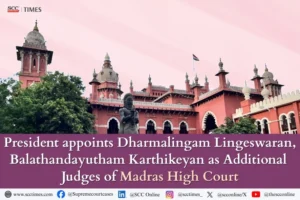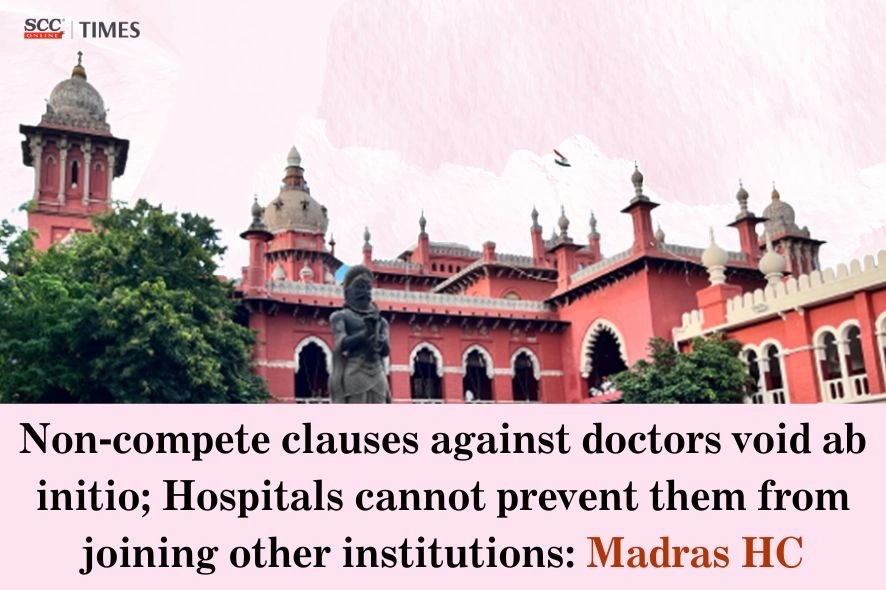
Madras High Court: While hearing a petition under Section 11(6), Arbitration and Conciliation Act, 1996 (Arbitration and Conciliation Act), the Single Judge Bench of N. Anand Venkatesh, J., observed that the professional agreement executed between a hospital and a doctor contained clauses relating to confidentiality, non-solicitation, and noncompete which were void ab initio. The Court held that such clauses, being in restraint of lawful profession, were unenforceable and opposed to public policy. Accordingly, the petition was dismissed with costs of Rs 1,00,000 payable by the hospital to the doctor.
Background
The dispute arose from a professional agreement dated 8 September 2022, under which a doctor was appointed as Consultant Cardio Thoracic Surgeon. The agreement contained provisions relating to secondment duties, confidentiality, non-solicitation, and noncompete. After serving for about two years and seven months, the doctor tendered his resignation on 21 April 2025 citing personal reasons.
The hospital invoked Clause 10.2 of the professional agreement, which required either three months’ notice or payment of three months’ professional fees, and alleged breach when the doctor subsequently joined another hospital. In addition, the hospital sought liquidated damages of Rs 42 lakhs under Clause 2.3 of the professional agreement. A legal notice was issued, to which the doctor replied denying liability.
As attempts at amicable settlement failed, the hospital initiated arbitration proceedings.
Analysis and Decision
The Court emphasised that a doctor, by profession, cannot be construed as an employee of the petitioner hospital since, by the very nature of service provided by a doctor, at best, a hospital can only utilise the services and cannot treat a qualified doctor like a regular employee of an organisation. The Court noted that Clause 8 of the professional agreement deals with confidentiality, non-solicitation and noncompete covenants, however, it is quite unfortunate that a hospital has incorporated such a clause in an agreement entered into with a doctor.
The Court observed that Clause 8 is either the result of a cut, copy and paste syndrome from an agreement regularly entered into between technology companies with their employees, or the petitioner hospital has forgotten the fact that they are running a hospital to serve patients and are indirectly admitting that the organisation is nothing short of a profit-making entity like any other business entity.
The Court emphasised that doctors can thrive without hospitals, whereas a hospital can never exist without doctors supporting such hospitals by rendering their services. Therefore, by no stretch can a hospital treat a doctor like a workman in a factory, a technical person, or a regular employee employed by an organisation in the field of technology and other service sectors.
The Court noted that a doctor is an independent professional who cannot be stopped from rendering his services wherever he wants to, and also cannot be stopped from attending to patients just because those patients were earlier taking treatment in the petitioner hospital. The Court further observed that when it comes to running a hospital, there is no question of a rival hospital, and each hospital is an independent entity which is run to serve patients and society at large.
The Court emphasised that an agreement entered into by a doctor with a hospital which contains a non-solicitation and/or noncompete clause is certainly opposed to public policy, and such an agreement is squarely hit by Section 23, Contract Act, 1872 (Contract Act). Consequently, the Court observed that it must be held to be unlawful, unenforceable, and void ab initio to that extent.
The Court further noted that the clauses also go against Section 27, Contract Act, since a doctor is restrained from practising his profession, and more so when such restraints are sought to be enforced even after the expiry of the contract. The Court also persuaded the hospital to settle the dispute amicably, and moreover the doctor submitted that under Clause 10.1 of the agreement, the hospital may even terminate the agreement and that he was willing to pay one month’s professional fee and to that extent, he was willing to settle the dispute. However, the Court observed that the hospital, being a big organisation, wanted to show its might against a doctor by making him undergo arbitration proceedings.
The Court emphasised that the doctor had given three months’ notice in compliance with the agreement, and in such circumstances, there was no further dispute to be resolved before the Arbitral Tribunal. For all these reasons, the Court held that the petition was devoid of merits.
Accordingly, the Court dismissed the original petition, directing the hospital to pay costs of Rs 1,00,000 to the doctor.
[MIOT Hospitals (P) Ltd. v. Balaraman Palaniappan, 2026 SCC OnLine Mad 1756, decided on 23-2-2026]
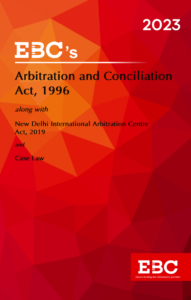
Buy Arbitration and Conciliation Act, 1996 HERE