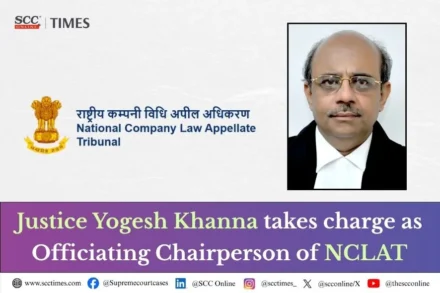
Justice Yogesh Khanna takes charge as Officiating Chairperson of NCLAT
Justice Yogesh Khanna’s appointment was made w.e.f 5 July 2026 after the conclusion of former Chairman, Justice Ashok Bhushan’s tenure on 4 July 2026.

Bringing you the Best Analytical Legal News


Justice Yogesh Khanna’s appointment was made w.e.f 5 July 2026 after the conclusion of former Chairman, Justice Ashok Bhushan’s tenure on 4 July 2026.
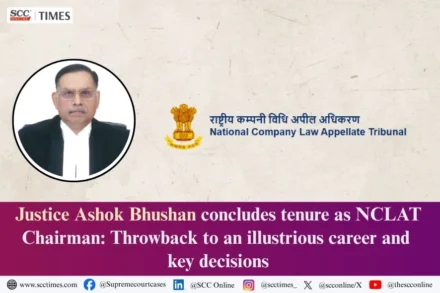
After an extensive career as an advocate and an equally extensive judicial career including the Supreme Court of India, Justice Ashok Bhushan took over as Chairman of NCLAT in 2021.
NCLAT observed that Tribunal cannot clothe itself with a jurisdiction which has not been vested upon it by the legislature. Thus, grant condonation of delay beyond the 15th day even on equitable consideration or on the ground of hardship or technical considerations will amount to jettisoning the intent of the legislature which is impermissible.
Commercial wisdom of the CoC in choosing the mode and counter-party of sale of assets, whether core or non-core, encumbered or unencumbered, is non-justiciable, barring jurisdictional or regulatory violations.

“There shall be liberty to the appellant to file a fresh Section 7 application for any default on the part of the corporate debtor subsequent to 10A period.”
“There is no mandatory requirement for factorising the date of uploading of the balance sheet on the MCA portal for computing the period of limitation.”
“If the Corporate Debtor operates as a manufacturing facility, then electricity may be treated as critical service by the insolvency professional and the dues for such services must be paid.”
“Any dispute even pending in the arbitration does not in any manner prohibit the financial creditor to take remedy under Section 7 IBC.”
The NCLAT noted that the NCLT had not delegated its jurisdiction to the 15-member committee but tasked the committee to act under the NCLT’s oversight, ensuring compliance with its guidance and observations.
The NCLAT held the appellant’s claim was inflated, and the Adjudicating Authority rightly recalculated the actual unpaid amount, which fell below the Rs 1 crore threshold.
The NCLAT upheld the grant of reliefs and concessions regarding shared utilities and services in Resolution Plan to facilitate the smooth and successful implementation of the Resolution Plan.
NCLAT held that CoCs’ resolution not to consider Resolution Plans from additional new entrants rendered the NCLAT’s orders unsustainable.
In the instant matter, the NCLT rejected the application, noting the approval of the resolution by the Committee of Creditors and the absence of filing through an authorized representative.

NCLAT upheld the Adjudicating Authority’s order on finding no error in rejecting the appellant’s objections to the Resolution Plan.
The NCLAT reiterated that Commercial wisdom of the CoC is crucial in determining the viability and feasibility of a resolution plan.
The NCLAT rejected Resolution Professional’s reliance on Section 17 of the Limitation Act, 1963, as no fraud was found on the part of the Corporate Debtor.
A mere availability of arbitration or any other proceeding could not preclude the operational creditor from initiating proceedings under Section 9 of the IBC. The critical question would be whether the application was filed within the limitation period.
NCLAT held that the impugned order passed by the Adjudicating Authority is at a prima facie stage and should not be treated as a final expression of opinion.
The principle of equality is applicable only in same class of creditors, i.e., secured or unsecured, financial or operational.
The NCLAT stated that prayers in general or in a very wide term or which is too elaborate as prayed in the applicant’s application may not require any consideration by the Adjudicating Authority.