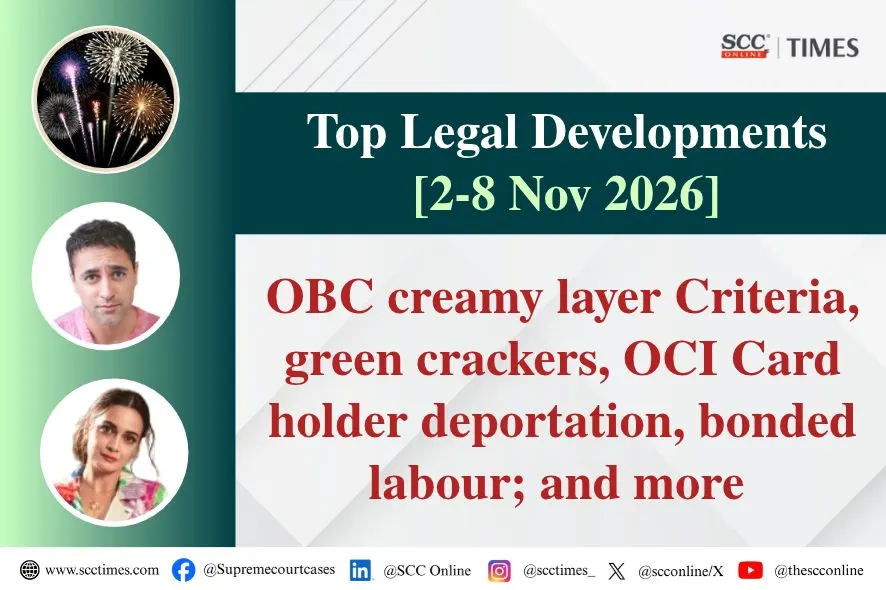
This roundup of weekly legal developments in India highlights significant Supreme Court and High Court rulings, including the Supreme Court’s clarification on the applicability of OBC creamy layer criteria to concluded selections and UPSC CSE 2025 service allocation, its decision permitting green crackers in Delhi-NCR for two days, the rights of OCI card holders against deportation, the constitutional obligation to ensure timely rehabilitation of bonded labourers, the scope of ‘related party’ status under the IBC, mandatory issuance of notice under Section 143(2) of the Income Tax Act in reassessment proceedings, juvenile bail under the JJ Act, maternity benefits for guest lecturers, disclosure of hospital medicine landing prices, inheritance rights of children born from void marriages, and key developments in GST refund proceedings and RTI disclosure of PMRBP selection records, among other important rulings.
TOP STORIES OF THE WEEK
OBC Creamy Layer Criteria: Supreme Court clarifies its March 2026 ruling doesn’t reopen concluded selections, but applies to UPSC CSE 2025 service allocation
In a batch of Miscellaneous Applications seeking clarification of the judgment dated 11 March 2026 concerning the application of the creamy layer criteria to Other Backward Classes (OBC) candidates whose parents were employed in Public Sector Undertakings (PSUs), Banks and other organisations, the Division Bench clarified that the benefit of the judgment was confined to the parties before the Court, including the intervenors, and did not direct retrospective reopening of concluded selections, appointments or seniority. The Court held that the binding force of the legal principle under Article 141 of the Constitution must be distinguished from the scope of the operative relief granted to the parties. Declining to prescribe any timeline for establishing equivalence of posts, the Court observed that the matter fell within the domain of the executive and the legislature. Accordingly, disposing of the Miscellaneous Applications, the Court extended the time for compliance with its earlier judgment by a further period of two months. Read more about SC OBC Creamy Layer Criteria HERE
[Union of India v. Rohith Nathan, Miscellaneous Application No(S). 3313 — 3315 of 2026, decided on 6-11-2026]
Supreme Court Allows Green Crackers in Delhi-NCR on November 7—8, Restores Ban from November 9
In a case concerning the regulation of manufacture, storage, sale and bursting of firecrackers in the Delhi-NCR region, in view of their adverse impact on air quality and public health, a Division Bench permitted the temporary manufacture, sale and bursting of certified Green Crackers on 7 November 2026 and 8 November 2026, subject to strict regulatory conditions. Emphasising that the right to practice, profess and propagate religion under Article 25(1) of the Constitution is subject to public order, morality, health and other provisions of Part III of the Constitution, the Court observed that the right to engage in a particular practice having a religious colour is only a qualified one and cannot go beyond constitutional restrictions. The Court reiterated that the right to life under Article 21 includes the right to a healthy, safe and pollution-free environment. Read more about SC Directions HERE
[Arjun Gopal v. Union of India, Writ Petition (Civil) No. 728 of 2015, decided on 29-10-2026]
Also Read: Bombay HC appreciates Dia Mirza’s firecracker awareness campaign | SCC Times
What rights does an OCI card holder have against deportation? Bombay HC seeks Union’s reply on Imran Khan’s Leave India Notice
While considering a challenge to a “Leave India Notice” issued by the Foreigners Regional Registration Officer (FRRO) to Imran Khan, an Overseas Citizen of India (OCI) card holder, the Division Bench observed that the rights of an OCI card holder are distinct from those of an Indian citizen and that the State, in exercise of sovereign functions, possesses the power to deport a person in an appropriate case. The Court nevertheless took on record Imran Khan’s unconditional apology and undertaking and granted time to Union of India to place its stand through a detailed affidavit-in-reply before the matter is finally decided. Read more about rights of an OCI card holder against deportation HERE
[Imran Khan Pal v. Union of India, Writ Petition (L) No. 36271 of 2026, order dated 2-11-2026]
SUPREME COURT HIGHLIGHTS OF THE WEEK
Bail| Bail matter or Criminal Trial cannot rest on Judge’s personal notions of morality; long incarceration and trial delay favour grant of bail
While considering the propriety of declining bail on considerations of morality and the perceived impact of an accused’s release on the social order and the “morals” of the prosecutrix’s family, a Division Bench set aside the High Court’s order, holding that Court must refrain from imposing personal views or value judgments on morality while adjudicating bail or criminal proceedings. Taking note of the appellant’s incarceration for more than 1 year and the time likely to be consumed in conclusion of the trial, the Court opined that a case for bail was made out and directed that the appellant be released on bail, subject to appropriate terms and conditions. Read more HERE
[Kanha v. State of M.P., 2026 SCC OnLine SC 2011, decided on 23-9-2026]
Bonded Labour| Rehabilitation delayed may amount to rehabilitation denied: Supreme Court issues directions on bonded labour
In a case concerning the identification, rescue, release and rehabilitation of bonded labourers across the country, a Division Bench emphasised that the State’s constitutional obligation does not conclude with the physical release of bonded labourers but extends to ensuring timely financial assistance, meaningful rehabilitation and protection against re-exploitation. Observing that identification, release and rehabilitation are interconnected stages of a continuing constitutional responsibility under Articles 21 and 23 of the Constitution, the Court held that rehabilitation delayed may, in substance, amount to rehabilitation denied. Read more about SC Directions on identification, rescue, release and rehabilitation of bonded labourers HERE
[Surendra Manjhi v. Union of India, 2026 SCC OnLine SC 2306, decided on 2-11-2026]
IBC| Role of navigation in policy-making sufficient to establish ‘related party’ status: Supreme Court upholds exclusion of debenture holder and trustee from CoC
In a batch of appeals concerning the exclusion of a Debenture Trustee and a Debenture Holder/Lender from the Committee of Creditors (CoC) as ‘related parties’ of the Corporate Debtor under the Insolvency and Bankruptcy Code, 2016 (IBC), the Division Bench upheld their exclusion, holding that participation in the policy-making process under Section 5(24)(m)(i) of the IBC does not require control to the extent of being in the driving seat, and a role of navigation in determining policy and channelising business interests would suffice. Read more about exclusion of debenture holder and trustee from CoC HERE
[ECL Finance Ltd. v. Abhinav Mukherjee, 2026 SCC OnLine SC 2252, decided on 27-10-2026]
Income Tax | Income Tax reassessment without Section 143(2) notice invalid even if assessee participated
In a batch of appeals concerning the validity of reassessment proceedings initiated under Sections 147 and 148, Income-tax Act, 1961, in the absence of a notice under Section 143(2) of the Act, the Division Bench held that issuance of a notice under Section 143(2) is mandatory and sine qua non for completing reassessment proceedings under Section 147. The Court observed that the omission to issue such notice is not a mere procedural irregularity capable of being cured and that mere participation of the assessee in the reassessment proceedings does not confer jurisdiction upon the assessing officer to frame an assessment under Section 143(3) read with Section 147 of the Act. Read more about mandatory notice in reassessment proceedings HERE
[CIT v. Orissa Mining Corpn. Ltd., 2026 SCC OnLine SC 2268, decided on 28-10-2026]
Transfer of Property| Flats built on disputed property can be sold subject to the outcome of the pending suits, buyers must be told
The civil appeal challenged the direction issued in order dated 3 August 2023 passed by the Calcutta High Court, which allowed the appellant to continue construction on disputed property but restrained the appellant from creating third-party interests in flats constructed on disputed property, a Division Bench set aside the restriction imposed by the High Court and permitted the appellant to create third-party rights in the constructed flats, clarifying that any such sale or transfer would remain subject to the outcome of the pending suits. The Court also directed the appellant to disclose the pendency of the litigation in the sale documents and requested the trial court to dispose of the suits expeditiously. Read more about creation of third party rights in disputed property HERE
[Bhola Paik v. State of W.B., Civil Appeal arising out of SLP (C) No. 27629 of 2023, decided on 26-10-2026]
MAJOR HIGH COURT RULINGS THIS WEEK
AIBE| Advocate who practiced for 10 years without clearing AIBE can face criminal proceedings; Bar Council’s disciplinary jurisdiction is not exclusive
In a petition filed under Section 482, Criminal Procedure Code, 1973 (CrPC) to quash the entire proceedings registered under Sections 419, 420, 120-B and 511, Penal Code, 1860 (IPC) read with Section 45, Advocates Act, 1961 on the file of the Principal Civil Judge and JMFC, Bangarpet, a Single Judge Bench dismissed the petition and permitted the police to proceed against the petitioner in accordance with law. The Court held that the complainant could invoke criminal jurisdiction for offences under both the IPC and the Advocates Act, and that the State Bar Council does not have exclusive jurisdiction in the matter. It added that whether Section 420 IPC and other offences are attracted is a matter for the Investigating Officer, and that maintainability of the Section 45 charge must be considered independently of the IPC allegations when the report is filed before the Magistrate. Read more about practice without clearing AIBE HERE
[M. Prasanna Kumar v. State of Karnataka, 2026 SCC OnLine Kar 16057, decided on 17-10-2026]
Arbitration| Unsuccessful party can seek post-award interim protection under Section 9, Arbitration Act in rare and compelling circumstances
In a matter concerning the scope of post-award interim protection under Section 9, Arbitration and Conciliation Act, 1996 (Arbitration Act), a Single Judge Bench held that an unsuccessful party to arbitration proceedings can invoke Section 9, Arbitration Act, to seek post-award interim protection in rare and compelling circumstances, particularly where withdrawal of existing protection may cause irreversible prejudice and render pending proceedings challenging the arbitral award under Section 34, Arbitration Act ineffective. Read more about scope of post-award interim protection HERE
[Thor Ventures (OPC) (P) Ltd. v. NYEQ Technologies (P) Ltd., 2026 SCC OnLine Del 8483, decided on 28-10-2026]
Bail| Prolonged detention when natural guardian ready to take responsibility contrary to reformative objective of JJ Act
In a criminal revision petition filed by a Class 12th student, through his father, against the rejection of a bail application in a murder case, the Single Judge Bench allowed the petition, holding that the Courts below did not properly apply the parameters of Section 12, Juvenile Justice (Care and Protection of Children) Act, 2015 (JJ Act). The continued incarceration of the juvenile was not in his best interest. The Court stated that though the observations in the Social Investigation Report (SIR) regarding the surrounding environment and the possibility of the child falling into undesirable company were relevant, the statutory scheme of the JJ Act does not permit denial of bail solely on generalised observations when the three exceptional circumstances enumerated in the proviso to Section 12(1) were not clearly and specifically made out. Read more HERE
[Child in Conflict with Law v. State of M.P., 2026 SCC OnLine MP 36779, decided on 27-10-2026]
Hospital Billing | Landing price disclosure in hospital bills: Karnataka High Court holds back FDA circular till 12 November hearing
In a writ petition challenging the circular dated 1 October 2026 issued by the Food Safety and Drugs Administration (FDA), mandating hospitals, nursing homes, clinics and other healthcare establishments in Karnataka to disclose the “Landing/Base Price” of medicines, medical devices and consumables in bills, the Single Judge Bench directed that the circular shall not be insisted upon until the next date of hearing and adjourned the matter to 12 November 2026. Read more about Landing price disclosure HERE
[Private Hospitals and Nursing Homes Association v. Karnataka Food Safety and Drugs Administration, WP No. 33279 of 2026 (GM — RES), decided on 30-10-2026]
Immigration| Valid visa no guarantee of entry into India as immigration authorities can deny entry
A Single Judge Bench declined to entertain a writ petition filed by a foreigner challenging denial of entry despite a valid visa. The Court held that a valid visa does not guarantee entry into India. Emphasising considerations of national security and public order, the Court observed that immigration authorities are empowered to deny entry on relevant grounds. Rejecting the Article 14 challenge as the two petitioners were not similarly situated, and having perused the sealed-cover material, the Court found no right infringed and dismissed the writ petition. Read more about guarantee of entry into India with valid visa HERE
[Annagurbanova Yazbibi Hummetgulyyevna v. Union of India, W.P.(C) 5740/2026, decided on 30-9-2026]
Jurisdiction| Civil courts retain jurisdiction unless expressly or impliedly barred; Kerala HC restores suits, holds NCLT cannot declare registered sale deed void
While allowing original petitions challenging orders of the Commercial Court declining jurisdiction over suits concerning an allegedly fraudulent sale deed, a Single Judge Bench held that the jurisdiction of civil courts is not ousted unless expressly or impliedly barred by law. The Court observed that the National Company Law Tribunal (NCLT), being a creature of statute, can exercise only the powers conferred upon it under the Companies Act, 2013 (2013 Act). A relief seeking a declaration that a registered sale deed is void and not binding on the company fell outside the NCLT’s jurisdiction under Sections 241 and 242 of the 2013 Act. Consequently, the bar under Section 430 was not attracted, and the suits were restored to the Commercial Court for trial. Read more about jurisdiction of civil courts HERE
[Satish Kumar v. Govindankutty, OP(C) Nos. 926 and 939 of 2026, decided on 13-10-2026]
Marriage Fraud| “Love Jihad” label unsupported by record, but suppression of identity, cheating and cruelty case goes on
In an application filed under Section 482, Criminal Procedure Code, 1973 (CrPC) seeking to quash the proceedings under Sections 419, 420, 498-A, 323, 313, 416, 120-B, 506 and 34, Penal Code, 1860 (IPC) pending before Additional Chief Judicial Magistrate, Barrackpore, against a police constable accused of posing as an unmarried Hindu man named “Rajib Sarkar” to enter into a relationship and a marriage ceremony with the complainant, and then subjecting her to assault, the single judge bench of Ajay Kumar Gupta, J., dismissed the application being devoid of merits and holding that the allegations, prima facie, disclosed cognizable offences warranting a trial. The Court also observed that the characterisation of the case as ‘love jihad’ was unsupported by the materials on record at this stage, as the case was confined to the alleged suppression of the petitioner’s name, religion and marital status. Read more about what Calcutta HC said on Love Jihad HERE
[Mohd. Rafikul Islam v. State of W.B., 2026 SCC OnLine Cal 16795, decided on 15-10-2026]
Maintenance| Are annual share sale earnings part of a husband’s income?
In cross writ petitions filed by husband and wife, a Single Judge Bench held that annual share sale earnings are a part of husband’s income for determining interim maintenance, even if they are not received monthly. The Court observed that the perquisites forming part of the husband’s total income were relevant to the interim maintenance assessment and that the wife had a legitimate expectation of sharing the benefits enjoyed by the husband. The fact that the amount was used to repay loans did not exclude it from consideration, as the repayments were voluntary in nature. Accordingly, the High Court allowed the wife’s writ petition, dismissed the husband’s writ petition, and enhanced the monthly interim maintenance from ₹50,000 to ₹1,20,000.Read more about annual share sale earnings as a part of husband’s income for determining interim maintenance HERE
[Elizabeth George v. Vivek George Jacob, 2026 SCC OnLine Kar 15214, decided on 24-9-2026]
Also Read: Jhar HC on Mental Incapacity and Marriage Annulment | SCC Times
Maternity Benefits| Guest Lecturers entitled to maternity benefits irrespective of regular employment status; Salary cannot be denied for maternity leave
In a writ petition seeking payment of monetary benefits admissible during maternity leave and challenging Clause 11.2 of the Circular dated 17 July 2026, a Single Judge Bench held that the salary for the period during which the petitioner had availed maternity leave could not be denied on the ground that she was serving as a Guest Lecturer. The Court observed that the Maternity Benefit Act, 1961 (Maternity Benefit Act), did not restrict the benefit of maternity leave to regular women employees and directed the respondent authorities to take an appropriate decision regarding the petitioner’s claim for unpaid salary. Read more about maternity benefits to guest lecturers HERE
[Pushpa Jaiswal v. State of Chhattisgarh, 2026 SCC OnLine Chh 21210, decided on 27-10-2026]
POCSO| Non-furnishing of grounds of arrest violates Articles 21 and 22
In a matter concerning the non-furnishing of grounds of arrest, a Single Judge Bench reiterated that failure to furnish the grounds of arrest to an arrestee in writing and in a language understood by them infringes their fundamental rights under Articles 21 and 22 of the Constitution of India and renders the arrest illegal, irrespective of the statute under which the arrest is made. Accordingly, the Court granted regular bail to an accused booked under Sections 363, 366-A, 370, 376, 506, 120-B and 34, Penal Code, 1860 (IPC), Section 6, Protection of Children from Sexual Offences Act, 2012 (POCSO Act), and Sections 3 and 4, Immoral Traffic (Prevention) Act, 1956, after noting that the prosecution had admitted that the grounds of arrest had neither been communicated orally nor furnished in writing to the accused. Read more about Bail in POCSO cases HERE
[Bhola v. State of NCT of Delhi, 2026 SCC OnLine Del 8553, decided on 9-10-2026]
Right to Health| Allahabad High Court issues notice on PIL seeking AI-based doctor verification and stricter regulation of clinical establishments
While considering a Public Interest Litigation (PIL) on quackery and right to life and health under Article 21 of the Constitution, seeking recognition of the right to protection from quacks and unqualified medical practitioners, and prohibition on the operation of unlicensed clinical establishments, as an integral component of the Right to Life and Health under Article 21 of the Constitution, the Division Bench issued notice to the respondents and directed that the matter be connected with a pending PIL raising overlapping issues. Read more about Quackery and right to health under Article 21 HERE
[Tulsa Devi Sewa Sansthan v. UOI, 2026 SCC OnLine All 40656, decided on 29-10-2026]
Succession| Can a daughter born of a void marriage claim her father’s share in joint family property
While deciding a family property dispute concerning the inheritance rights of a daughter born from a void marriage, a Single Judge Bench held that Section 16 of the Hindu Marriage Act, 1955 (HMA) confers legitimacy to a child born out of a void marriage and entitles such a child to succeed to her deceased father’s notional share in joint family property. It ruled that although the trial court had held that the 2nd wife was not entitled to a share on account of the void marriage, the daughter was rightly granted a ¼ share in the joint family property. Accordingly, it dismissed the second appeal, finding no substantial question of law arising for consideration. Read more about inheritance rights of a daughter born from a void marriage HERE
[Hanumanthappa v. Shanthamma, 2026 SCC OnLine Kar 16058, decided on 8-10-2026]
TRIBUNAL UPDATES
GSTAT | Post-decisional hearing at appellate stage cannot cure absence of RFD-08 notice
In a batch of 39 appeals concerning partial rejection of accumulated input tax credit (ITC) refund claims on the ground of mismatch of ITC, the Division Bench held that the rejection orders, passed without issuing a show-cause notice in Form GST RFD-08 and without any opportunity of hearing, were legally unsustainable. The Tribunal set aside the orders-in-original and the orders-in-appeal and remanded all the matters to the adjudicating authority for fresh adjudication, without going into the merits. Read more HERE
[Vikram Inderjit Kapur v. Deputy Commissioner of State Tax, APL. No. 12 to 50/THN/2026, decided on 22-10-2026]
RTI Act| CIC rejects blanket fiduciary exemption for PMRBP selection records, directs disclosure of nomination status and aggregate statistics
In a second appeal concerning information sought regarding the appellant’s 4 nominations under the Pradhan Mantri Rashtriya Bal Puraskar (PMRBP), the Information Commissioner, P.R. Ramesh held that mere custody of evaluation records or their forming part of an internal selection process does not, by itself, establish a fiduciary relationship under Section 8(1)(e), Right to Information Act, 2005 (RTI Act), and that a general assertion of third-party information cannot justify withholding the entire record where reasonably severable information exists under Section 10, RTI Act. The Commission directed the Central Public Information Officer (CPIO), Ministry of Women & Child Development, to furnish the status of the appellant’s nominations, the exact URL/hyperlink to the PMRBP guidelines and aggregate statistical data regarding nominations received, shortlisted and finally selected, after redacting exempt information under Section 10, RTI Act. Read more HERE
[Zain Eqbal v. CPIO: Ministry of Women & Child Development, CIC/MOWCD/A/2026/641779, decided on 1-10-2026]
THIS WEEK’S KEY LEGISLATIVE UPDATE
-
Inside ECI’s Form 6 Clarification on Submission During Special Intensive Revision | SCC Times
-
CBDT notifies Income-tax Eighth Amendment Rules, 2026 | SCC Times
OTHER DEVELOPMENTS OF THIS WEEK
OP.ED.
-
From Penalties to Polluter Pays: The Evolving Powers of Pollution Control Boards by Varun Chugh
-
Reconciling Public Defence with Private Practice: A Pluralistic Framework by Amber Singh
-
Regulating the Regulated: SEBI’s Advertisement Code and the Limits of the Register by Lakshya Pratap Yadav and Shanaya Singh
-
Does the Interest Cease on Award Amount if Deposited in Section 34 Court: An Analysis by Saurav Rajurkar
-
Agricultural Land and the Law of Valuation: From Estate Duty to SARFAESI by Rabish Ammathur
LAW MADE EASY
Also Read:
-
Supreme Court Warns Against Fake Websites, Flags scigovinjudicial.com | SCC Times
-
Top Weekly Legal Developments India: 26 Oct – 1 Nov 2026 | SCC Times
-
Supreme Court October 2026: Explore Key Judgments and Top Stories | SCC Times
-
Dubai Arbitration Week 2026: Global Arbitration Community to Convene in Dubai | SCC Times