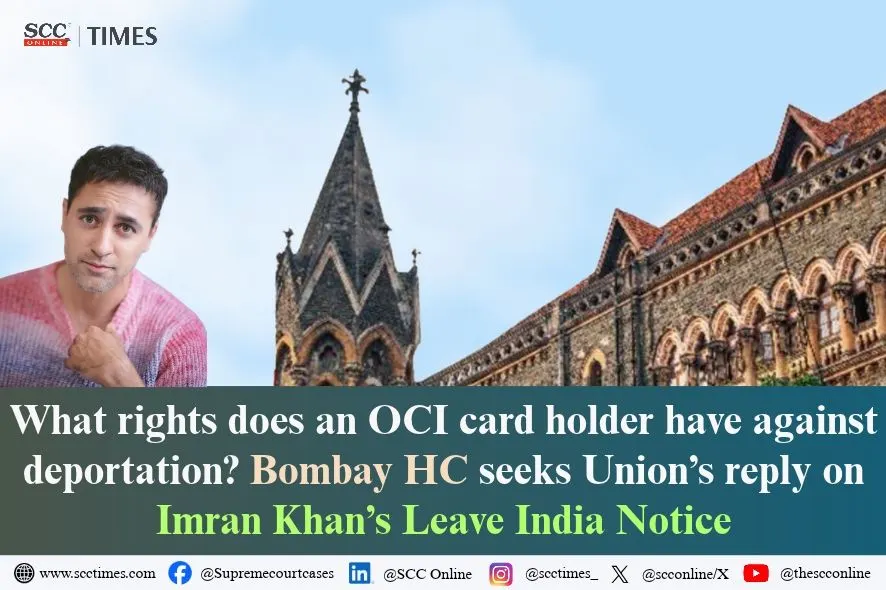
Bombay High Court: While considering a challenge to a “Leave India Notice” issued by the Foreigners Regional Registration Officer (FRRO) to Imran Khan, an Overseas Citizen of India (OCI) card holder, the Division Bench of Mahesh Chandra Tripathi, CJ, and Advait M. Sethna, J., observed that the rights of an OCI card holder are distinct from those of an Indian citizen and that the State, in exercise of sovereign functions, possesses the power to deport a person in an appropriate case. The Court nevertheless took on record Imran Khan’s unconditional apology and undertaking and granted time to Union of India to place its stand through a detailed affidavit-in-reply before the matter is finally decided.
Also Read: Citizenship (Amendment) Rules, 2026: OCI Registration
Background
The petition challenged a “Leave India Notice” dated 14 October 2026 issued to Imran Khan (petitioner) by FRRO. An earlier order dated 27 October 2026 had kept the operation of the impugned notice in abeyance pending further hearing. The petitioner contended that he was neither concerned with nor connected to the protest in question and that he was not present at the protest site. It was submitted that he held an OCI card issued on 15 December 2006, was a holder of a United States passport, and had been residing in India for approximately 42 years.
Reliance was placed upon an undertaking dated 27 October 2026 wherein the petitioner stated that he had no intent as could be seen from his limited remarks to the media on 10-10-2026, never made any demands, and had gone there to see why freedom of movement was allegedly being restricted, and voluntarily undertook that he would not participate in any protests in future, nor directly or indirectly influence or instigate others to do so. The undertaking further referred to his long residence in India, absence of criminal antecedents, family ties in the country, and his assertion that his life, profession and affiliations were confined to India. The petitioner also tendered an unconditional apology through Senior Counsel.
On the other hand, the Union of India contended that the rights of an OCI card holder are restricted and extremely limited. It was argued that an OCI card holder is a foreigner and not an Indian citizen and, therefore, the Central Government acting through FRRO has unfettered rights to deport such a person from India, without the need to establish any jurisdictional fact. The State Government additionally informed the Court that an FIR had been lodged against the petitioner.
Also Read: Del HC: Mere presence at protest does not establish offences
Analysis and Decision
The Court noted that no affidavit-in-reply had yet been filed by the Union of India. The Court observed, prima facie, that there could be no quarrel with the proposition that the rights of an OCI card holder and those of an Indian citizen operate in distinct and different spheres.
The Court further noted that the OCI certificate issued to the petitioner on 15 December 2006 recorded under the head “Occupation” the description “Searching for Job”. The Court thereafter noted that the State, in exercise of its sovereign functions, would possess the right to deport a person out of India in a given case.
The Court observed that, to further clarify the position and make clear the stand of the Union of India, a formal affidavit-in-reply was necessary. The Court noted that the last date stipulated for deportation under the impugned Leave India Notice was 28 October 2026. However, because the notice had already been kept in abeyance by the Court’s ad interim order dated 27 October 2026, the Court considered it appropriate to permit the Union of India to place its stand on affidavit before any final determination was made.
The Court took on record the undertaking dated 27 October 2026 and specifically noted that the petitioner, through the Senior Counsel, had tendered an unconditional apology. In view thereof, the Court granted the Union of India 3 weeks from the date of uploading of the order to file a detailed affidavit-in-reply and granted liberty to the petitioner to file a rejoinder within 1 week thereafter.
The Court directed that, having regard to the factual complexion, the matter would be listed as the first item on 7 December 2026 for final hearing. Pending such adjudication, the Court expressed the expectation that the petitioner would reside in India as a law-abiding person and would not associate with or indulge in activities or protests, observing that such rights are available to citizens of the country under the Constitution.
[Imran Khan Pal v. Union of India, Writ Petition (L) No. 36271 of 2026, order dated 2-11-2026]
Advocates who appeared in this case:
For the Petitioner: Mr. Venkatesh Dhond, Senior Advocate a/w Zulfiquar Memon, Kunal Vajani, Parvez Memon, Chirag Naik, Vaijayanti Sharma, Kush Agarwal, Mahesh Ahire, Drishti Singh, Kshemendra Bhardwaj, Aman Tiwari, Rohit Deoras, Soumyajoti Lodh and Lisa Memon i/by MZM Legal LLP.
For the Respondents: Mr. Anil C. Singh, Additional Solicitor General of India, Savita Ganoo, D.P. Singh, Jainendra Sheth, Dhaval Sethia, Prithviraj Chauduri, Adarsh Vyas and Krishnakant Deshmukh, Anjali N. Helekar, Government Pleader a/w Jyoti Chavan, Addl. Government Pleader
For the Intervenor: Subhash Jha a/w Siddharth Jha & Chetan Gogawale i/by Law Global Advocates